

Measuring the ROI of Bulk SMS Campaigns
TL;DR: Measure bulk SMS ROI with
((SMS revenue − total campaign cost) ÷ total campaign cost) × 100, using every cost rather than just the message fee. Track delivery, clicks, conversions, average order value, unsubscribes, and campaign revenue through tagged links, unique discount codes, or CRM attribution so you can connect sales to each send. A 50,000-message campaign can look successful on revenue while losing money after discounts and fulfilment.
You may watch delivery reports and click counts rise while sales remain flat. That is frustrating, especially when you paid for every message and still cannot tell whether the campaign made money. Clicks are useful, but profitable customer action is the real test: Klaviyo classifies a US SMS/MMS conversion rate of 1.0% to 2.0% as “Good”. This guide covers campaign costs, attribution, revenue, profit, benchmarks, India’s compliance costs, and practical ways to improve returns through testing and segmentation.
Table of Contents
- What Bulk SMS ROI Really Measures
- Build a Reliable SMS ROI Tracking System
- Calculate Campaign ROI: A Worked Measurement Framework
- Read Results Against Benchmarks and Business Context
- Avoid the ROI Traps That Distort SMS Reporting
- Turn ROI Findings Into the Next Campaign Plan
- My honest take on measuring bulk SMS ROI
- Measure More Confidently With DomainAdda SMS Marketing
- Frequently Asked Questions
- Recommended reads
| Point | Details |
|---|---|
| Use profit-based ROI | Calculate ROI from attributable profit, subtracting message, platform, creative, discount, and operational costs from campaign return. |
| Tag every campaign | Use at least 1 UTM parameter, unique coupon code, or dedicated landing page to separate SMS conversions from other channels. |
| Track the full funnel | Review 6 measures together: delivery, clicks, conversions, revenue per recipient, unsubscribes, and opt-outs. |
| Segment before scaling | SlickText reported a 6.5% median click rate for one-segment campaigns versus 4.3% for two-segment campaigns, showing how audience design changes results. |
| Include compliance costs | In India, budget for 4 registration requirements, including the sender, header, template, and consent, before judging campaign ROI. |
What Bulk SMS ROI Really Measures
ROI tells you whether a bulk SMS campaign created more attributable profit than it consumed in resources. Use this formula:
ROI = (attributable profit ÷ total campaign cost) × 100
If a campaign produces ₹60,000 in attributable profit and costs ₹20,000, its ROI is 300%. The calculation is easy. Defining profit and capturing every cost is harder. Teams often report revenue alone, which makes weak campaigns look successful.
Include costs that appear on an invoice and costs hidden inside someone’s workload:
- SMS credits, sender fees, and platform charges
- Setup, integrations, landing pages, and tracking tools
- Copywriting, design, testing, and creative production
- Coupon discounts, refunds, and fulfilment costs
- Staff time spent planning, launching, and answering replies
Here is how the common metrics differ:
| Metric | What it tells you | What it misses |
|---|---|---|
| Revenue | Sales attributed to SMS | Product costs and campaign expenses |
| Gross profit | Revenue minus direct cost of goods sold | Platform, staff, and promotional costs |
| Contribution margin | Revenue left after variable costs, fulfilment, and discounts | Fixed overhead outside the campaign |
| ROAS | Attributed revenue divided by advertising spend | Non-ad costs and actual profitability |
| ROI | Attributable profit divided by total campaign cost | Results from poor attribution or missing costs |
Delivery and click rates diagnose the campaign, but neither proves that you made money. A 98% delivery rate only says most messages reached a handset. A high click rate can still produce losses if the offer has a thin margin, the landing page fails, or customers use an expensive discount. For context, Klaviyo classifies a US SMS/MMS click rate of 8.9% to 14.5% as “Good”, but that benchmark does not establish profitability.
Revenue per recipient gives you a useful comparison alongside ROI. Divide attributed revenue by recipients, not just buyers. Klaviyo lists $0.66 to $2.41 as a “Good” US SMS/MMS range, although currency, audience, and offer change the baseline.
Pro Tip: Calculate both revenue ROI and contribution-profit ROI when discounts or product margins vary significantly between campaigns.
With the definitions fixed, assign revenue to the messages that actually influenced each purchase.
Build a Reliable SMS ROI Tracking System
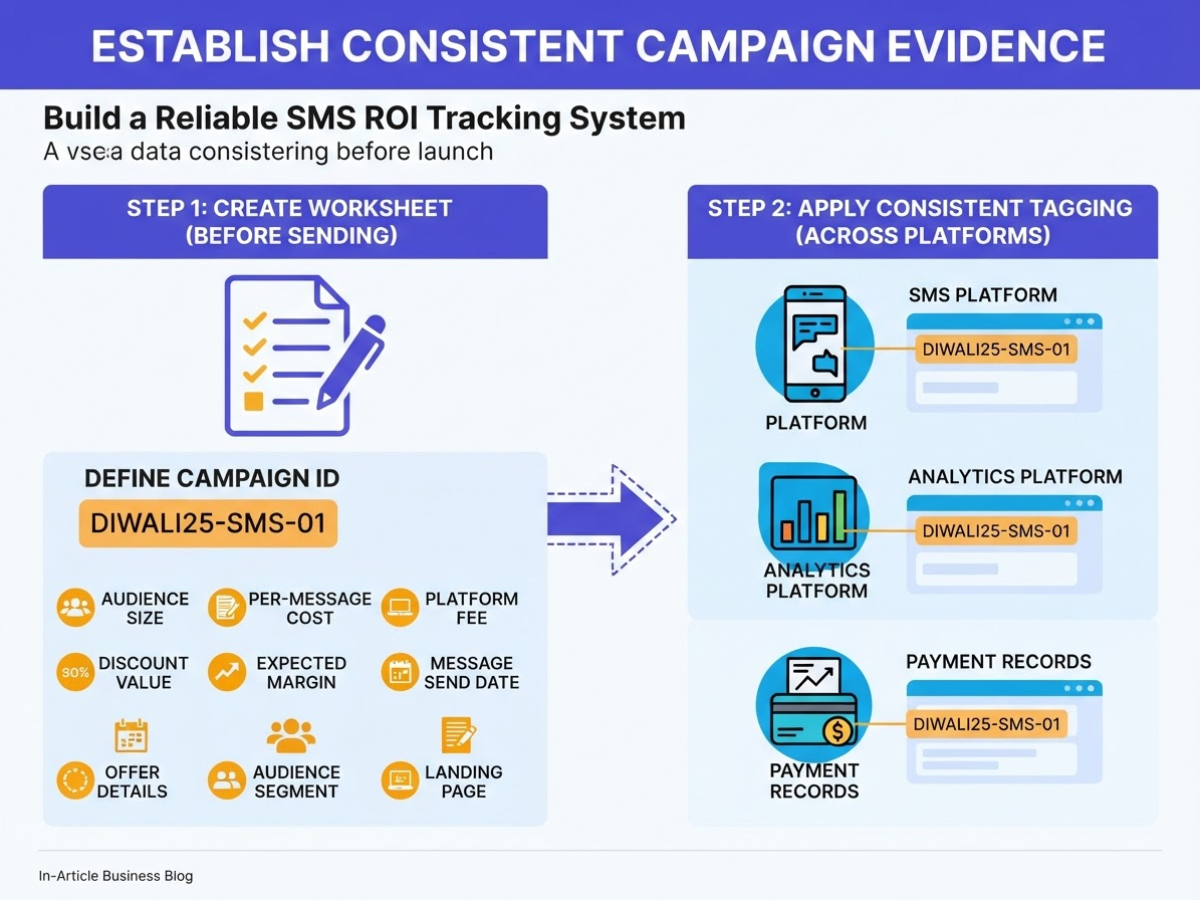
Before sending, decide what evidence counts as a sale. I have seen teams open a campaign report after launch and discover that delivery data, coupon orders, and payment records use different names. Fixing attribution after the fact is mostly guesswork.
- Create the campaign worksheet. Give the campaign one ID, such as
DIWALI25-SMS-01, and record audience size, sent and delivered messages, per-message cost, platform fee, discount value, and expected margin per order. Include the send date, offer, segment, and landing page. Your basic cost is message spend plus platform fees, but the discount reduces the margin attributable to SMS. - Name and tag everything consistently. Use the same campaign ID in your SMS platform, analytics property, CRM, ecommerce report, and finance sheet. Add UTM parameters to every link, for example
utm_source=sms&utm_medium=bulk_sms&utm_campaign=diwali25_sms_01. Keep values lowercase and avoid spaces. A mismatch such asDiwali25in one system anddiwali-25in another can split one campaign into two reports. Document event names before launch rather than asking an integration to guess them. Connecting Bulk SMS API to Your Website or App covers the implementation side.
Pro Tip: Create the tracking URL and coupon code before writing the SMS copy; measurement constraints often reveal the best call to action.
- Add a backup attribution method. Use a unique coupon code, campaign-only landing page, dedicated phone number, or CRM event when links are unavailable or likely to be shared. Coupon codes are easy to reconcile, but customers forget to enter them. Phone calls capture offline intent, though staff must record the source correctly.
- Set the attribution window in advance. Use 24 hours for an urgent flash offer and 7 days for a considered purchase. Write the rule in the worksheet before seeing results. Otherwise, teams quietly extend the window when revenue looks weak.
- Reconcile after the window closes. Compare delivered messages with website sessions, tracked clicks, ecommerce orders, CRM events, and payment records. Remove cancelled, refunded, and duplicate orders before calculating revenue and profit. Investigate gaps instead of forcing the numbers to match.
- Use a holdout when volume permits. Keep a randomly selected control group unsent, then compare its purchase rate and margin with the SMS group. This requires more contacts and cleaner data, but it shows incremental sales rather than customers who were already ready to buy.
Calculate Campaign ROI: A Worked Measurement Framework
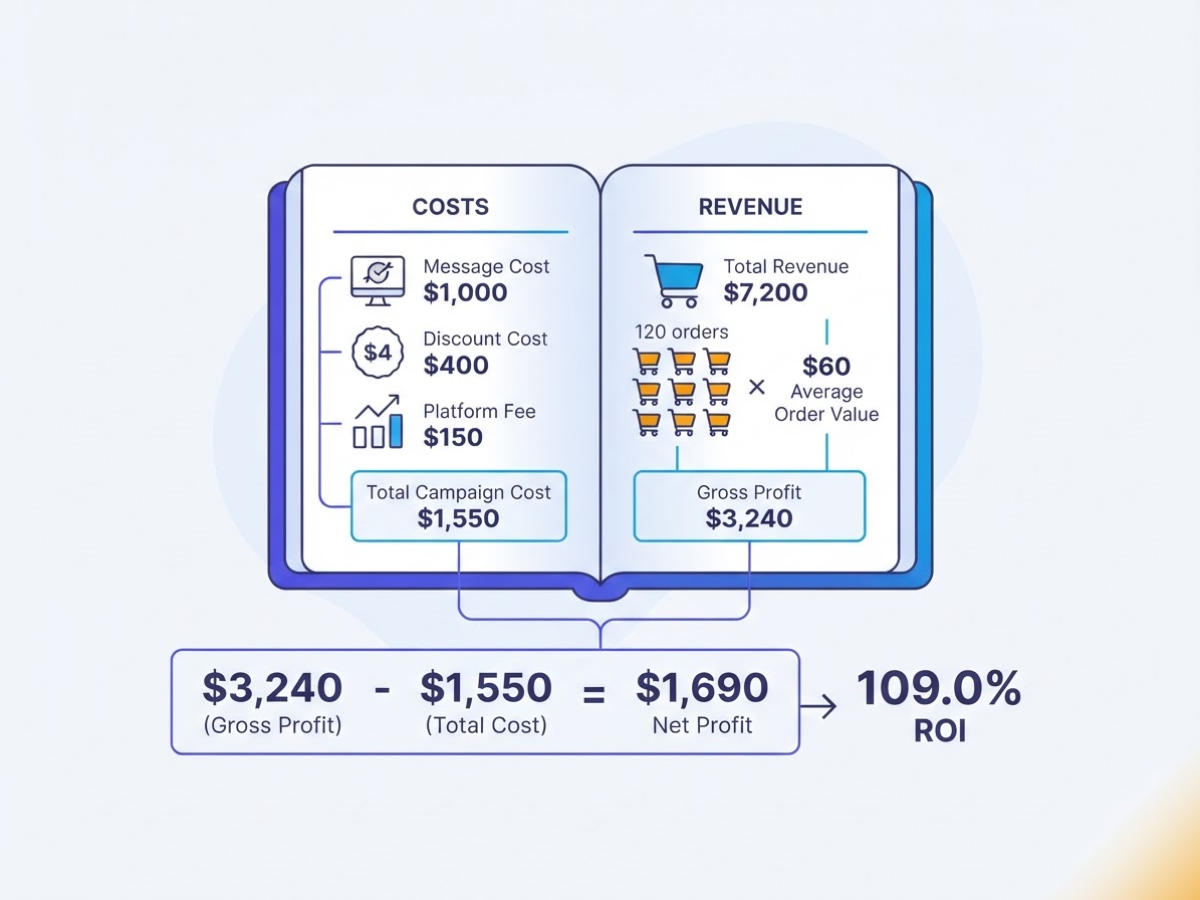
Start with the campaign ledger, not the dashboard’s headline revenue number. Assume you sent 50,000 messages at $0.02 each, paid a $150 platform fee, offered $10 off, and recorded 120 attributable orders with a $60 average order value and a 45% gross margin.
| Measure | Calculation | Result |
|---|---|---|
| Message cost | 50,000 × $0.02 | $1,000 |
| Discount cost | 40 redeemed discounts × $10 | $400 |
| Total campaign cost | $1,000 + $150 fee + $400 discounts | $1,550 |
| Total revenue | 120 orders × $60 | $7,200 |
| Gross profit | $7,200 × 45% | $3,240 |
| Net profit | $3,240 − $1,550 | $1,690 |
| ROI | $1,690 ÷ $1,550 × 100 | 109.0% |
| Revenue per recipient | $7,200 ÷ 50,000 | $0.144 |
That 109% is profit ROI, not a 109% sales lift. Revenue per recipient is modest because the campaign reached many more people than it converted. Use external benchmarks only as a sanity check: Klaviyo classifies $0.66 to $2.41 as a “Good” US SMS/MMS revenue-per-recipient range, but price, audience, and attribution make direct comparisons unreliable.
Your attribution rule changes the 120-order figure. Last-click is simple but often overstates SMS when email or paid search created demand. Coupon-code attribution works well for an exclusive offer but misses buyers who forget the code. First-touch suits acquisition analysis, not a sale-by-sale profit report. Multi-touch splits credit across channels, but its weighting can become an argument disguised as mathematics.
Pro Tip: Report incremental orders separately from attributed orders when possible, because last-click attribution can overstate SMS impact.
Define accounting rules before comparing campaigns. Count repeat purchases only if your stated window includes them, such as 30 days. Remove cancelled orders and refunds, calculate margin after product cost, exclude sales tax, treat shipping revenue separately, and subtract fulfilment costs. Free delivery is a campaign cost even when checkout hides it.
A campaign can show $7,200 in revenue yet lose money. At a 15% margin, gross profit falls to $1,080, below the $1,550 cost, producing a $470 loss and negative 30.3% ROI. Report absolute incremental profit and percentage ROI, then carry the attribution definition into the next review.
Read Results Against Benchmarks and Business Context
A good-looking click rate can hide a weak campaign. When I review SMS results, I separate three numbers: click rate shows whether the message earned attention, conversion rate shows whether the page or offer closed the sale, and revenue per recipient shows whether the economics worked across the send. Combining them into one engagement score hides the problem.
SlickText’s 2026 benchmark puts the median campaign click rate at 5.5%, based on more than 400 million messages across nearly 75,000 campaigns. Treat that figure as a direction marker, not a target for every Indian business. A Bengaluru restaurant, national ecommerce brand, and clinic sending appointment reminders have different intent, order values, and customer journeys.
Offer strength, consent quality, message type, geography, device behaviour, and attribution window also change results. A coupon sent to opted-in repeat buyers can outperform a product launch sent to cautious first-time subscribers. A 7-day window captures delayed purchases that a 2-hour report misses, while a long window can credit SMS for a sale another channel influenced.
Use a review timeline:
- Within 24 hours: Check delivery, clicks, unsubscribes, and revenue per recipient. Revise low-click copy when delivery is healthy but few people visit.
- After the conversion window: Compare conversion rate with landing-page load time, checkout errors, stock status, and offer terms. High clicks with low conversion usually point to a page or promise problem.
- After 2 or 3 comparable sends: Compare new versus returning customers, segment, offer, send time, and automation versus broadcast. Reviewing when to time bulk SMS sends by cohort beats chasing a universal hour.
- At monthly review: Scale campaigns that produce profitable incremental sales, revise weak ones, and suppress segments that remain unprofitable.
Benchmark performance is not incremental lift. Hold out a small control group where possible, then measure extra profit against customers who would have purchased anyway. Track repeat purchases and long-term customer value too. The next review should turn these findings into tighter tests and budget decisions.
Avoid the ROI Traps That Distort SMS Reporting
A campaign can look profitable in the dashboard and lose money in the ledger. In client accounts, the biggest errors came from generous attribution rules and missing costs, not bad arithmetic.
Common mistakes include:
- Claiming every order in the attribution window. A purchase within 24 or 72 hours does not prove that SMS caused it. Use a campaign ID, unique coupon, or holdout group.
- Counting revenue instead of contribution profit. Subtract discounts, refunds, failed payments, taxes, message retries, payment fees, fulfilment, registration work, creative time, and staff hours. A ₹100,000 sales report can represent a loss.
- Comparing unlike campaigns. A one-time sale broadcast and an abandoned-cart flow have different intent, costs, and expected conversion rates.
- Defending spend with vanity metrics. Delivery and clicks show whether messages moved through the system. They do not show whether the campaign made money.
- Ignoring list fatigue. Opt-outs, spam complaints, weak consent, and declining response rates create future revenue costs. Suppress opted-out contacts immediately.
- Launching without India-specific records. Before sending commercial SMS in India, document sender, header, content-template, and consent registration requirements. Keep approval details with the campaign brief.
Do not treat an opt-out as a temporary reporting nuisance. Under TRAI’s 2025 amendment, a sender generally cannot request consent again from that customer until 90 days have passed, so the 90-day restriction after an opt-out belongs in audience rules and forecasts.
Before increasing the budget, recalculate profit by campaign type, audience status, and total cost. Then decide whether the campaign deserves more spend.
Turn ROI Findings Into the Next Campaign Plan
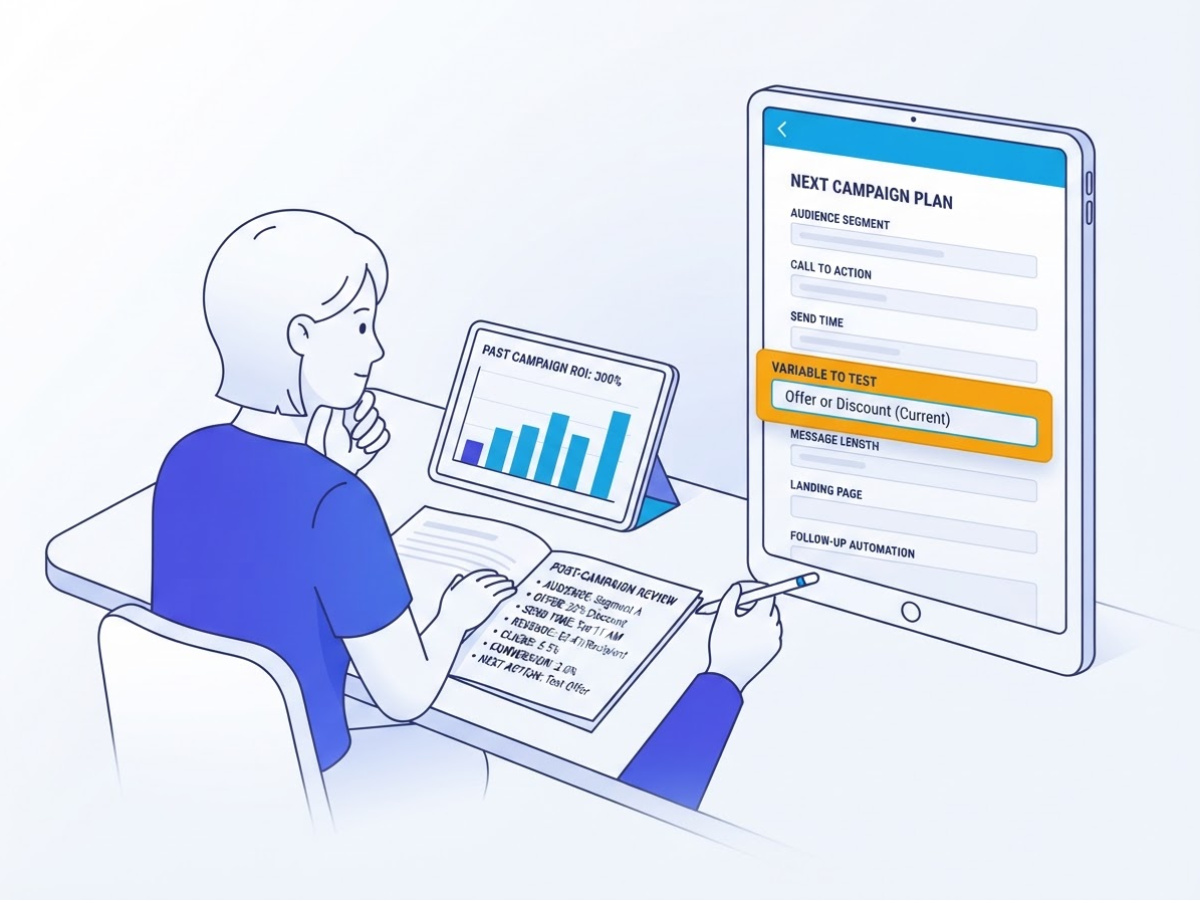
Review the campaign while details are fresh. In our post-campaign checks, the dashboard rarely explains the whole result, so record audience, message, offer, send time, delivery, clicks, conversions, revenue, contribution profit, opt-outs, and the next action. A cheap sale requiring heavy discounting may not deserve another send.
Choose one test, not seven. Change one variable:
- Audience segment
- Offer or discount
- Call to action
- Send time, using timing guidance for bulk SMS sends
- Message length
- Landing page
- Follow-up automation
Testing everything at once feels productive, but leaves you guessing. I usually test the audience or offer first because each can move profit more than a minor copy edit. A new landing page can also make a good SMS look bad when slow checkout or a broken tracking parameter is the real problem.
Bulk SMS earns its place when the customer already has a reason to act. Prioritize abandoned carts, appointment reminders, flash offers, order updates, and replenishment prompts. Broad awareness campaigns need stronger margins and tighter consent management. Thank Tommi reported a 300% ROI from its first SMS campaign, but a high-intent recovery message is not comparable with a cold promotional blast.
Set the break-even point before sending. If total campaign cost is $600, contribution profit per order is $30, and 10,000 messages are delivered, you need 20 orders, or a 0.2% conversion rate, to break even.
| Decision | Example rule before sending |
|---|---|
| Scale | Profit exceeds target and opt-outs stay below 0.3% |
| Revise | Break-even result, but clicks or checkout completion are weak |
| Pause | Profit is positive, but opt-outs rise sharply |
| Stop | Campaign loses money or triggers complaint and consent problems |
Add frequency caps, such as 3 promotional texts per subscriber in 30 days, and suppress recent buyers, active support cases, and anyone who opted out. Those rules reduce reachable volume, but protecting trust costs less than rebuilding a damaged list.
My honest take on measuring bulk SMS ROI
I have seen teams celebrate a 12% click rate while missing the real question: did the campaign create profit that would not have happened otherwise? A lower-click campaign can win if it reaches a consented, higher-value segment and produces more incremental profit. Clicks are easy to screenshot; profitable customer actions are harder to prove.
For a small business, I would not start with expensive attribution software. Begin with one tagged link, a unique offer code, a campaign cost sheet, and a weekly profit review. Record delivery fees, discounts, staff time, refunds, and revenue from redeemed offers. The spreadsheet feels clumsy, but it exposes bad assumptions quickly.
I also count compliance as part of ROI. Opt-outs, complaint rates, consent records, and list quality belong beside revenue. A message that generates short-term orders but causes customers to leave the list has damaged future earning potential, even if this week’s report looks good.
My preferred maturity path is simple: start with a manual worksheet, connect integrated analytics when volume justifies it, then use holdout testing to measure incremental lift. Most businesses rush to the final stage before they can explain basic costs.
— AVM Cloud Content Strategy Team
Measure More Confidently With DomainAdda SMS Marketing
AVM Cloud’s DomainAdda SMS marketing service is worth considering if you would rather measure campaign profit than build the delivery layer yourself. Start with a defined audience, then use trackable links or campaign codes to match sales or enquiries to each send. Reconciliation remains annoying: campaign reports rarely line up perfectly with orders when customers switch devices or contact you offline.
Before choosing a plan, check reporting depth, API access, compliance support, delivery reliability, and total pricing, not only the lowest per-message rate. Cheap campaigns become expensive after failed deliveries and manual follow-up. Review DomainAdda’s step-by-step bulk SMS setup guide and bulk SMS provider selection advice before deciding whether the service fits your measurement process.
Frequently Asked Questions
What is a good ROI for a bulk SMS campaign?
There is no universal target because margins, message price, discounts, and attribution change the result. Set a break-even point first, then aim for positive incremental profit. Reported outcomes can range from 300% to more than 80x ROI, but those figures are context, not a promise.
How do you track sales from a text message campaign?
Use UTM-tagged links, a unique coupon code, or a dedicated landing page to connect an order to SMS. Keep one attribution window, such as 7 days, and reconcile tracked orders with refunds, cancellations, and repeat purchases before calling the campaign profitable.
What costs should be included when calculating SMS marketing ROI?
Count message credits, platform or API fees, setup work, integrations, staff time, creative work, discounts, landing-page costs, and registration or compliance expenses. For profit-based calculation, also subtract fulfilment, payment processing, delivery, refunds, and incentive costs, even when each order adds only ₹50 to the bill.
What is the difference between SMS ROI and SMS conversion rate?
Conversion rate shows the percentage of recipients or visitors who complete a defined action, such as buying within 7 days. ROI measures the money left after campaign costs, so 10% of recipients can convert while discounts, fulfilment, and fees still create a loss.
How long should you wait before measuring SMS campaign results?
Match the window to the buying cycle: an urgent offer may be judged after 24 hours, while a considered purchase may need 7 days or longer. Use the same window for comparable campaigns, and report delayed repeat purchases separately.
Recommended reads
- Cost Comparison Bulk Sms Vs Other Channels
- Connecting Bulk Sms Api To Your Website Or App
- Avoiding Common Bulk Sms Marketing Mistakes
- Step By Step Bulk Sms Setup With Domainadda
Sources
- Campaign SMS and MMS benchmarks
- SMS Benchmark Report 2026: The State of SMS Marketing Engagement
- How Thank Tommi drove a 150% uplift in completed orders with SMS
- How Rebecca Minkoff Drives 80x+ ROI by Engaging Mobile-First Shoppers With Triggered Messages
- BulkSupplements | Recart SMS Case Study
- Advice to Senders | Telecom Regulatory Authority of India | Government of India
- Press Release No. 11 of 2025
- 2026 SMS Marketing Benchmarks & Stats by Industry – Klaviyo