

Cost Comparison: Bulk SMS vs Other Channels
TL;DR: Bulk SMS is often predictable and inexpensive, but the headline message price can mislead you when delivery, responses, and conversions are weak. Compare cost per delivered message, lead, and customer across email, paid advertising, social media, and direct mail before choosing a channel mix.
A ₹20,000 campaign budget can disappear quickly when you choose between SMS, email, paid ads, and direct mail for a small Indian business. I have seen teams focus on the per-message price, then get caught by weak targeting, poor tracking, or a response rate that makes a cheap campaign expensive. Published transactional SMS rates range from ₹0.28 for 2,000 messages to ₹0.165 for 1,000,000 messages before GST, but that is only one part of the decision. This comparison covers total campaign cost, reachable audience, response, conversion, tracking, and break-even points.
Table of Contents
- What You’re Really Comparing in a Marketing Channel
- Bulk SMS Cost: A Worked Example for Indian Businesses
- Bulk SMS vs Email: Reach, Depth, and Conversion
- Bulk SMS vs Paid Ads and Social Media
- Bulk SMS vs Direct Mail: When Physical Reach Pays
- How to Choose the Cheapest Channel That Can Win
- My honest take on bulk SMS versus other channels
- Build a More Cost-Efficient SMS Marketing Mix
- Frequently Asked Questions
- Recommended reads
| Point | Details |
|---|---|
| Count Every Cost | Add platform fees, creative work, data, delivery, taxes, and staff time instead of judging channels by one per-message or per-click rate. |
| Measure Unit Economics | Calculate cost per delivered message, response, lead, and customer before calling a channel cheaper. |
| Match Urgency Carefully | Bulk SMS fits time-sensitive offers, reminders, alerts, and short calls to action because recipients can see messages within minutes, although character limits can make copy feel cramped. |
| Use Email For Depth | Email handles longer content, education, segmentation, and prospect nurturing across 3 or more touches better than SMS. |
| Test Blended Campaigns | Give SMS and email distinct roles, then compare each channel against a measurable conversion goal. A coordinated 2-channel flow can beat a one-time send. |
What You’re Really Comparing in a Marketing Channel
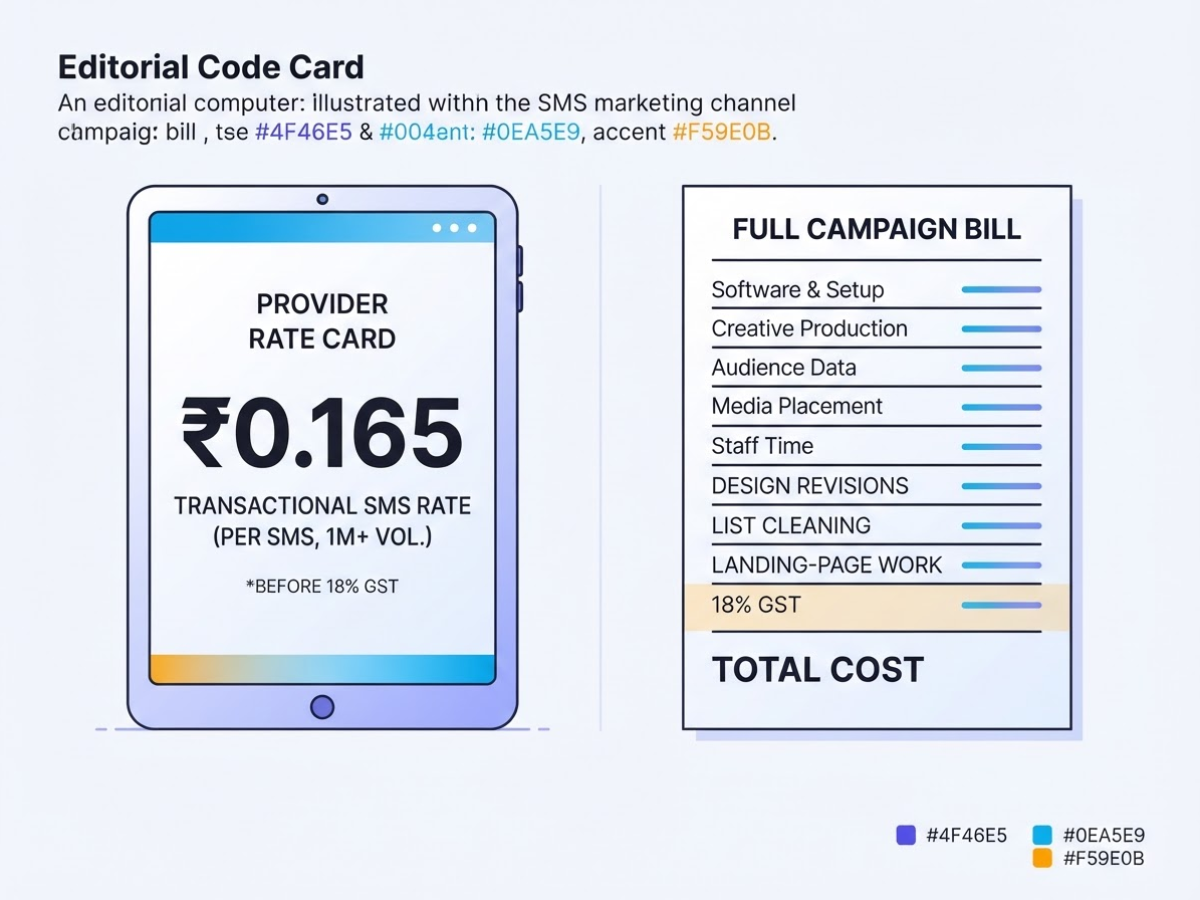
A fair channel comparison starts with the full campaign bill, not the price shown on a provider’s rate card. When I review campaign plans, I separate fixed costs such as software, setup, creative production, audience data, media placement, staff time, and taxes from variable costs such as messages, clicks, impressions, or printed pieces. Teams often forget design revisions, list cleaning, landing-page work, and GST. Those “small” items can change the result.
For SMS, the headline rate can look tiny. One Indian provider lists transactional SMS at ₹0.28 each for 2,000 messages and ₹0.165 each for 1,000,000, before 18% GST, as shown on its published pricing page. That is useful context, but it does not tell you whether the campaign makes money.
Track the funnel in separate stages:
- Reach: the audience you intended to contact.
- Delivery: the messages, emails, ads, or mail pieces that actually arrived.
- Response: clicks, replies, calls, or visits.
- Conversion: completed purchases, sign-ups, or bookings.
- Customer-acquisition cost: total campaign spend divided by new customers.
Use a simple worksheet for every channel:
| Spend | Audience | Delivered contacts | Responses | Conversions | Revenue |
|---|---|---|---|---|---|
| ₹10,000 | 20,000 | 18,600 | 930 | 93 | ₹46,500 |
The cheap message can still produce an expensive customer if the list is poorly targeted, the offer is weak, or the checkout page loses buyers. I have seen teams celebrate a low cost per delivered SMS while ignoring that only a handful of recipients reached the payment screen. That is a bad bargain, even when the message cost is low.
Label the SMS correctly. Transactional messages support an existing action, such as an order update or one-time password. Promotional SMS sells something and normally requires consent, approved sender identification, compliant templates, opt-out handling, and local registration rules. Treating an advertisement as transactional creates compliance risk and delivery problems.
Pro Tip: Use contribution margin rather than revenue alone when deciding whether a campaign is profitable.
With those inputs fixed, you can compare bulk SMS with email, paid ads, and direct mail on the same financial basis.
Bulk SMS Cost: A Worked Example for Indian Businesses
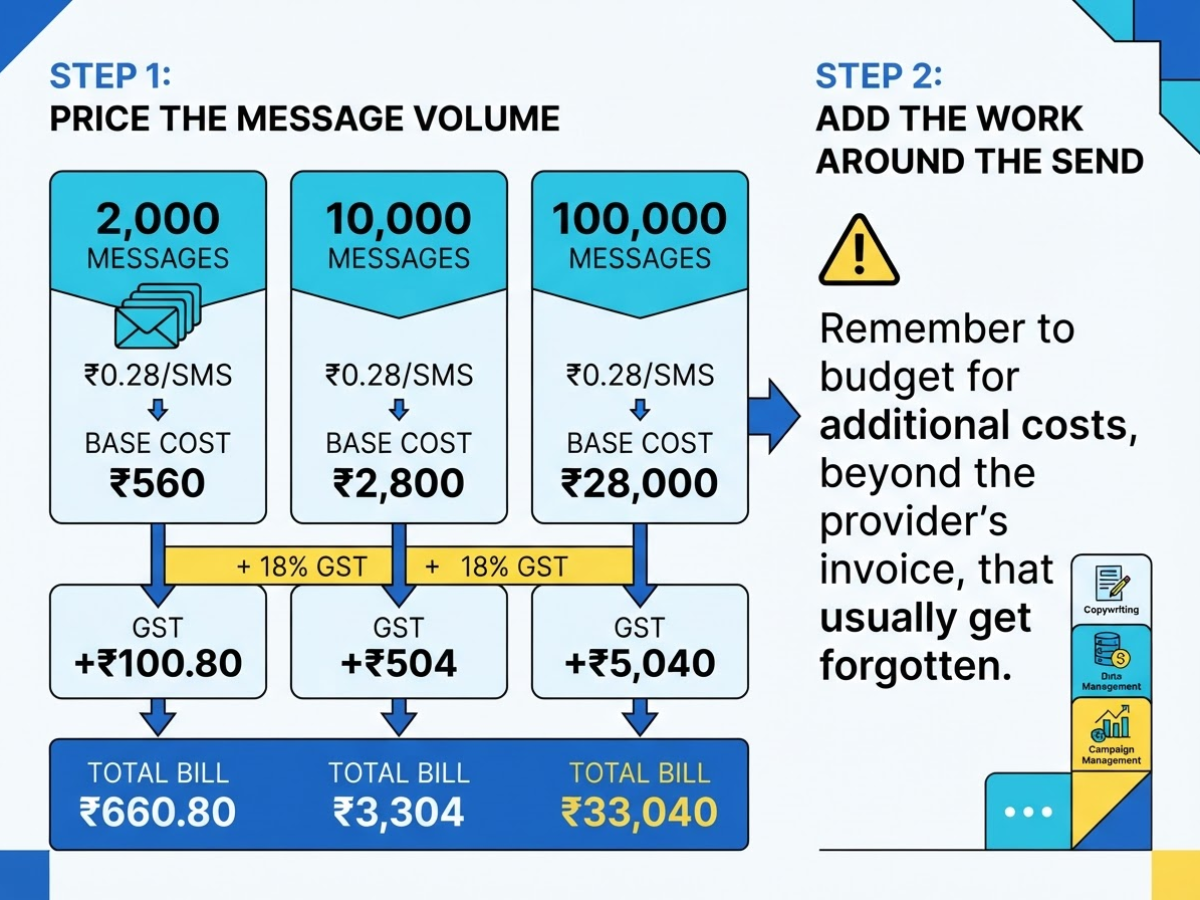
When I price a campaign for an Indian business, I start with the provider’s invoice, then add the costs that usually get forgotten. A published rate card lists 2,000 transactional SMS at ₹560, or ₹0.28 per message, before the separate 18% GST charge. Use that rate as a cautious starting point, not as your final quote.
- Price the message volume. At ₹0.28 each, 2,000 messages cost ₹560, 10,000 cost ₹2,800, and 100,000 cost ₹28,000. GST adds ₹100.80, ₹504, and ₹5,040 respectively, producing message bills of ₹660.80, ₹3,304, and ₹33,040. The published SMS pricing shows that the per-message rate can fall to ₹0.165 at 1,000,000 messages, but do not assume that tier applies to 100,000.
- Add the work around the send. For a realistic small-business example, budget ₹1,500 for platform or setup, ₹2,000 for list cleaning and preparation, ₹1,500 for copywriting, and ₹3,000 for a landing page when needed. Those extras total ₹8,000 before GST if the vendor charges GST on them. Your 2,000-message campaign can therefore exceed ₹10,000, while the same fixed work becomes far less significant at 100,000 messages. Comparing only the SMS rate is misleading.
- Track each outcome separately. “Sent” means the provider accepted the message. “Delivered” means the network reported delivery. A click records a landing-page visit, a reply records a response, and a conversion records the business result, such as a paid order or booked appointment. A failed delivery is not the same as a delivered message that nobody clicks.
- Calculate the useful metrics. Use these formulas:
- Cost per delivered message = total campaign cost ÷ delivered messages.
- Cost per lead = total campaign cost ÷ qualified leads.
- Cost per acquisition = total campaign cost ÷ new customers.
- ROAS = revenue attributed to the campaign ÷ total campaign cost.
Pro Tip: Reserve a small test batch and compare its delivered-to-conversion rate before committing to the largest volume tier.
A discount improves unit economics only if the extra recipients produce enough incremental revenue. Buying 100,000 messages that reach an unresponsive or poorly permissioned list simply spreads a bad decision over a larger invoice. Next, compare these outcome-based figures with the real costs of email, paid ads, and direct mail.
Bulk SMS vs Email: Reach, Depth, and Conversion
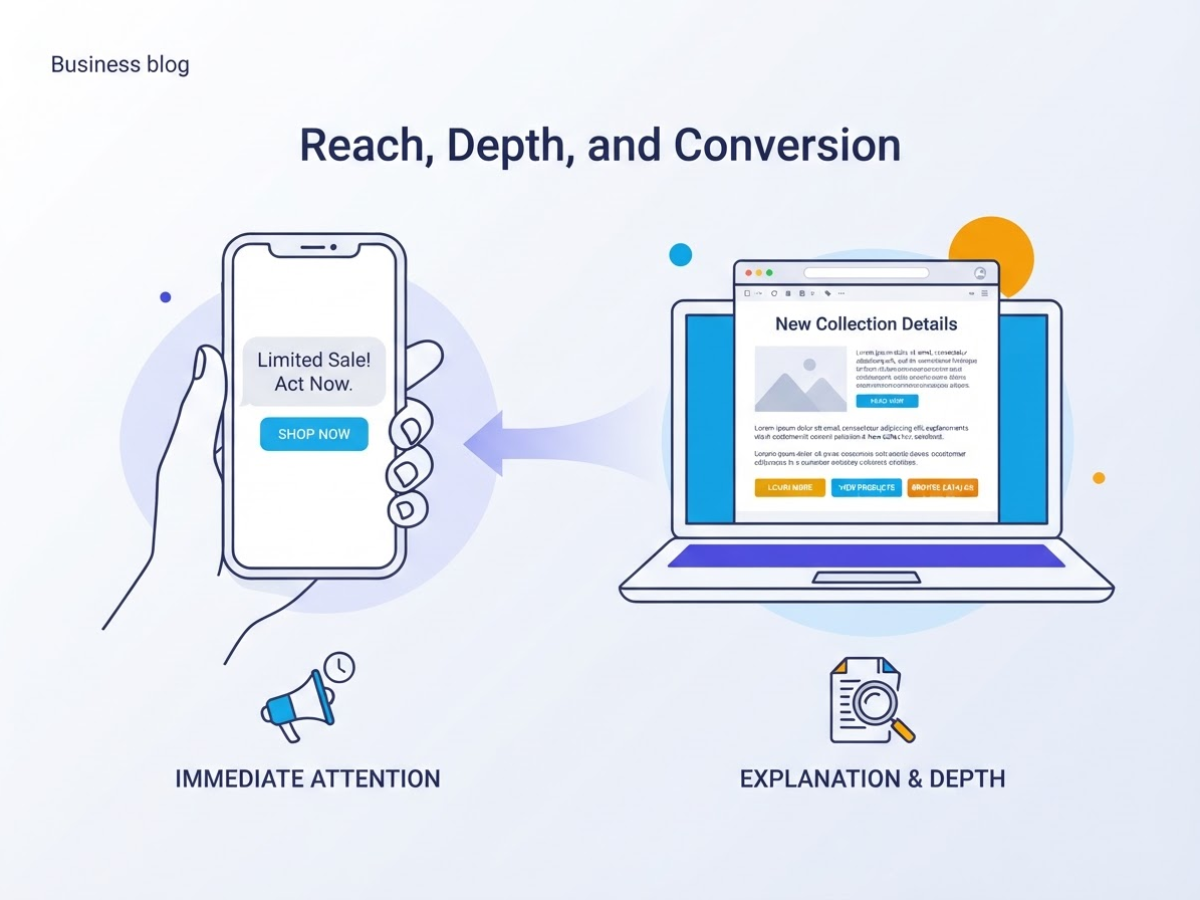
The first message I usually write for a campaign is not the one I send first. Email carries the explanation, while SMS earns attention when a customer needs to act soon. Treating them as interchangeable usually produces a long text message and a crowded email that does neither job well.
| Factor | Bulk SMS | |
|---|---|---|
| Format | Short, plain-text message with one clear action | Longer copy, images, buttons, product details, and multiple links |
| Cost structure | List permission, SMS credits, sender registration, and delivery fees | List growth, email platform, templates, design, copywriting, and sending volume |
| Attention | Usually noticed quickly, but easy to find intrusive | Slower to open and easier to miss, but better for research |
| Automation | Useful for alerts, reminders, one-time passwords, and abandoned-cart prompts | Better for welcome series, education, segmentation, and multi-email journeys |
| Measurement | Delivery, clicks, replies, coupon use, and completed actions | Opens, clicks, revenue, unsubscribes, and assisted conversions |
SMS often costs more per individual contact, but the production bill stays small. You can write a 160-character reminder in minutes, whereas an email may need copy, design, mobile testing, link checks, and several approval rounds. For a concrete reference, one Indian provider lists transactional SMS at ₹0.28 each for 2,000 messages and ₹0.165 for 1,000,000, before 18% GST. Your final rate depends on message type, registration, and provider terms.
Email usually wins when the customer needs proof. A comparison chart, testimonials, pricing terms, product photos, and a detailed explanation belong in the inbox. Mailchimp’s all-user benchmark reports a 35.63% average open rate and 2.62% click rate, but treat those figures as directional. Industry, list quality, subject lines, and inbox placement can move the result sharply.
SMS wins the last-mile moment: “Your sale ends at midnight,” “Your appointment is tomorrow,” or “Your cart is waiting.” It is not a good place to explain a complicated offer. A message with three links, disclaimers, and five benefits looks careless and can trigger complaints.
Pro Tip: Do not send the same full message through both channels; give each touchpoint a different job.
Use a two-step workflow: send email first with the context, evidence, and terms, then send SMS to remind engaged customers about a deadline or prompt a high-intent action. Automated journeys deserve testing too; Klaviyo’s benchmark of more than 3 billion texts found that automated flows can produce substantially more revenue per recipient than one-time campaigns, although no benchmark guarantees your conversion rate.
The next comparison looks at whether social media can match SMS’s speed without adding the same delivery cost.
Bulk SMS vs Paid Ads and Social Media
The biggest difference appears after you build a permission-based list. You pay for each SMS, but you do not enter an auction every time you contact an existing customer. Paid search and social ads work differently: cost changes with the audience, season, placement, creative competition, and bidding pressure. A January click and a Diwali click can have very different prices, even when the landing page stays identical.
I have seen teams judge SMS against ads using impressions or message volume. That comparison is usually useless. Measure the cost to produce a qualified lead and then a customer:
| Channel | Usually strongest for | Main cost risk | What you must track |
|---|---|---|---|
| Paid ads | Discovery and list growth | Rising auction costs and wasted clicks | Qualified leads and customers |
| SMS | Existing contacts and immediate action | Consent loss, fatigue, and delivery fees | Incremental conversions and revenue |
Paid media gives you audience targeting, creative testing, and new reach. It also brings friction: you need several ad variations, a working landing page, conversion tracking, and enough budget to learn. Attribution gets messy when someone clicks an ad, leaves, then buys after an SMS. Mixpanel’s 2024 benchmarks found product-action conversion of about 7% from paid ads versus 5.9% from non-paid channels, but that does not make every paid click profitable.
SMS skips much of the discovery work because the recipient already knows your business. It suits abandoned-cart reminders, appointment confirmations, limited-time deadlines, and follow-ups to leads who opted in. Message costs can also fall with volume: one Indian provider lists transactional SMS at ₹0.28 each for 2,000 messages and ₹0.165 at 1,000,000, before 18% GST. Sending too often creates unsubscribes, and a weak offer cannot be rescued by instant delivery. Permission-based SMS remains useful when the message reaches customers at the right moment.
Use ads to earn consent, then let SMS nurture and activate that contact. Compare each channel on qualified lead cost, customer acquisition cost, revenue, and incremental lift, not clicks alone. The next comparison looks at whether SMS can beat direct mail when physical reach is part of the plan.
Bulk SMS vs Direct Mail: When Physical Reach Pays
The envelope adds a bill before your customer sees the offer. For a direct-mail campaign, you may pay for list rental, creative work, paper, printing, folding, addressing, postage, packing, and manual handling. You also need weeks, not minutes, to approve artwork, produce the pieces, and get them into homes.
By contrast, SMS usually adds a delivery charge to an approved message and a platform fee, with no paper or fulfilment queue. For example, one Indian provider lists transactional SMS at ₹0.28 per message for 2,000 messages and ₹0.165 at 1,000,000, before GST. Your actual rate depends on message type, volume, sender requirements, and compliance, but the cost structure remains simpler.
| Cost or constraint | Direct mail | Bulk SMS |
|---|---|---|
| Production | Design, paper, printing, finishing | Copy, template, platform setup |
| Delivery | Postage, packing, handling | Per-message delivery fee |
| Lead time | Often days or weeks | Usually minutes to hours |
| Testing | New print runs and lists | Fast copy, offer, and audience tests |
| Tracking | Requires response mechanisms | Clicks, replies, and delivery data |
Direct mail earns its place when the physical item matters. A furniture showroom can mail a premium catalogue, a local restaurant can target homes within a few kilometres, and a healthcare or financial brand may want a letter that older customers trust more than a short code. Paper also gives premium offers room to feel considered rather than disposable.
The benchmark numbers need restraint. JICMAIL reported 7.9% response for warm direct mail, 0.9% for cold mail, and 0.6% for door drops in 2024, but geography, list quality, creative, offer value, and purchase timing can change the result sharply. A printed campaign can look cheap per response and still lose money if the margin cannot cover production and fulfilment.
Connect every mail piece to a QR code, unique URL, promo code, or dedicated phone number. That extra setup prevents the familiar argument over whether a sale came from the postcard or something else. For fast offers and repeated testing, bulk SMS remains a practical part of a wider marketing strategy, while direct mail is the costlier choice when presence and local trust matter more than speed.
The next comparison turns to another channel where creative reach can hide substantial acquisition costs.
How to Choose the Cheapest Channel That Can Win
The cheapest channel is the one that produces profitable incremental action for this campaign, not the one with the lowest delivery fee. I use the following filter before approving a send because a cheap message aimed at the wrong customer is still wasted spend.
- Name the job. Choose one primary objective: awareness, lead generation, a sale, repeat purchase, appointment booking, reminder, or service notification. SMS earns consideration when timing matters, while email gives you room to explain a complicated offer. For broader discovery, paid media is necessary because your existing list cannot reach new buyers.
- Score each channel from 1 to 5. Rate SMS, email, paid media, and direct mail for audience access, urgency, average order value, message complexity, tracking quality, and compliance risk. A score of 5 means the channel fits well. Give urgency and compliance extra weight for appointment reminders or time-sensitive offers. A channel that reaches nobody legally or predictably should not win because its unit cost looks attractive.
- Build a minimum viable test by day 3. Use one audience, one offer, one landing experience, and one conversion window. Keep the audience split as evenly as practical, use unique links or codes, and decide the window in advance: 24 hours for a flash sale, 7 days for a retail offer, or 30 days for a higher-value purchase. Do not change the landing page halfway through. That mistake makes every result arguable.
- Review on the final day. Compare incremental conversions against a holdout group that receives no campaign. Then calculate profit: incremental conversions × contribution margin, minus media, message, creative, landing-page, discount, and staff costs. Attributed conversions flatter channels that would have received the sale anyway. Automated flows deserve separate attention too: Klaviyo’s benchmark found $3.65 in revenue per abandoned-cart email recipient versus $0.11 for an average email campaign.
| Choose | When it usually fits |
|---|---|
| SMS alone | The audience has permission, urgency is high, and the action takes one or two taps. |
| Email alone | The offer needs explanation, images, comparison, or several links. |
| Paid media | You need new reach and can tolerate testing costs before conversion data stabilizes. |
| Direct mail | The order value supports print and postage, and a physical reminder may stand out. |
| Blended sequence | One channel creates demand and another closes it, such as email explanation followed by an SMS deadline. |
After the first test, keep the channel with the strongest incremental profit and check whether volume changes that result.
My honest take on bulk SMS versus other channels
I have seen businesses choose SMS because a campaign report showed a 20% response rate, then assume it beat every other channel. That conclusion is too generous. A loyal customer may already have planned to buy, so the message can claim credit for a sale it did not create.
My view is that bulk SMS is rarely the cheapest channel in every situation. It is often the most economical way to reach an existing, permission-based audience quickly, especially for appointment reminders, payment deadlines, OTPs, delivery updates, and short offers. The trade-off is real: message fees add up, opt-outs can damage a carefully built list, and a badly timed text feels intrusive.
Email usually wins when customers need product details, comparisons, or several follow-up messages. Paid advertising matters when you have no audience yet. I judge SMS by incremental conversions, profit after message, creative, staff, and platform costs, and a holdout group whenever the campaign size allows it.
For AVM Cloud and DomainAdda customers, I recommend a measured mix. Use content or ads to attract attention, earn consent, explain the offer by email, and reserve SMS for high-intent moments. That approach is less exciting than chasing a high response rate, but it gives you a clearer view of what actually produced revenue.
— AVM Cloud Content Strategy Team
Build a More Cost-Efficient SMS Marketing Mix
When I help businesses compare channels, I start with a small SMS test, not a large contract. Define one audience, write one focused message, and track a link or coupon code. That gives you a real cost per delivered message and cost per customer instead of a spreadsheet built on guesses. SMS is not always the winner, especially when the offer needs explanation or the list needs cleaning first.
AVM Cloud’s affordable SMS marketing services through DomainAdda can fit that measured approach. Before launching, review sender compliance support, delivery reports, provider capabilities, and pricing in the guide to choosing a bulk SMS provider in India. Then compare the expected cost and response against email, ads, and other channels. Use SMS where its speed and direct reach earn their place.
Frequently Asked Questions
Is bulk SMS cheaper than email marketing?
It depends on list size, software fees, design work, delivery rates, and conversion value. For a 1,000-person campaign, SMS can cost less when you need a short, urgent prompt, while email usually costs less per contact for detailed content, automation, and repeat newsletters.
What is the average cost of sending 1,000 bulk SMS in India?
The price changes by provider, route, message type, volume, and taxes. One published Indian rate card lists transactional SMS at ₹0.28 per message at a 2,000-message tier, which makes 1,000 messages ₹280 before 18% GST, but request a current quote because rates and applicable fees change.
How do I calculate the ROI of a bulk SMS campaign?
Subtract the campaign’s total cost from its incremental profit, divide the result by the total cost, and multiply by 100. For example, ₹10,000 in extra profit from a ₹2,000 campaign produces 400% ROI, but include SMS charges, 18% GST, setup, creative, landing-page, discount, and staff costs in the ₹2,000 figure.
What is better for local businesses, SMS or social media advertising?
SMS usually works better when you have an opted-in local audience that knows your business and needs a prompt, while social advertising is better for reaching new people. Test both for 30 days with separate discount codes or landing pages, because comparing impressions with delivered SMS alone can make social ads look cheaper than they are.
How many SMS messages should a business send per month?
There is no fixed number because consent, customer expectations, message value, and local regulations affect the right frequency. Start with 1 useful campaign or automated trigger per month, then increase volume only if conversions stay profitable and opt-outs do not rise.
Recommended reads
- How To Choose The Right Bulk Sms Provider In India
- The Power Of Sms Marketing Reaching Your Customers Like Never Before
- Sms Marketing 2023 How To Market Your Business Effectively And Easily
- Why Sms Marketing Is Still Popular In India Even With New Rules
Sources
- Pricing — SMS, WhatsApp, Voice & IVR, GST shown | SMSAPI
- 2024 SMS Marketing Statistics and Benchmarks – Klaviyo
- Email Marketing Benchmarks & Industry Statistics | Mailchimp
- What is email click-through rate (CTR)? | Campaign Monitor
- Paid vs. Unpaid Marketing Conversion Rates
- Good Works released the 2024 Direct Mail Benchmarks report
- JICMAIL Press Release: JICMAIL Scales Up Its Response Rate Tracker For 2024
- What Are the Key Direct Mail KPIs to Track? | Postalytics
- Direct Media Response Rate, CPA and ROI Benchmarks – Marketing Charts