

How to Choose the Right Bulk SMS Provider in India
TL;DR: To choose the right bulk SMS provider in India, check DLT compliance, sender ID and template support, delivery reliability, transparent pricing, APIs, reporting, customer support, and data safeguards. Run at least 1 test campaign and compare the cost per delivered message, not just the advertised per-SMS rate, before you commit.
Choosing a bulk SMS provider in India can look like a price exercise until rejected messages, extra billable segments, or a delayed DLT setup disrupt your campaign. I have seen teams blame copy and timing when the real problem was incomplete sender registration. TRAI’s guidance requires bulk communicators to complete principal-entity, header, content-template, and applicable consent registrations, so compliance belongs in your shortlist, not in the cleanup queue. Message length matters too: Twilio says Indian SMS is split after 160 characters and charged per segment. Compare compliance, deliverability, pricing, integrations, support, and the provider’s scorecard before you choose.
| Point | Details |
|---|---|
| Check DLT readiness | Confirm support for principal-entity registration, registered headers, approved templates, and consent workflows before sending campaigns in India. |
| Calculate delivered cost | Add message segments, carrier fees, taxes, failed deliveries, and the price difference between promotional and transactional messages to estimate your true cost per 1,000 delivered SMS. |
| Test deliverability | Run sample campaigns across at least 3 major Indian operators and record delivery rate, latency, failures, and template accuracy. |
| Review integrations | Check for documented APIs, webhooks, dashboards, plugins, and tested connections with your CRM or business software before committing. |
| Verify business safeguards | Review opt-out handling, access controls, data policies, reporting, uptime commitments, and escalation support before scaling beyond your first 10,000 messages. |
What Makes a Bulk SMS Provider Reliable in India?
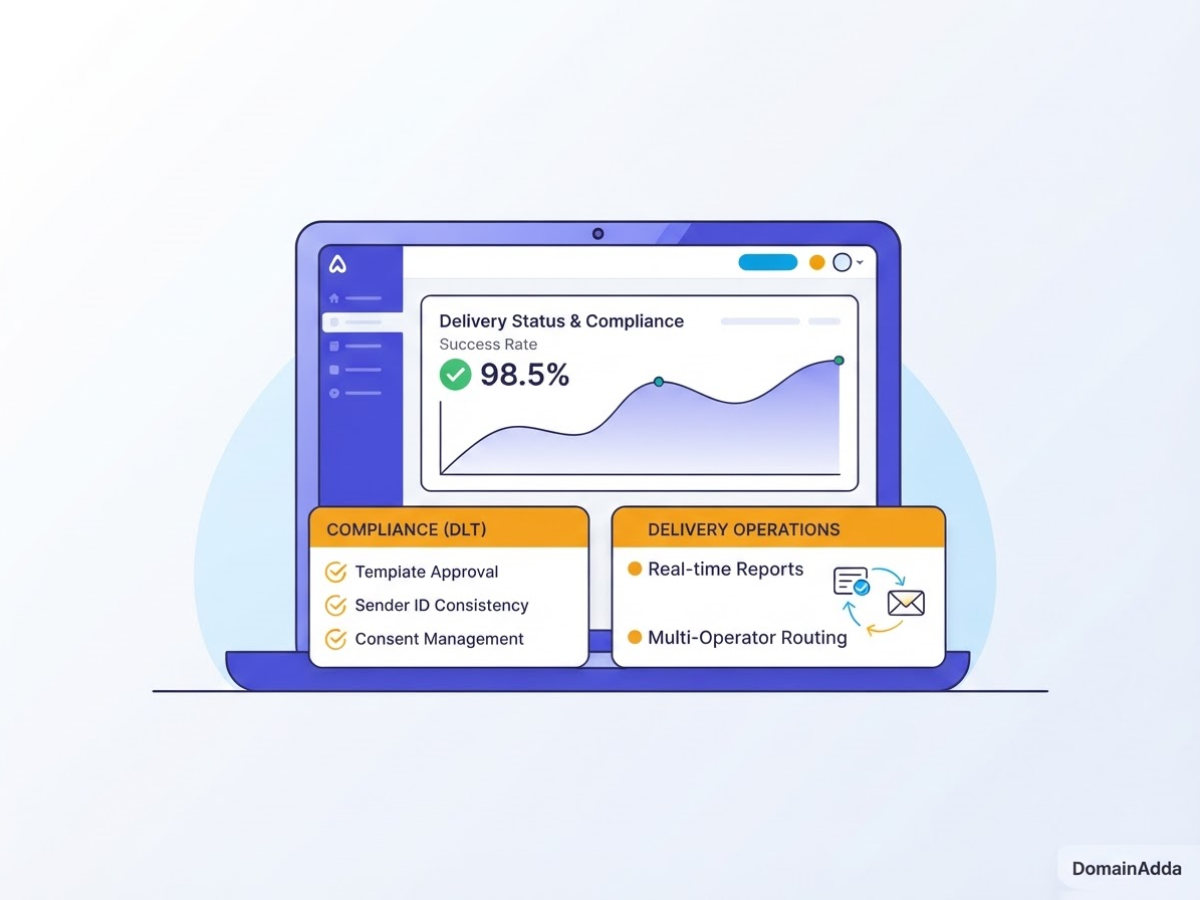
A reliable provider is not simply the one quoting the lowest rate. When I help businesses compare SMS platforms, the failures usually appear later: an unapproved template, inconsistent sender IDs, missing delivery reports, or messages stuck with one operator. In India, compliance and delivery operations matter as much as the dashboard.
Start by identifying the provider model:
- Bulk SMS gateway: Mainly supplies API access and routing. You handle templates, integrations, consent, and much of the troubleshooting.
- Reseller: Buys capacity from another platform and sells it under its own brand. Pricing can look attractive, but support becomes a frustrating game of passing tickets between companies.
- Full-service provider: Handles DLT registration support, headers, templates, campaigns, APIs, reports, and delivery issues. You pay more for assistance, but that cost can be worthwhile when an OTP failure affects customers.
For Indian traffic, ask how the provider manages DLT registration. Under TRAI’s TCCCPR 2018 requirements, businesses may need principal-entity registration, registered headers, approved content templates, consent templates, and consumer consent records. Promotional messages, transactional alerts, OTPs, and service messages are not interchangeable. Your provider should explain which route and template applies before you send anything.
Delivery checks should be equally practical. Confirm that the platform reaches major Indian operators, preserves your registered sender ID, returns delivery receipts, and shows timestamps for submission, routing, and final delivery. Ask about typical latency during peak periods, not just an impressive average. Check message-length billing too: a long or Unicode message can split into multiple segments, increasing both cost and failure points.
Pro Tip: Ask the provider to demonstrate one complete DLT-to-delivery workflow before signing a long-term contract.
Use this scorecard instead of judging a quote by its per-SMS price:
| Criterion | Weight |
|---|---|
| Compliance | 25% |
| Delivery quality | 25% |
| Features and integrations | 20% |
| Price | 15% |
| Support | 15% |
I would reject a cheap service that cannot show receipts or explain DLT status. A provider with local SMS service experience in Chandigarh may still be a poor choice if its India-wide routing and support are weak. Put those claims through a use-case test next.
Which Provider Fits Your Business Use Case?
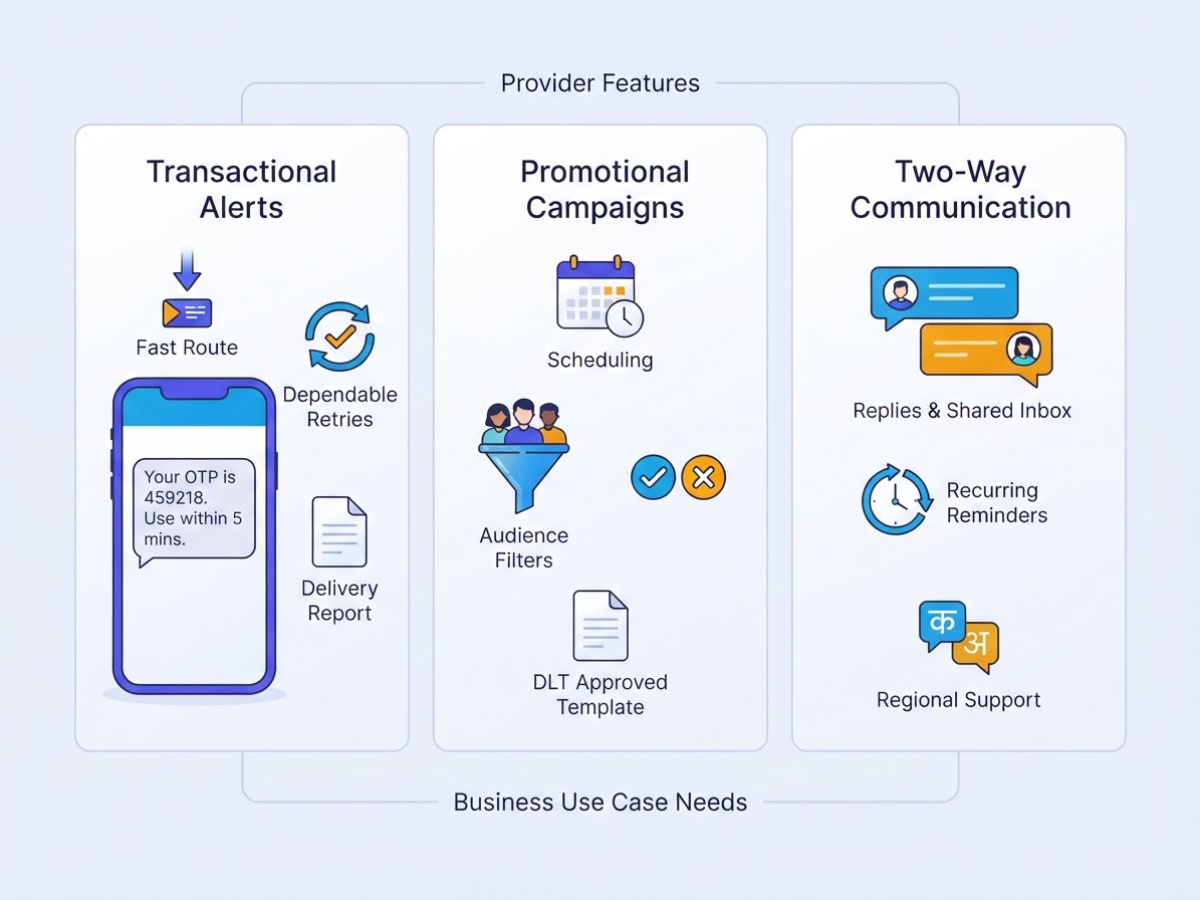
Your message type should determine the shortlist before price enters the conversation. OTPs and delivery alerts need fast transactional routes, dependable retries, and clear delivery reports. Promotions need scheduling, audience filters, consent handling, opt-outs, and DLT-approved templates. Appointment reminders and education notifications usually need recurring schedules and regional-language support, while support teams may need replies, shared inboxes, or two-way customer communication. Twilio also lists two-way SMS and concatenated messages for India, subject to sender-ID and character-encoding limits.
Use this comparison to narrow the field:
| Business | Start with | Look for next |
|---|---|---|
| Small business | No-code dashboard for reminders, offers, and alerts | Simple contact imports, scheduling, templates, and opt-outs |
| Growing e-commerce company | Dashboard plus API for order and payment updates | Webhooks, delivery callbacks, segmentation, and burst capacity |
| Agency | Multi-client workspace | Subaccounts, client billing, approval queues, and separate sender IDs |
| Education provider | Scheduled notifications and regional-language messages | Batch uploads, consent records, attendance integrations, and role controls |
| Enterprise team | API-first service with operational support | Webhooks, role-based access, audit logs, failover routes, and escalation contacts |
A dashboard is enough when one or two people send planned campaigns and manually upload contacts. Do not pay for an API because it sounds professional. You need API access when your CRM, store, billing system, or booking tool must trigger messages automatically. Webhooks matter when your team needs delivery or failure events inside another system. Subaccounts and role-based access become necessary once agencies, branches, or departments send from the same account.
Check Hindi and other Unicode handling before signing up. A non-Latin character can reduce the text allowance and create extra billable segments, so test a real message rather than trusting the preview. Test delivery across the states you serve, scheduling by Indian time, contact segmentation, unsubscribe controls, and campaign approval workflows. For a local comparison, review a bulk SMS service provider in Chandigarh alongside national options.
Pro Tip: Choose based on your hardest message type and busiest sending period, not on the simplest campaign you run today.
Shortlist three providers, then test their technical setup and total pricing with your actual templates, volumes, and approval process.
Compare Pricing, Delivery, and Provider Features
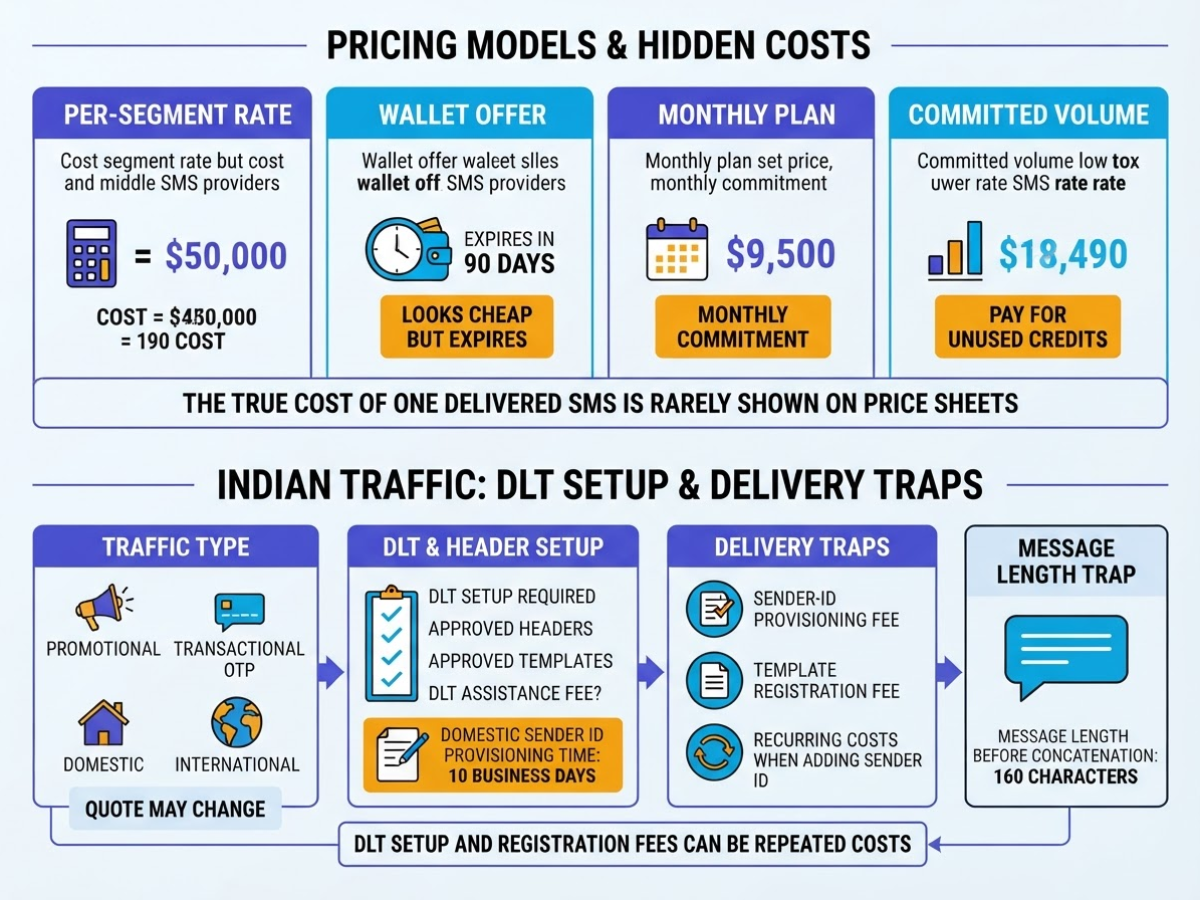
Price sheets rarely show what one delivered SMS actually costs. When I compare providers, I use the same monthly volume and three real messages, then separate per-SMS, per-segment, wallet, monthly-plan, and committed-volume offers. A wallet can look cheap but expire in 90 days, while a committed plan can reduce the rate and leave you paying for credits you never use.
Check whether the quote changes for promotional, transactional, OTP, domestic, or international traffic. Indian domestic traffic can require DLT setup, approved headers, and templates. Ask whether DLT assistance, sender-ID provisioning, or template registration carries a separate fee. Some providers call these “one-time” costs, then charge again when you add a new sender ID.
Message length is another easy trap. SMS can be split into billable segments after 160 characters in India, and Unicode characters can reduce the usable character limit further. A long Hindi message, emoji, or special symbol can turn one advertised SMS into two or more paid segments. Test your actual OTP, order update, and promotional copy before accepting a quote.
Use this worksheet during demos. Make the salesperson fill every cell instead of sending a vague rate card.
| Provider | Unit price | Segments | Delivery rate | API | Reports | Support | Refund policy |
|---|---|---|---|---|---|---|---|
| Provider A | ₹___ | ___ | ___% delivered | ___ | ___ | ___ | ___ |
| Provider B | ₹___ | ___ | ___% delivered | ___ | ___ | ___ | ___ |
| Provider C | ₹___ | ___ | ___% delivered | ___ | ___ | ___ | ___ |
Pro Tip: Calculate cost per delivered message for three real message samples instead of comparing the providers’ advertised SMS rate.
Include GST, carrier charges, setup fees, DLT assistance fees, sender-ID fees, and the treatment of failed messages in your calculation. Does a failed message return to your wallet, disappear, or remain pending until you open a ticket? Ask about unused-credit expiry too. A low rate is not a bargain if 10% of your balance expires unused.
For technical teams, test API documentation, delivery webhooks, retry controls, rate limits, and exportable reports. Do not overvalue a glossy dashboard if your developers cannot trace a failed OTP. If you use Busy, review the provider’s SMS API integration approach before signing a yearly commitment.
Once the numbers are comparable, run a small live campaign and verify delivery evidence before discussing contract terms.
How to Test a Bulk SMS Provider Before You Commit
A free trial can hide the problems that appear after your first busy campaign. I use a short, paid-style validation process instead. It exposes compliance gaps, delivery delays, awkward workflows, and support weaknesses before they affect real customers.
- Write down your actual requirements. Record monthly volume, message categories, supported languages, sender IDs, peak sending windows, integrations, and reporting needs. Separate transactional alerts from promotional campaigns because they can follow different approval and routing rules. Include unusual cases such as Hindi text, long messages, Unicode characters, and a campaign sent to 50,000 recipients at 10 a.m.
- Put DLT responsibilities in writing. Ask who handles principal-entity registration, sender-header approval, template registration, consent records, and rejected templates. TRAI’s bulk-communication process includes these registration and consent activities, so a provider that says “we will take care of compliance” without naming the tasks is leaving you exposed. Confirm ownership, documents, fees, and expected dates in the contract. Sender approval is not instant: Before registering for DLT check this 5 steps required for DLT Registration in India
- Run controlled delivery tests. Send the same approved message to several operators, phone models, and locations. Record delivery time, the displayed sender, character handling, duplicate messages, failed numbers, and delivery-report accuracy. Test both English and regional-language content. Check message length too, since SMS charges can apply per segment after the 160-character limit.
- Use the product, not just the sales demo. Upload a real CSV, create a segment, schedule a small campaign, download delivery reports, and cancel a scheduled send. For API testing, check authentication, invalid-number responses, webhook payloads, rate limits, and retry behaviour. Follow the documentation yourself when connecting an existing system. A provider can claim easy integration, but a missing error code leaves developers guessing. This SMS API integration guide for Busy software is the sort of practical documentation you should expect.
- Test support under pressure. Open a ticket with a realistic issue, such as a template rejection or missing delivery report. Score the first-response time, technical accuracy, clarity of the fix, and whether the agent escalates the issue properly. Sales replies in five minutes mean little if an urgent delivery problem sits unanswered for six hours.
- Run a small paid pilot. Send enough messages to test a normal campaign and one peak window, then compare delivery records with the invoice. Check segment counts, carrier fees, failed-message charges, taxes, and unused-credit rules. Before increasing volume, set go/no-go thresholds, such as 95% successful delivery, reports within 15 minutes, no unexplained invoice variance, and support responses within four business hours. Then compare the remaining commercial risks before signing a longer agreement.
Bulk SMS Provider Mistakes to Avoid
The cheapest quote often becomes expensive after delivery failures, extra segments, and support delays appear. When I review SMS setups, the same avoidable mistakes keep surfacing:
- Choosing only by the advertised rate: A provider can show ₹0.10 per SMS, then bill separately for DLT registration, failed retries, premium routes, or additional segments. Compare delivered-message cost, support terms, minimum balance, expiry rules, and refund policy instead. Price matters, but it is a poor shortcut.
- Treating DLT as the provider’s entire responsibility: Your business still needs to complete the required sender, header, template, and consent work under TRAI’s bulk communication requirements. Ask exactly what the provider submits, what you must approve, and who fixes a rejected template. Commercial messages also need a registered sender header, not an improvised brand name.
- Uploading a purchased or old contact list: Keep the consent source, date, purpose, and phone number for every contact. Record opt-outs and suppress those numbers before every send. If you cannot explain why a person is receiving a message, do not upload the number.
- Ignoring how SMS is counted: Long copy, emojis, and regional-language characters can change encoding and split one message into multiple billable segments. Check character limits, Unicode rules, variable limits, sender-ID display, and concatenation behaviour before writing campaign templates. A 160-character limit can matter far more than a small difference in the headline rate.
- Scaling before checking the reports: Run a small campaign first. Inspect delivery status, failure reasons, queue time, duplicate prevention, abuse controls, login security, API keys, and how the provider stores exported contact data. A dashboard showing “sent” is not proof that customers received the message.
Regulatory exposure is not a theoretical footnote. Unregistered telemarketers can face a cap of 20 outgoing messages per day, and repeated commercial-communication violations can result in disconnection for up to two years and blacklisting. That can stop legitimate alerts along with marketing campaigns, so compliance belongs in your provider scorecard from day one.
Before you sign, test the workflow with real templates and a small, consented list, then compare the provider’s answers against why SMS marketing remains popular in India despite new rules.
My Honest Take on Choosing an Indian Bulk SMS Provider
I would not choose a bulk SMS provider in India by comparing the cheapest quoted rate. In campaigns I have reviewed, the low headline price often hides message segmentation, failed-delivery charges, slow sender-header approvals, or support that disappears when a template is rejected. I first eliminate providers that cannot clearly explain DLT onboarding, sender IDs, approved templates, consent handling, delivery reports, and escalation support.
Here is my contrarian view: a smaller Indian provider can be a better choice than a globally recognised platform. If you need local billing, hands-on help with sender IDs, or someone who understands why an Indian template was rejected, a smaller team can resolve the issue faster. Brand recognition does not fix a blocked campaign. Local familiarity is not enough, though. I still require documented APIs, transparent segment pricing, operator-level testing, and a written data-handling policy.
I would score three providers against your actual use case, run a limited paid pilot, and calculate the cost per delivered message rather than the cost per submitted SMS. Treat compliance as shared responsibility. Your provider can supply tools and guidance, but you remain responsible for lawful campaigns, consent where applicable, and accurate records.
— AVM Cloud Content Strategy Team
Choose a Cost-Effective SMS Partner with AVM Cloud
When I help businesses compare SMS providers, the cheapest rate rarely settles the decision. AVM Cloud’s DomainAdda SMS marketing service is a practical option if you want Indian messaging costs reviewed alongside campaign support, delivery reports, and guidance for connecting SMS with your website, CRM, or email tools. Ask for pricing that matches your monthly volume rather than accepting a vague package quote.
The setup can still require a few back-and-forth messages, especially when you need a specific sender ID or have technical restrictions. Share your monthly volume, message type, sender-ID requirements, and integration needs so the team can suggest a sensible starting point. You can also review local bulk SMS support in Chandigarh or Mumbai bulk SMS services if your business operates in either city. DomainAdda also covers domains, hosting, email, and digital marketing, which can simplify vendor management.
Frequently Asked Questions
How much does it cost to send bulk SMS in India?
Bulk SMS pricing depends on message type, provider, operator route, order volume, taxes, and the number of billable segments. A standard SMS can use 1 segment, while a long or Unicode message can use 2 or more, so compare the final cost per delivered message rather than the advertised per-SMS rate.
Is DLT registration mandatory for bulk SMS in India?
Businesses sending regulated commercial communications in India must follow the applicable TCCCPR 2018 process, which can include registration of the principal entity, headers, message templates, and consent details. Start the setup several weeks before your first campaign and confirm the exact requirements with TRAI guidance and your provider. An incomplete registration can stop messages from being delivered.
What is the difference between promotional and transactional SMS?
Promotional SMS advertises an offer, while transactional SMS or service SMS provides information linked to a customer interaction, such as a payment alert or booking update. The classification can affect sender headers, templates, consent, delivery rules, and pricing, so ask your provider to review the exact message before sending it to a list of 10,000 contacts.
How can I improve bulk SMS delivery in India?
Use an approved sender ID and template, send only to clean consent-based lists, and keep each message within the appropriate encoding and length limits. Run a pilot of at least 100 messages across multiple operator networks, then check delivery reports for rejected templates, invalid numbers, delayed routes, and carrier-specific failures before launching the full campaign.
Can bulk SMS software connect with a CRM or business application?
Many providers support APIs, webhooks, plugins, or direct integrations, but the details vary and setup becomes irritating when documentation is incomplete. Before committing, test authentication, contact synchronisation, delivery-status callbacks, retries, rate limits, and error reporting with your actual application, ideally using a 50-message test batch.
Recommended reads
- Why Sms Marketing Is Still Popular In India Even With New Rules
- Bulk Sms Service Reasons Why Any Business Needs One
- Step By Step Guide Of How You Can Integrate Domainadda Sms Apis With Busy Software
- The Power Of Sms Marketing Reaching Your Customers Like Never Before