

Difference Between .Com and .Org: Which to Choose?
TL;DR: The main difference between
.comand.orgis their usual purpose:.comsignals a commercial business, while.orgis commonly used by nonprofits, communities, and other organizations. Neither domain extension automatically improves Google rankings, so choose based on your audience, credibility, availability, and long-term goals.
Finding the same name available under .com and .org sounds simple until you have to choose one for your business, portfolio, or community project. If you worry that the wrong ending will make visitors hesitate, you are dealing with a real trust problem, not a technical detail. Google says a top-level domain such as .com or .org does not by itself affect search performance, while .com’s scale can shape expectations: the extension had 163.6 million registrations at the end of the first quarter of 2026. This guide compares what each ending means, how audiences read it, credibility and SEO, availability, registration steps, and your options when the preferred extension is taken.
| Point | Details |
|---|---|
| Meaning and purpose | .com traditionally signals commercial activity, while .org is commonly linked to organizations and community initiatives. |
| SEO impact | Google says the top-level domain itself does not determine search performance, so .com has no automatic ranking advantage. |
| Audience expectations | Choose .com when customers expect to buy from you, and consider .org when mission, membership, or public-interest work drives the site. |
| Trust and clarity | The right extension should match your purpose and be easy for visitors to remember within 2 or 3 seconds. |
| Practical selection | Before registering, compare availability, renewal costs, brand conflicts, email use, and whether the domain can support your next 3 to 5 years of growth. |
What Is the Difference Between .Com and .Org?
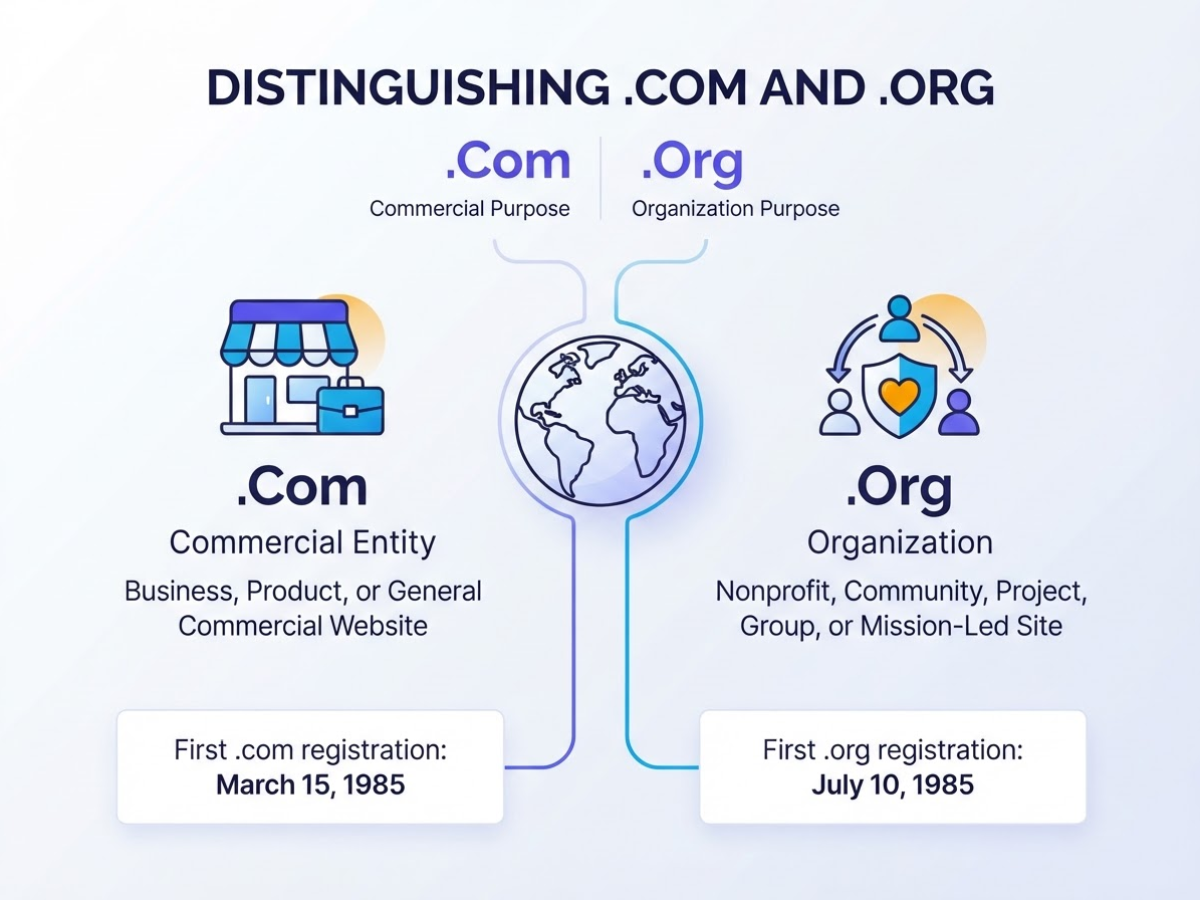
A domain extension is the ending after the final dot in a web address. The “com” in example.com and “org” in example.org are both generic top-level domains (gTLDs), meaning they are intended for broad global use rather than one specific country. By contrast, country-code top-level domains, such as .in for India or .uk for the United Kingdom, identify a country or territory.
The original naming convention was straightforward:
| Extension | Original meaning | What it signals today |
|---|---|---|
.com |
Commercial entities | A business, product, or general commercial website |
.org |
Organizations | A nonprofit, community, project, group, or mission-led site |
The labels describe the original purpose, not strict legal rules. The early internet proposed .com for commercial entities and .org for organizations, but registering either extension does not prove that the owner has a particular legal status. The first .com, symbolics.com, was registered on March 15, 1985. The first .org, MITRE.org, followed on July 10, 1985.
In practice, .org is not technically restricted to registered charities or nonprofits. Businesses, individuals, social enterprises, clubs, open-source projects, and informal groups can register one. That freedom creates a small trust problem: a company can use .org, while a genuine nonprofit may use .com. Visitors often treat the extension as a shortcut for judging the site, even when that judgment is wrong.
Pro Tip: Treat the extension as a visitor expectation signal, not as proof of a company’s legal status or nonprofit registration.
The two extensions also have different registry managers. VeriSign operates the .com registry, while Public Interest Registry operates .org, as shown in the IANA Root Zone Database. That difference affects administration behind the scenes, but it does not make one extension inherently more legitimate or better for search rankings.
When I help someone choose between them, the real issue is usually audience expectation and name availability, not a legal requirement. For a practical comparison of ownership, trust, and use cases, see this difference between .com and .org guide before registering.
.Com vs .Org: A Side-by-Side Comparison
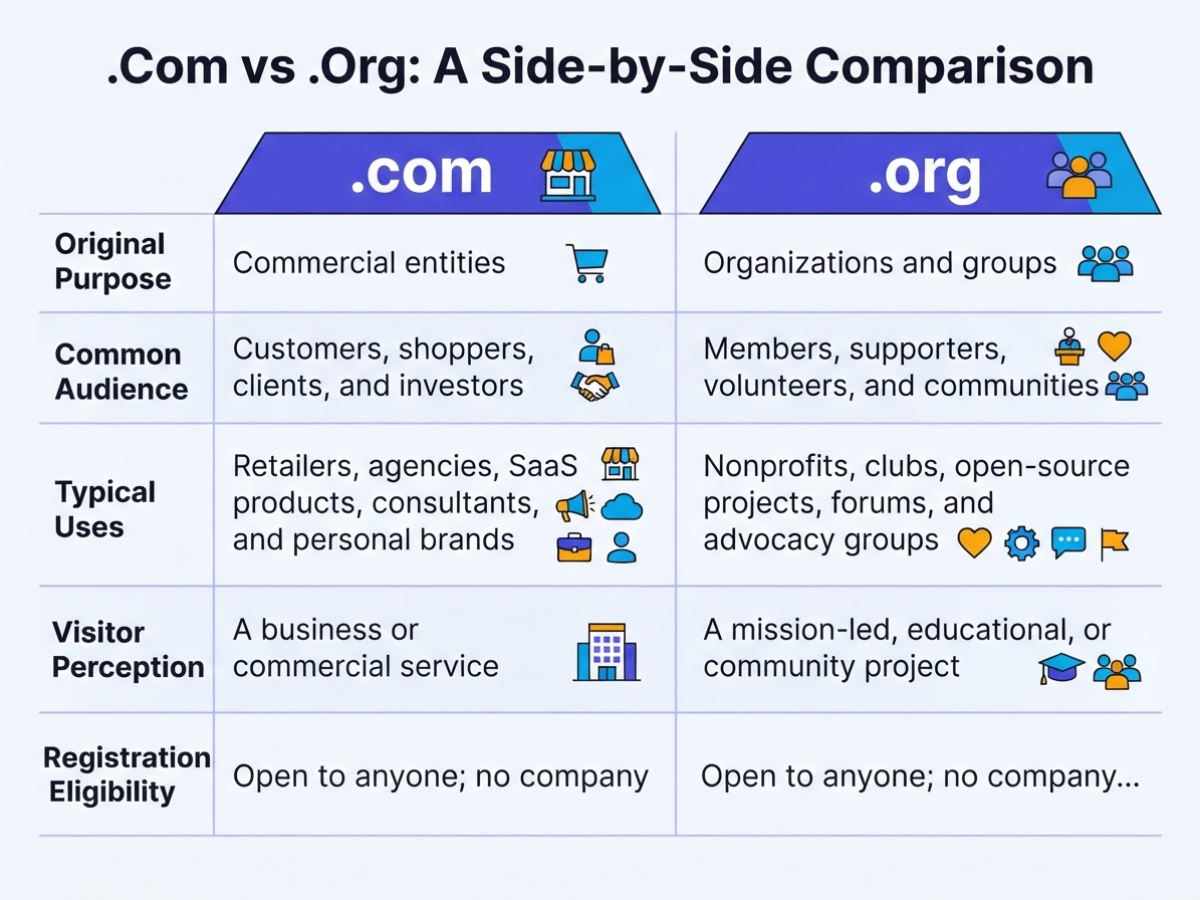
When I help clients choose a domain, the deciding factor is usually not a technical rule. It is what visitors assume the website does before they read a single word. The table below shows the practical difference between .com and .org at a glance.
| Factor | .com | .org |
|---|---|---|
| Original purpose | Commercial entities | Organizations and groups |
| Common audience | Customers, shoppers, clients, and investors | Members, supporters, volunteers, and communities |
| Typical uses | Retailers, agencies, SaaS products, consultants, and personal brands | Nonprofits, clubs, open-source projects, forums, and advocacy groups |
| Visitor perception | A business or commercial service | A mission-led, educational, or community project |
| Registration eligibility | Open to anyone; no company license is required | Also open to businesses, individuals, nonprofits, and other groups |
| Search rankings | No inherent advantage over .org | No inherent disadvantage compared with .com |
| Availability | Familiar names are often harder to find | You may find more acceptable alternatives, but popular names disappear quickly |
The original naming scheme assigned “com” to commercial entities and “org” to organizations, but those labels are not strict eligibility tests today. A retailer can register a .org, and a nonprofit can register a .com. That distinction matters because perceived identity and legal eligibility are different things.
For most conventional businesses, .com remains the default mental shortcut. People type it automatically, say it without thinking, and often add it when they remember only a brand name. A .org can communicate mission, membership, or community orientation well, but it may create doubt if you sell shoes, accounting services, or kitchen appliances. A shopper might wonder whether the site is a campaign or information project rather than a store.
Google generally does not care whether your site uses .com or .org for ranking. Content quality, technical health, relevance, and reputation matter far more. Do not choose .org for an imagined SEO boost.
Pro Tip: Read the domain aloud in a customer-support scenario; the easier extension to say, spell, and repeat may be the stronger choice.
Before you register, test the exact name in a phone conversation. Check its spelling, pronunciation, hyphens, likely typos, and whether the matching email address is available. A memorable .org is often better than a clumsy .com, but a familiar business name with the wrong extension can create avoidable support questions. For more context, compare this guide with the difference between .com and .org before making your shortlist.
Next, narrow the choice by matching the extension to your organization’s actual purpose and audience.
When Should You Choose a .Com or a .Org?
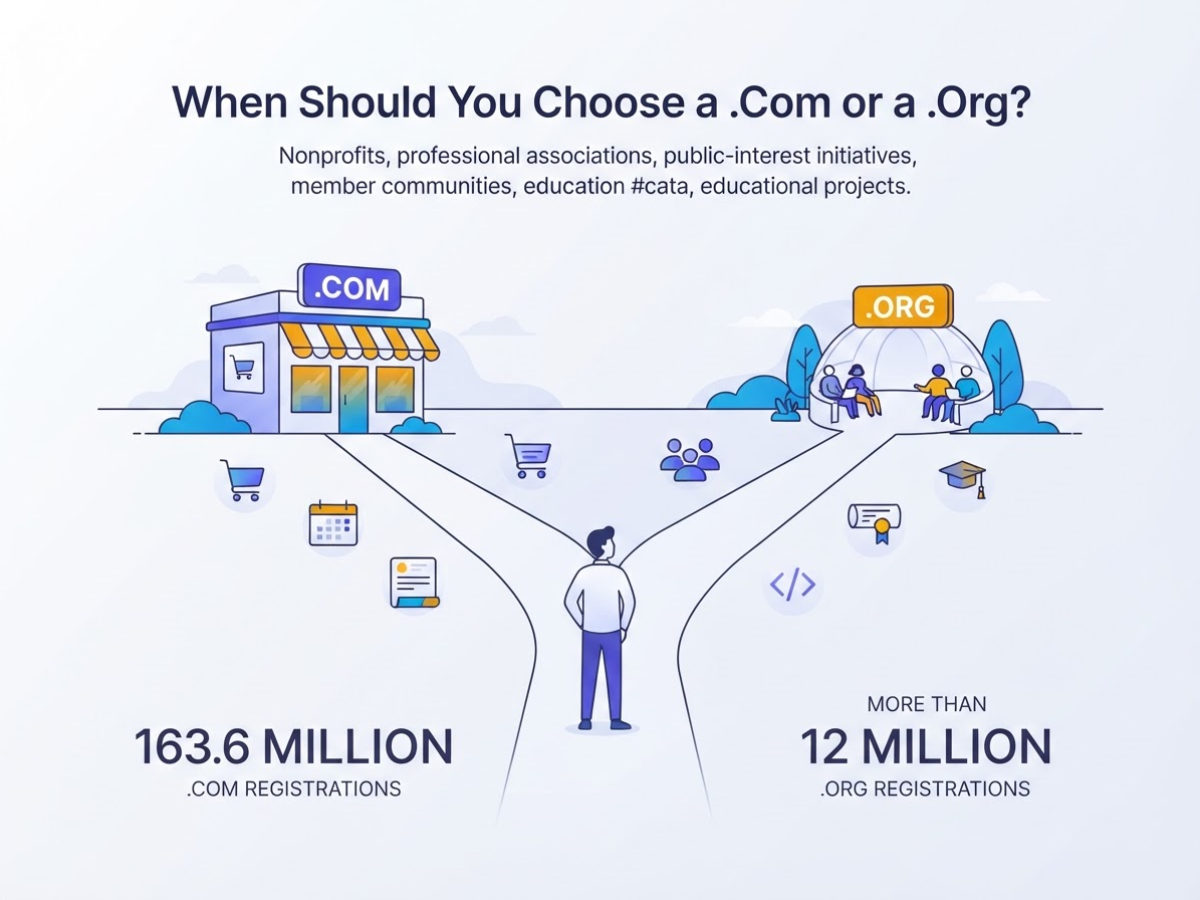
The practical choice depends on what visitors expect to find after they click your domain. In client projects, I usually recommend .com when the site’s main job is selling, booking, collecting leads, or supporting a commercial product. That includes retailers, agencies, consultants, freelancers, SaaS products, and businesses preparing to sell online.
Choose .org when the organization’s identity matters more than a transaction. Nonprofits, professional associations, public-interest initiatives, member communities, educational projects, and open-source groups usually make a clearer first impression with it. The extension is not technically restricted to charities: businesses, social enterprises, individuals, and other organizations can use .org. Your site still needs to explain its purpose plainly.
| Your situation | Usually the clearer choice | Why |
|---|---|---|
| You sell products, subscriptions, or services | .com | Visitors expect a commercial website |
| You run a nonprofit, association, or community | .org | The mission or membership comes first |
| You operate a social enterprise | .com or .org | Pick the identity your audience recognizes |
| You are building open-source software | .org | Collaboration and public access feel central |
Social enterprises deserve a closer look. A company selling fair-trade goods may use .org if its public mission drives every decision and the site clearly explains how it works. Do not choose it just to appear virtuous. If customers see a standard sales funnel on a .org domain with no visible public benefit, the mismatch can create more suspicion than trust.
Pro Tip: If your organization may change from a community project into a commercial service, choose the extension that fits the next three years—not only today’s launch.
Use this quick decision tree before you register:
- Does your audience expect to buy, hire, subscribe, or request a quote? Start with .com.
- Is revenue secondary to a mission, membership, education, or shared resource? Consider .org.
- Will people question the extension because your business is plainly commercial? Prefer .com, even if the name needs a small adjustment.
Owning both can make sense when the brand name is valuable. Put the main site on one extension and redirect the other, especially if customers may type the wrong ending or competitors could register it. Buying .org solely because the .com is unavailable is riskier: visitors may expect a nonprofit and wonder why they are seeing a sales page.
The next step is checking whether your preferred name remains clear, memorable, and available on the extension your audience expects.
How to Choose and Register the Right Extension
When we help a customer choose between .com and .org, the mistake is usually buying the first available name. A domain can look fine in a search box and still sound awkward over the phone, conflict with another organization, or become expensive after the introductory year. Use this process before you pay.
- Write both versions and say them aloud. Put your preferred name beside
.comand.org, then ask someone to repeat it after hearing it once. Check pronunciation, spelling, hyphens, and whether people can remember it later. If you must explain where the dot goes every time, the name is already creating friction. Our comparison of .com and .org can help you judge the expectation each ending creates. - Search the exact name and sensible alternatives. Check both extensions, singular and plural forms, common abbreviations, and a shorter version before you build your brand around one option. Do not settle for a name merely because it is available. A strange spelling may leave you correcting customers, losing email, and watching visitors land on a similarly named site.
- Read the registrar’s full price details. Compare the first-year price with the renewal price for at least three years. Check transfer rules, grace periods, privacy protection, domain-lock settings, auto-renewal, and any restrictions in the registrar’s policies. Cheap registration can become an expensive annoyance if renewal jumps sharply or transferring out requires extra steps.
- Check for name conflicts. Search company directories, trademark databases, nonprofit listings, social platforms, and public projects for the same or a confusingly similar name. A
.orgending does not make a business name safe, and a.comending does not give you ownership of the wording. If another group already has a strong claim, choose a different name and get legal advice before registering. - Test the working identity, not just the URL. Create a sample address such as
hello@yourname.comand check whether it fits business cards, invoices, social profiles, SMS campaigns, and email signatures. Long names and extra hyphens look especially poor in print. Reserve matching usernames where possible, even if you will not use every channel immediately. - Configure the domain properly after purchase. Point it to your hosting, set the required DNS records, enable HTTPS, and test the website on mobile and desktop. If you buy both extensions, choose one as the primary address and redirect the other with a permanent redirect. Recheck contact forms, email delivery, and links after the DNS changes settle.
- Run the final checklist. Confirm audience fit, credibility, availability, three-year cost, email clarity, and growth potential. Choose the extension that still makes sense if your services, location, or audience change, then review the setup before launching the site.
Common .Com and .Org Mistakes to Avoid
Most expensive domain mistakes happen before launch, when a name feels “good enough.” In domain reviews, I see teams grab an available extension, then spend months explaining the address to customers. Use this checklist before you register:
- Assuming .com ranks higher: Google says a top-level domain does not, by itself, affect search performance. A relevant, useful site on .org can outrank a weak site on .com, so do not pay extra for .com based on an SEO myth. Review the difference between .com and .org as a branding decision, not a ranking shortcut.
- Using .org to create a false impression: The extension can suggest a nonprofit, public-interest group, or community-backed project. Although .org is open to businesses and individuals, using it to imply authority or public endorsement can make visitors question your motives.
- Choosing a confusing backup name: A longer, hyphenated variation under .com is not automatically better than a short, clear name under .org. Say both options aloud, type them in lowercase, and place each inside an email address. Watch for awkward spelling, repeated letters, and words that run together.
- Ignoring ownership and renewal details: Check the renewal price, registrant information, recovery email, auto-renewal setting, and account access before paying. Add two-factor authentication and keep the recovery address separate from the domain email. Losing access during a renewal problem is a miserable way to discover your security plan was missing.
- Launching without professional email: An address such as
hello@yourdomain.orglooks more credible than a free mailbox, but only if you configure it correctly. Match your logo, signature, social profiles, and website name from day one. - Buying both extensions without a plan: Owning .com and .org can prevent confusion, but two live websites split links, analytics, and customer attention. Choose one primary domain, redirect the other, and use a consistent canonical setup.
Availability is useful, but it should never make the decision for you. Next, compare the practical registration and management steps before committing.
What If the .Com or .Org Domain Is Taken?
A taken domain is inconvenient, not a reason to force a bad name. I have seen teams add three random digits, stack hyphens between every word, and then spend months correcting customers who cannot remember the address.
Start with a clearer variation instead:
| Alternative | Example | Why it works |
|---|---|---|
| Distinctive brand phrase | getnorthstar.com |
Keeps the brand recognizable while adding personality |
| Geographic modifier | northstarindia.com |
Helps a local business signal its service area |
| Product descriptor | northstaranalytics.com |
Tells visitors what the company actually does |
| Short verb | usenorthstar.com |
Gives a software or service brand an action-oriented name |
Avoid names such as northstar123.com unless the number has a real meaning. A short, pronounceable phrase is usually easier to say aloud, print on packaging, and use in email addresses.
Choosing the other extension can work when it matches your audience. A nonprofit, open-source project, community group, or public-interest initiative may feel credible on .org. A commercial retailer, consultancy, or software company will usually create less confusion with .com. Google says a top-level domain does not by itself affect search performance, so do not pay extra simply because you assume .com guarantees better SEO. The difference between .com and .org is mainly about audience expectation and brand positioning.
Be cautious with an inactive-looking domain. Check trademark databases, old website snapshots, spam history, backlinks, and whether the previous owner used it for scams or unwanted email. Then price the acquisition realistically. A seller asking ₹10,000 may still require legal review, broker fees, and a transfer delay.
If you acquire both extensions, choose one primary address and redirect the other with a permanent redirect. Use that same choice in email, social handles, website menus, invoices, signs, and printed cards. Otherwise, customers will keep guessing which address is official.
The next decision is how to register the name without repeating these avoidable mistakes.
My honest take on the difference between .com and .org
I would not treat the choice between .com and .org as a search-ranking contest. Google’s guidance is clear that the extension itself is not a ranking shortcut. In domain consultations, I focus first on what a visitor will assume when they see the address in an email, advertisement, or search result.
For a business selling products or services, I would usually start with .com. People commonly read it as a commercial home base, which removes one small question before they contact you. A nonprofit, association, community group, or public-interest project can use .org when that identity is genuine and visible in the site’s content.
Here is my contrarian view: .org is not automatically more trustworthy, and .com is not automatically more professional. A mismatch creates more doubt than either extension alone. I have seen businesses choose .org to appear mission-driven, then confuse customers when every page sells ordinary commercial services. That choice can backfire.
I would prioritize a short, pronounceable, legally sensible name, then check email delivery and renewal management before celebrating the purchase. If the ideal .com is unavailable, choose a clear .org only when your mission supports it. Otherwise, rename the project rather than settling for a confusing imitation with extra punctuation or a near-copy of another brand.
— AVM Cloud Content Strategy Team
Register the Right Domain for Your Website
After helping businesses set up websites, I’ve found that the hardest part is often not choosing between .com and .org. It’s finding an available name, spotting the renewal price, and avoiding a setup split across three different providers. DomainAdda lets you check domain pricing and renewal terms before you commit, which is useful when a first-year discount hides a higher renewal cost.
You can start with the name you want, compare the .com and .org options, then add hosting and business email in the same setup. That does not make one extension rank better than the other, but it can remove a few launch-day annoyances. Review the terms, choose the extension that fits your audience and purpose, and explore DomainAdda’s setup options when you’re ready.
Frequently Asked Questions
Is .com or .org better for a small business?
For most commercial small businesses, .com is the more familiar choice because visitors usually expect a company website to use it. A memorable .org can still fit if your business has a clear community or public-interest mission, but using it may require extra explanation.
Can anyone register a .org domain?
Yes, almost anyone can register a .org domain, including individuals, businesses, social enterprises, and nonprofit groups. The extension is open to the public, but you should use it only when it accurately reflects your website’s purpose.
Does having a .org domain make a website more trustworthy?
No, a .org domain does not automatically make a website trustworthy. Visitors usually judge trust through several details, including clear ownership, accurate information, HTTPS security, visible contact details, and a consistent experience across the site.
Can I use a .org domain for an online store?
Yes, you can use a .org domain for an online store, but shoppers may expect a mission-led or community-focused organization rather than a conventional retailer. Make the store’s purpose obvious in the first 5 seconds, or visitors may question why the domain does not use .com.
Should I buy both the .com and .org versions of my name?
Buying both versions can protect your brand when the names are available and the extra annual cost fits your budget. Use 1 domain as the primary site, redirect the other to it, and check for trademark conflicts before registering either name.
Recommended reads
- What To Look For In A Web Host Check These 7 Tips
- Domainadda Hosting Review Everything You Need To Know
- Linux Shared Hosting Pricing
- Blog
Sources
- Root Zone Database
- Report on Redelegation of the .org Top-Level Domain
- VeriSign Marks 25 Years of .Com
- MITRE.org: The First Registrant of the .ORG Domain
- SEO Starter Guide: The Basics
- FAQ: Site Position in Google Search
- DNIB.com Reports Internet Has 392.5 Million Domain Name Registrations at the End of the First Quarter of 2026
- 12 Million .ORG Domains: A Milestone Powered by Purpose
- .ORG Domain – PIR