
Microsoft 365 Price Increase in India From Jan 2027: Business Basic and Standard
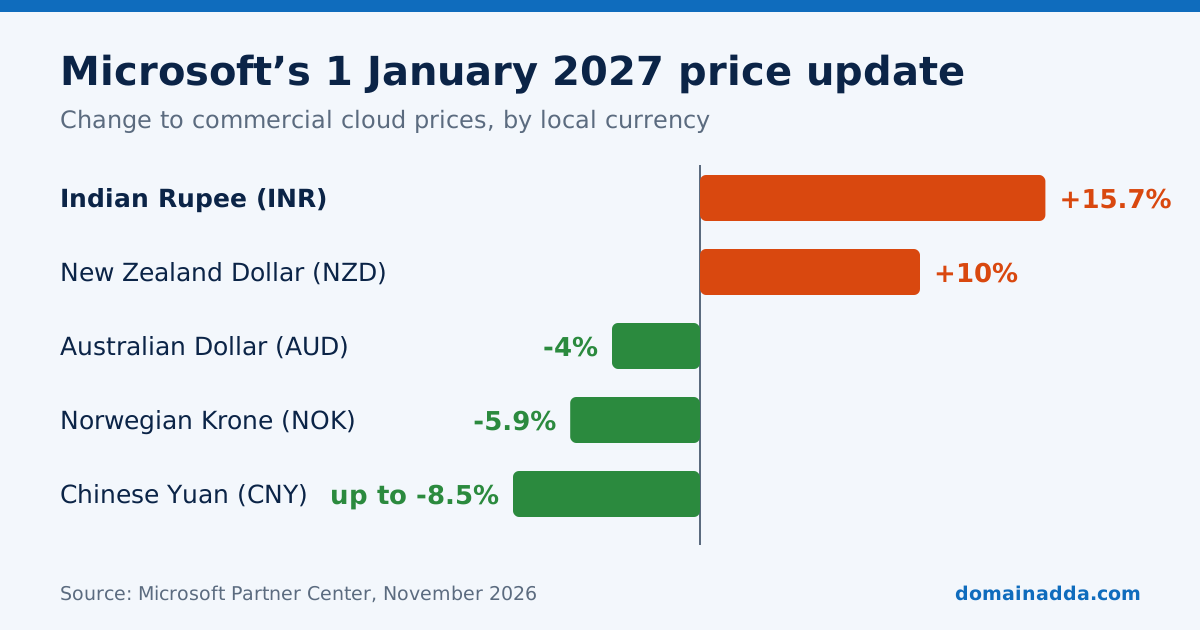
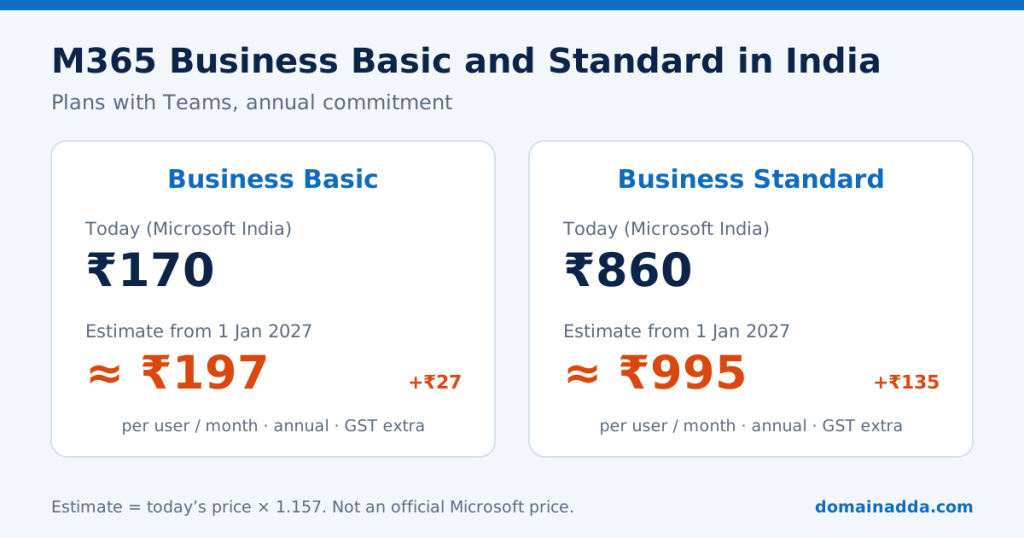
TL;DR: From 1 January 2027, Microsoft is raising commercial cloud prices in Indian rupees by 15.7%. That should reach M365 Business Basic and Standard, although Microsoft hasn’t published new per-plan prices yet. Today, Microsoft lists Business Basic at ₹170 and Business Standard at ₹860 per user per month on an annual commitment, plus GST. Using the 15.7% figure, expect roughly ₹197 and ₹995. Treat those as estimates until your price list or renewal quote confirms them.
Picture a ten-person accounts firm that renews its Microsoft 365 subscription every January. The owner has budgeted the same amount as last year, and then a notice arrives saying the price in rupees is going up by almost a sixth. The software hasn’t changed and neither has the team. Only the exchange-rate adjustment has.
That is what Microsoft announced for India in November 2026. This guide covers what was announced, what it probably means for M365 Business Basic and Standard, what you’ll pay per user, and what to check before your next renewal. Prices below come from Microsoft’s own India pages and its Partner Center announcement, not from any reseller.
| Point | Details |
|---|---|
| What changes | Microsoft commercial cloud pricing in Indian rupees (INR) goes up 15.7% on 1 January 2027. |
| Other currencies | AUD down 4%, CNY down up to 8.5%, NOK down 5.9%, NZD up 10%. |
| Business Basic today | ₹170 per user per month (annual commitment, GST extra). |
| Business Standard today | ₹860 per user per month (annual commitment, GST extra). |
| Next adjustment | Microsoft now adjusts local currency prices once a year, every January, with notice each November. |
What exactly did Microsoft announce?
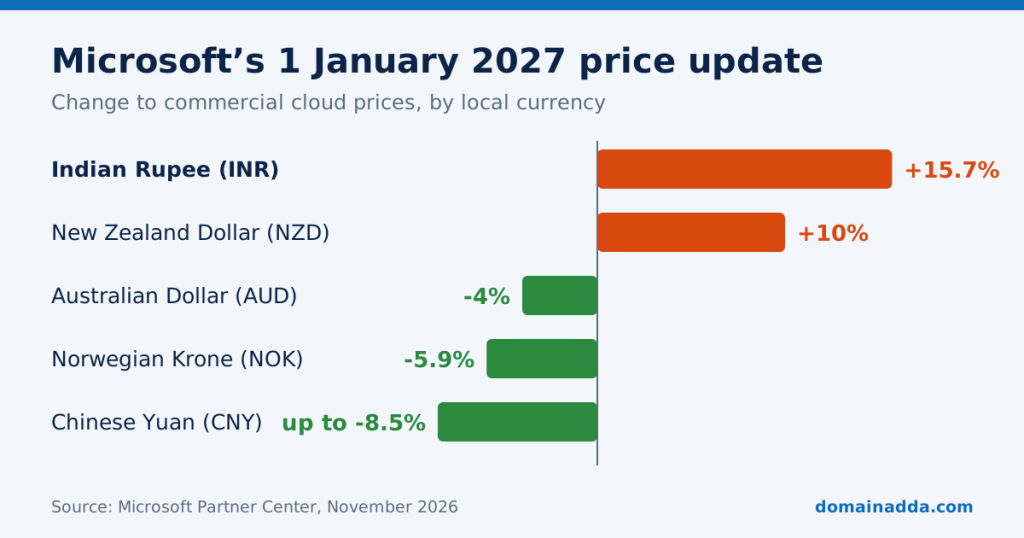
Microsoft’s Partner Center announcement for November 2026 says it will update commercial cloud pricing in select currencies on 1 January 2027, as part of its annual review of local currency pricing. The currencies covered are:
| Currency | Cloud price change | On-premises change |
|---|---|---|
| Indian Rupee (INR) | +15.7% | Up to +20% |
| New Zealand Dollar (NZD) | +10% | +10% |
| Australian Dollar (AUD) | -4% | None |
| Norwegian Krone (NOK) | -5.9% | None |
| Chinese Yuan (CNY) | Up to -8.5% | None |
Microsoft’s stated reason is to bring local prices closer to global levels. It also adds that the percentage for an individual plan can differ slightly from these headline numbers because of rounding. India sits at the top of the table, so Indian customers are the ones who will notice it most.
This isn’t a surprise move in timing, only in size. In July 2026 Microsoft said it would stop adjusting local prices twice a year and move to a single update every January, as Geltec explains. January 2027 is the first one under that system.
Will M365 Business Basic and Standard go up too?
Almost certainly, though Microsoft hasn’t said so plan by plan. The announcement talks about “commercial cloud pricing” and doesn’t list products or new rupee prices, a gap that tBreak also points out. Business Basic and Business Standard are subscription cloud services sold to businesses, so they fall under that heading. The exact new figures will appear when Microsoft updates its India price list.
One more thing worth separating. This is a currency adjustment, not a change to the product itself. Microsoft handles product-level price changes and packaging updates separately, and it made some of those on 1 July 2026. So a plan can be affected by both over a year.
What do M365 Business Basic and Standard cost in India today?
These are the prices listed on Microsoft India’s plans with Teams and plans without Teams pages at the time of writing. All are per user per month, with GST extra.
| Plan | Annual commitment | Monthly commitment |
|---|---|---|
| Microsoft 365 Business Basic (with Teams) | ₹170 | ₹204 |
| Microsoft 365 Business Standard (with Teams) | ₹860 | ₹1,032 |
| Microsoft 365 Business Basic (no Teams) | ₹130 | – |
| Microsoft 365 Business Standard (no Teams) | ₹665 | – |
Business Basic gives you web and mobile versions of Word, Excel, PowerPoint and Outlook, business email, Teams and 1 TB of cloud storage. Business Standard adds the full desktop apps and webinar hosting in Teams. The monthly commitment price is 20% higher than the annual one on Microsoft’s list, which is the price of being able to leave at any time.
What could you pay from January 2027?
Microsoft hasn’t published the new numbers, so the table below is our own arithmetic: today’s official price multiplied by 1.157. It will be close, but not exact, because Microsoft says individual plans can vary slightly.
| Plan (annual commitment) | Official price today | Estimate from 1 Jan 2027 | Extra per user per month |
|---|---|---|---|
| Business Basic (with Teams) | ₹170 | about ₹197 | about ₹27 |
| Business Standard (with Teams) | ₹860 | about ₹995 | about ₹135 |
| Business Basic (no Teams) | ₹130 | about ₹150 | about ₹20 |
| Business Standard (no Teams) | ₹665 | about ₹769 | about ₹104 |
| Business Basic, monthly commitment | ₹204 | about ₹236 | about ₹32 |
| Business Standard, monthly commitment | ₹1,032 | about ₹1,194 | about ₹162 |
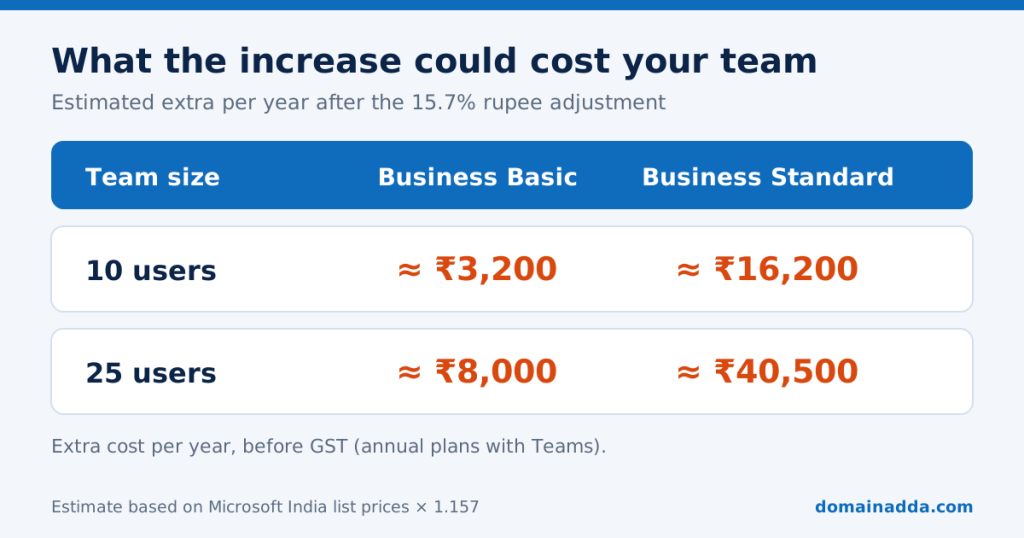
Here is what that means for a whole team over a year, before GST, on the annual plans with Teams:
| Team size | Business Basic: extra per year | Business Standard: extra per year |
|---|---|---|
| 10 users | about ₹3,200 | about ₹16,200 |
| 25 users | about ₹8,000 | about ₹40,500 |
The gap between the two plans also widens. Standard costs ₹690 more per user than Basic today, and about ₹798 more after the adjustment. For a ten-person team, upgrading everyone from Basic to Standard would cost roughly ₹95,800 a year extra, before GST.
Pro Tip: Before you decide whether you can live with Basic, check who actually needs the desktop apps. Often it is only two or three people, and Microsoft lets you mix plans inside the same tenant, up to 300 users in total.
When will the new price actually hit your invoice?
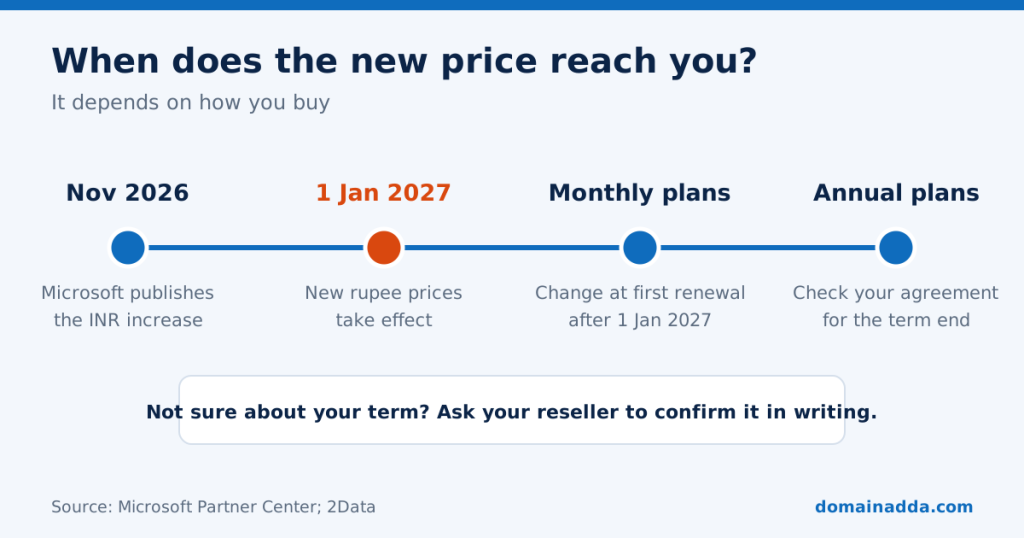
It depends on how you buy. According to 2Data’s explanation of the change, customers on a monthly commitment see the update at the first monthly renewal after 1 January 2027. If you’re on an annual commitment, the usual expectation is that your price is held until the term ends, but Microsoft’s announcement doesn’t spell this out, so check your own agreement or ask your reseller in writing.
Two more things can change the number you see. First, Microsoft’s list price is the starting point, and a reseller’s price can differ. Second, GST is added on top of everything, so budget for it separately.
Should you renew early, or change plans?
A few sensible moves, none of them urgent:
- Find your renewal dates. If a renewal falls in the next few weeks, ask whether renewing now locks today’s price for the full term. Don’t assume it does.
- Count seats. Unused licences cost more after a price rise. Remove anyone who has left before you renew.
- Look at the no-Teams versions. If your team already uses another meeting tool, Business Basic without Teams is ₹130 today, against ₹170 with it.
- Don’t downgrade people who need desktop apps. Saving about ₹800 per user per month isn’t worth it if staff end up working in browser versions of Excel all day.
- Compare alternatives properly. If you’re open to other email and office suites, look at Google Workspace with the same checklist: price, GST, term and what’s included.
If you’re moving a business email address onto Microsoft 365 for the first time, you’ll be adding your domain and editing DNS records. Our explainer on fully qualified domain names covers the terms you’ll run into.
Why did Microsoft move to one adjustment a year?
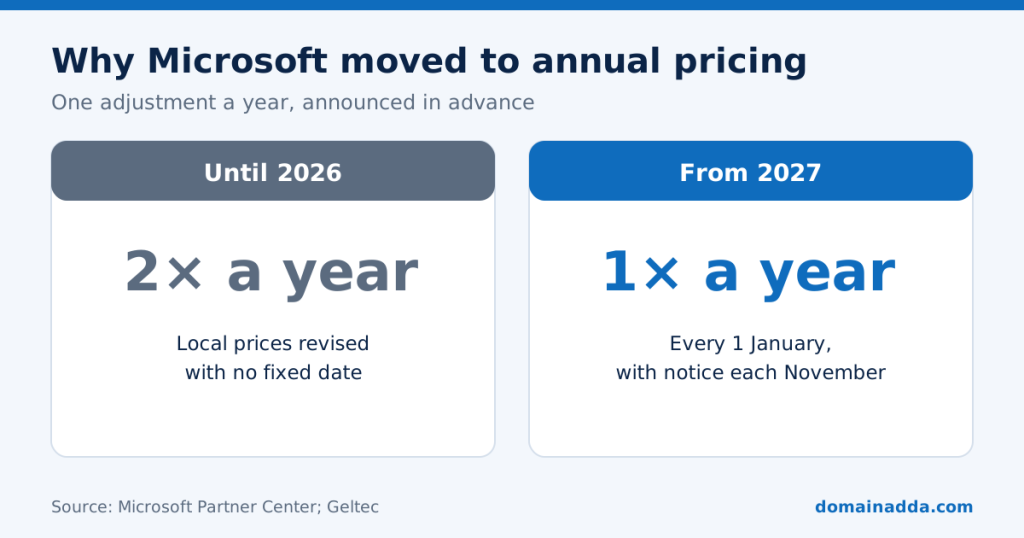
Before this, Microsoft revised local prices roughly twice a year, with no fixed date. Now there is one date, 1 January, and Microsoft says it will publish guidance each November. The next adjustment is due on 1 January 2028, except in what Microsoft calls limited exceptional circumstances.
That gives you predictability, because you can plan a budget around one date. It also takes away flexibility. If the rupee is weak against the dollar on 1 January, the higher price stays for the whole year, and there is no second chance for it to come down in mid-year. So if you buy Microsoft 365 for a team, put a reminder in your calendar for November each year.
My honest take on the 15.7% increase
It’s a big step, and it’s fair to be annoyed. But it helps to look at it in rupees per person. For Business Basic, the extra is about ₹27 per user per month, and for Standard about ₹135. For a small firm that is a real cost, but it’s rarely the difference between keeping and dropping Microsoft 365.
What I would not do is panic-buy or cut people down to a cheaper plan just to hit last year’s budget. Spend the time on the boring things: know your renewal dates, remove unused seats, and ask your reseller what the January price list says before you sign. One written confirmation of how your annual term is priced is worth more than any amount of guessing.
— AVM Cloud Content Strategy Team
Need help with M365 Business Basic or Standard?
If you’d like to buy through a local partner, you can see the plans on our Microsoft 365 page. Microsoft’s own price list is what governs, so ask the team for a quote in writing, including GST and the term, before you commit. They can also help you work out which of your staff really need Standard.
Frequently Asked Questions
When does the Microsoft price increase in India start?
Microsoft’s update for Indian rupee pricing takes effect on 1 January 2027. If you’re on a monthly commitment, expect it at your first monthly renewal after that date.
Is the increase exactly 15.7% on M365 Business Basic and Standard?
Microsoft’s announced figure for INR cloud pricing is 15.7%, but it says individual plans may differ slightly because of rounding. Microsoft hasn’t published the new prices for each plan yet, so use ₹197 and ₹995 as estimates only.
Will my existing annual subscription cost more mid-term?
Microsoft’s announcement doesn’t say. Annual terms are normally held at the price you agreed until they renew, but you should confirm that in your agreement or with your reseller before assuming it.
Does this change affect other countries?
Only five currencies are covered: Indian rupee, New Zealand dollar, Australian dollar, Norwegian krone and Chinese yuan. The Australian dollar, Norwegian krone and Chinese yuan prices go down, while the Indian rupee and New Zealand dollar go up.
Is GST included in the Microsoft 365 price?
No. Microsoft’s India pages list the price as “GST extra as applicable”, so the tax is added on top of the per-user price.
Recommended reads
- Fully Qualified Domain Name (FQDN): How to Use It
- Google Workspace plans from DomainAdda
- Email Marketing and SMTP services from DomainAdda
Sources
- Microsoft Learn: Partner Center announcements, November 2026 (annual currency adjustments)
- Microsoft India: Microsoft 365 Business plans with Teams
- Microsoft India: Microsoft 365 Business plans without Teams
- tBreak: Microsoft commercial cloud pricing rises 15.7% in India
- 2Data: Microsoft moves to once-a-year currency pricing
- Geltec: Microsoft is switching to annual currency-based price updates