

Emerging Bulk SMS Marketing Trends in 2026
TL;DR: In 2026, bulk SMS marketing is moving toward richer RCS messages, AI-assisted personalization, coordinated email and messaging journeys, clearer revenue attribution, and tighter consent governance. Before scaling, improve your customer data, test message variants, track conversions, and meet TRAI requirements so your campaigns do not create compliance problems or wasted spend.
If SMS has been your dependable way to reach customers, you may now feel caught between reliable delivery and rising demands for richer, more relevant conversations. A plain promotional text can still work, but poorly timed or generic messages are easy to ignore. The shift is already visible: RCS usage increased fivefold globally in 2024. This guide helps Indian businesses assess six 2026 trends, choose practical use cases, connect SMS with email and RCS, measure results, and build consent-first workflows under current TRAI rules, ending with a prioritized adoption checklist rather than a prediction list.
| Point | Details |
|---|---|
| RCS Goes Richer | RCS usage increased fivefold globally in 2024, so test rich cards, media, and interactive actions instead of plain text alone. |
| AI Needs Guardrails | Use AI to build segments and message variants, but keep human review for accuracy, tone, and consent. |
| Channels Work Together | Coordinate SMS with email because 85% of consumers who subscribe to brand texts also subscribe to that brand’s emails. |
| Consent Is Strategic | Before scaling commercial messages in India, prepare a registered entity, sender headers, approved templates, and applicable consent records. |
| Measure Business Outcomes | A 2026 benchmark found a 5.5% median SMS campaign click rate, giving you a practical comparison point for testing. |
What is changing in bulk SMS marketing in 2026?
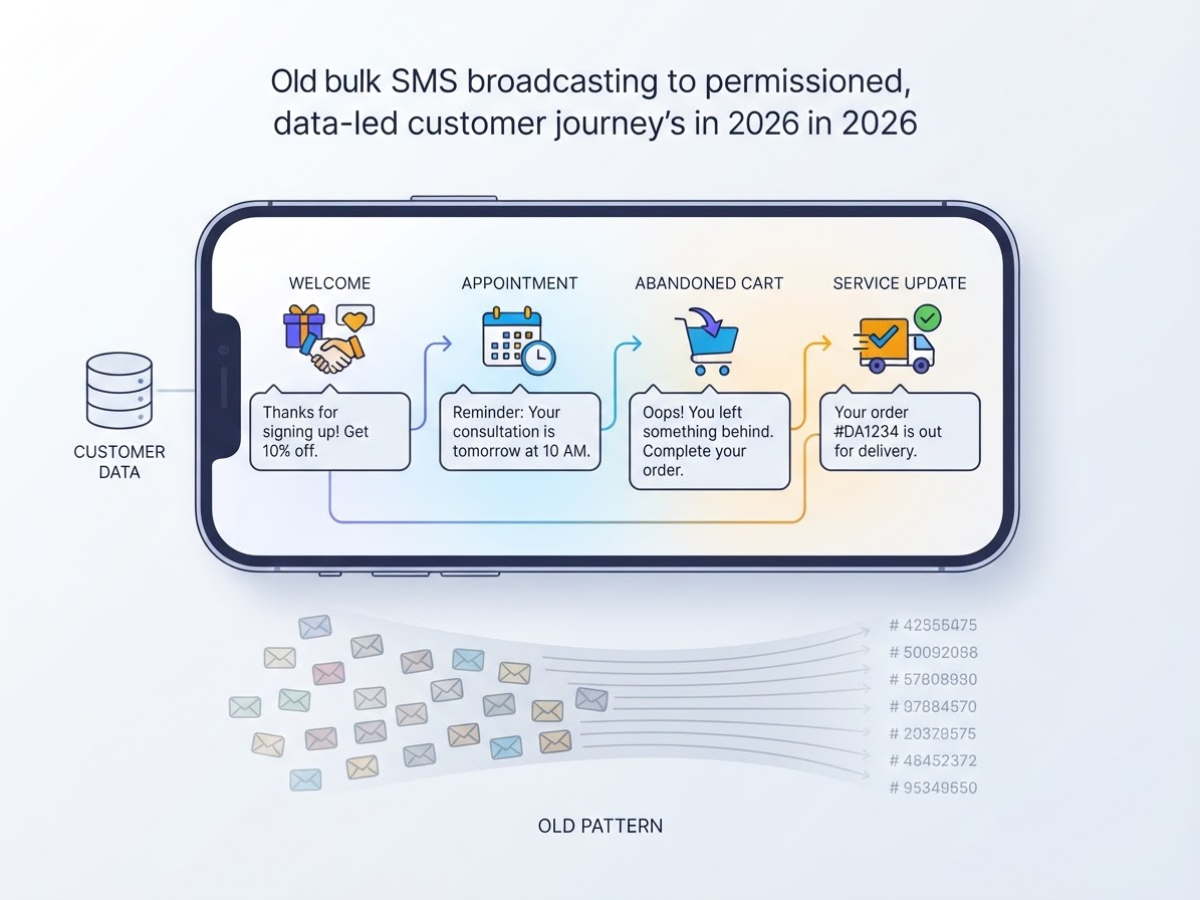
Bulk SMS is moving beyond the old pattern of sending the same promotion to every number on a list. In the accounts I review, the useful shift is toward permissioned, data-led journeys: a welcome message after signup, a reminder before an appointment, a recovery message after an abandoned cart, or a service update triggered by a real event.
The six trends shaping 2026 are:
- RCS: Rich cards, buttons, images, and branded conversations where device and network support them. RCS usage increased fivefold globally in 2024, while North American traffic rose 14-fold year over year, according to Infobip’s analysis.
- AI personalization: Models help choose timing, wording, or the next offer, but poor customer data still produces awkward messages at machine speed.
- Orchestration: SMS works alongside email, push notifications, WhatsApp, and onsite messages instead of operating as an isolated campaign.
- Conversational support: Customers reply, ask questions, confirm appointments, or reach an agent rather than receiving a dead-end alert.
- Measurement: Teams track delivery, clicks, replies, conversions, opt-outs, and revenue by journey, not just the number of messages sent.
- Compliance: Consent records, sender identity, templates, quiet hours, and opt-out handling become part of campaign design, not paperwork added later.
SMS still earns its place when a message must reach someone quickly. A plain text delivery alert or one-time code often does the job better than a rich message that depends on an app, data connection, or compatible handset. RCS is worth testing, but replacing SMS everywhere is mostly vendor hype.
Pro Tip: Classify every trend as either a channel change, a workflow change, or a measurement change before deciding whether it deserves budget.
Technology adoption is not business readiness. Start with consent, usable customer data, a clear use case, and a baseline metric. Then use this practical filter:
| Priority | What belongs here |
|---|---|
| Immediate | Consent cleanup, opt-out handling, triggered alerts, and measurement for existing SMS journeys |
| Test next | RCS on supported devices, AI-assisted copy, and two-way support for a narrow use case |
| Monitor | Fully automated decisioning, ambitious channel replacement, and features without a defined business outcome |
Next, we’ll examine why RCS is attracting attention and where its promise meets everyday delivery limitations.
RCS versus SMS: when should businesses use richer messaging?
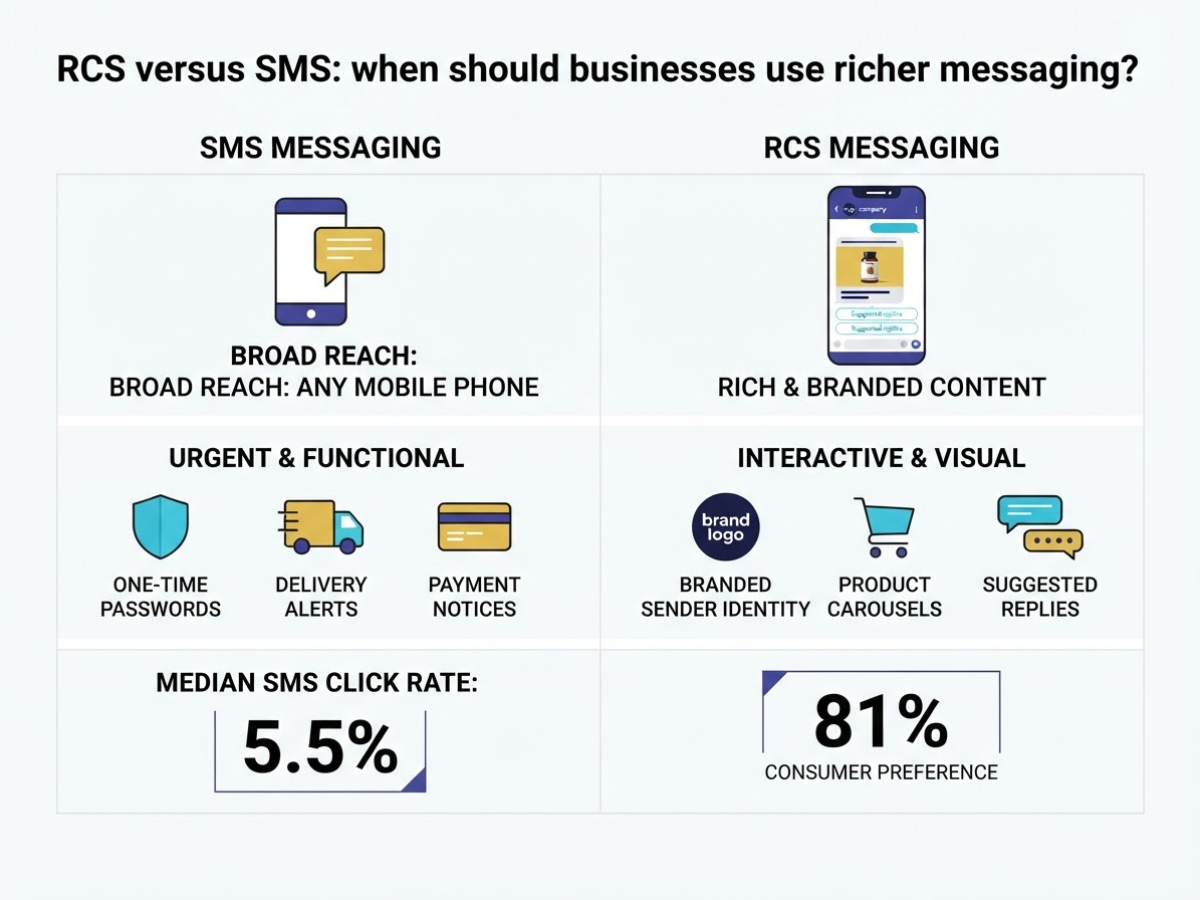
The practical choice depends less on which channel looks newer and more on what the message must accomplish. SMS reaches almost any mobile phone with a signal, so it remains the safer option for one-time passwords, delivery alerts, payment notices, and urgent service updates.
RCS gives you a richer message when the recipient’s phone, carrier, and messaging app support it. You can show a branded sender identity, images, product carousels, buttons, and suggested replies instead of asking customers to type a response. A 2026 consumer survey found that 81% of surveyed consumers preferred RCS over SMS for brand communication, but preference does not guarantee delivery or action.
| Factor | SMS | RCS |
|---|---|---|
| Reach | Broad reach across supported mobile networks and basic phones | Limited by device, carrier, app, region, and connection support |
| Creative options | Plain text, links, and occasional media support through related formats | Branded identity, images, carousels, buttons, and suggested replies |
| Cost considerations | Usually simpler to price and forecast per message | May cost more or use different rates, especially for rich content and conversations |
| Best fit | OTPs, alerts, reminders, and time-sensitive notices | Product discovery, appointment choices, menus, and guided support |
| Main risk | Limited space and fewer ways to guide a customer | Feature support varies, and a rich experience can fail or fall back |
Do not treat RCS as an all-or-nothing replacement. Set a fallback rule before launch: if the recipient cannot receive the rich message, send a concise SMS with the essential information and one working link. Test that fallback separately because broken buttons, truncated copy, and duplicate sends are common annoyances during rollout. Our guide to avoiding common bulk SMS marketing mistakes covers the kind of sending errors that can quietly damage response rates.
Pro Tip: Use RCS for messages where visual context reduces friction, but keep SMS as the fallback for time-sensitive or universally reachable notifications.
I would pilot the change with one audience, one action, and one control group. For example, send an RCS product carousel to opted-in returning customers, measure completed purchases, and keep 10% on the equivalent SMS as the control. Check delivery, device support, fallback rate, clicks, conversions, opt-outs, and cost per completed action for at least two send cycles before moving more traffic.
RCS adoption grew fivefold globally in 2024, yet the right next step is still a controlled test, not a wholesale switch. Use those results to decide which customer journeys deserve richer messaging next.
How to apply AI personalization without losing relevance
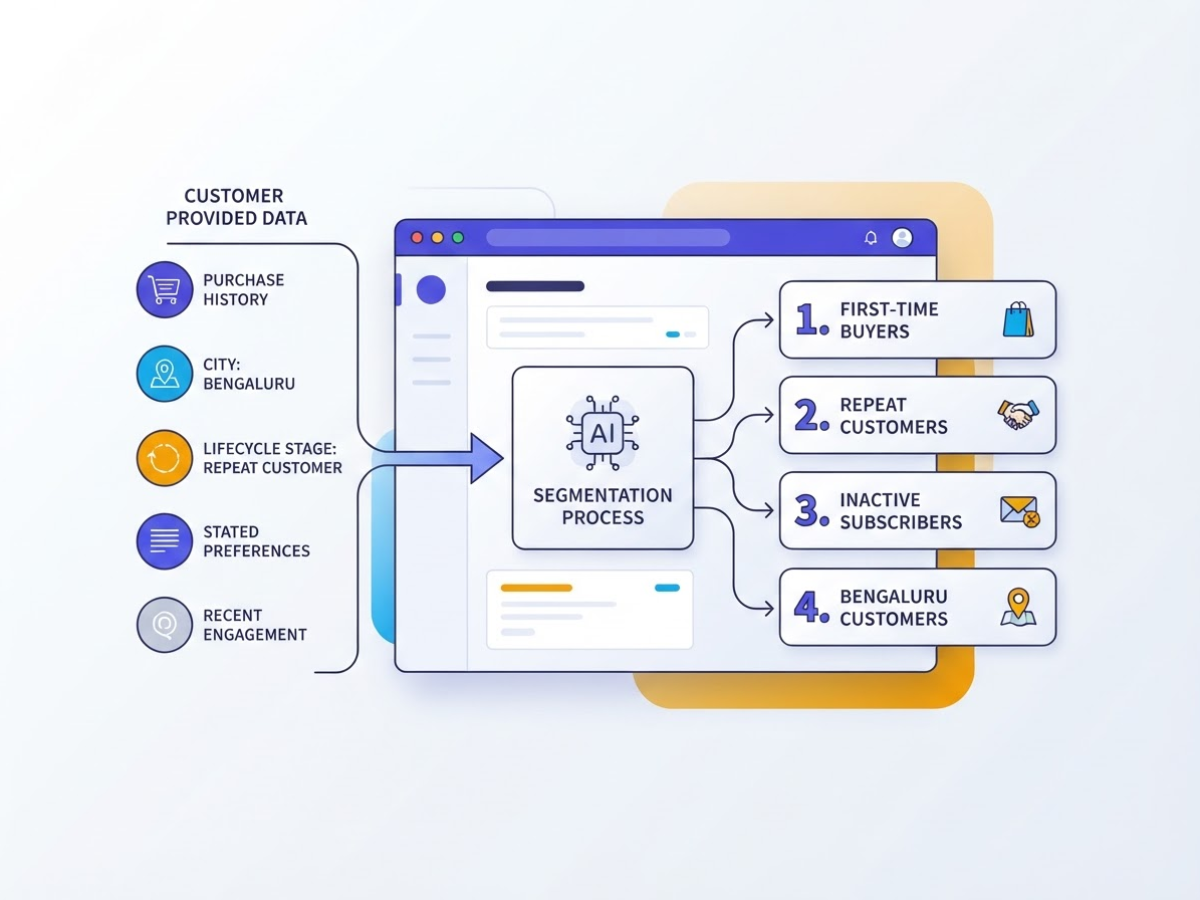
The safest AI workflow starts with data your customer knowingly gave you, not guesses about who they are. At AVM Cloud, we would begin with purchase history, city or service area, lifecycle stage, stated preferences, and recent engagement. Avoid buying extra attributes just because a model can process them.
- Build a few useful segments. Start with three to five groups, such as first-time buyers, repeat customers, inactive subscribers, Bengaluru customers, or students who viewed an admissions page. One-to-one personalization sounds impressive, but it often produces thin assumptions and awkward copy. A retail brand in India might send a saree offer to recent ethnicwear buyers, while an education institute could separate enquiry leads from students who already booked a counselling call.
- Give AI a narrow job. Ask it to suggest three message variants, translate approved copy into Hindi or another local language, propose send-time hypotheses, or flag unusual drops in clicks. Do not let it invent discounts, product availability, fees, deadlines, testimonials, or health claims. A human should approve every message, audience, link, and language version before sending.
Pro Tip: Personalize the offer and timing before personalizing the person’s name; relevance usually comes from context, not cosmetic tokens.
- Set hard campaign rules. Document which sensitive fields AI cannot use, such as health conditions, financial difficulty, caste, religion, or inferred income. Add frequency limits, an opt-out route, approved offer tables, and a rule against unsupported claims. Indian senders also need registered sender details, templates, and consent processes under TRAI’s commercial SMS framework. These checks feel slow when a sale is about to end, but one bad message can create complaints and block future delivery.
- Test one change at a time. Keep the segment and offer fixed while comparing two openings, then test timing in a separate experiment. Track clicks, conversions, opt-outs, revenue per recipient, and complaints, not just delivery. For a local salon in Pune, compare a Tuesday afternoon appointment reminder with a Saturday morning version; for a home-repair service, test a neighbourhood-specific call to action rather than changing the copy and audience together.
- Review the misses. A coaching centre may find that English copy gets clicks but Hindi copy produces more completed forms. An appointment-based clinic may discover that a reminder sent 24 hours ahead reduces no-shows, while a second promotional message annoys people. Keep a simple log of winning variants, failed assumptions, complaints, and exclusions, alongside these common bulk SMS marketing mistakes.
With this workflow in place, your next priority is deciding how often each segment should hear from you without exhausting its attention.
Build an omnichannel journey instead of sending isolated blasts
During campaign audits, I often find three teams sending three versions of the same message. The customer receives an email, an SMS, and an app notification after already buying. That is not omnichannel marketing. It is a coordination failure.
Give each channel one job before you write the copy:
| Channel | Best use |
|---|---|
| Product detail, terms, education, and longer instructions | |
| SMS | Urgency, reminders, delivery updates, and short calls to action |
| Website or app | Checkout, booking, account changes, or other completion steps |
| Customer support | Questions, exceptions, refunds, and issue resolution |
A simple promotion might work like this: send an email at 9 a.m. with the offer and product details, then send an SMS at 4 p.m. only to people who opened the email but did not purchase. Link the text to a mobile-first landing page, not a crowded desktop homepage. Add separate campaign parameters to the email and SMS links so you can see which channel produced the visit and the sale.
Suppression rules prevent the most irritating mistake: reminding someone to act after they have already acted. Suppress the SMS as soon as the purchase, booking, form submission, or app event arrives. Also set a frequency cap, such as one promotional SMS per customer in 24 hours, and stop the sequence when a customer opts out or support opens a related case.
Before launch, document these five fields in the campaign brief:
- Trigger event and delay, such as “cart abandoned for 60 minutes”
- Eligible audience, consent status, location, and exclusions
- Channel owner and the system that confirms conversion
- Exit conditions, including purchase, reply, opt-out, or failed delivery
- Fallback action if the link, app, or payment page fails
For help requests, SMS should not merely push another offer. Webex research found that 62% of surveyed customers preferred messaging for business help or information, compared with 33% who preferred a phone call during business hours. Send a delivery exception, appointment change, or “reply HELP” route when a quick answer matters.
Use standalone SMS when the message is time-sensitive and self-contained, such as a one-time password, appointment reminder, outage notice, or last-minute schedule change. For broader promotions, integrating bulk SMS with email marketing gives each channel room to do its job without making customers repeat the same step. With those rules set, you can judge which messages deserve richer formats and which should stay plain.
Consent-first delivery becomes a competitive advantage
The first compliance failure usually happens before anyone writes the SMS. Indian businesses sending commercial messages must complete the required sender, header, content-template, and consent steps under TRAI’s sender guidance. That means registering as a Principal Entity, securing a header, registering each content template, and transmitting the correct sender and template identifiers with the message.
Consent cannot live in a vague CRM field labelled “subscribed.” Keep the acquisition source, timestamp, stated purpose, consent wording or template, phone number, and current revocation status. If a customer agreed to delivery updates, that does not automatically authorise a credit-card offer. Your records need to show the difference when a carrier, regulator, or customer challenges a send.
Opt-outs also need operational handling, not just a sentence at the end of the message. Process STOP requests quickly, honour blocked preferences, cap promotional frequency, and synchronise suppression lists across your CRM, SMS provider, and support tools. A stale export can put a person back into a campaign after they have already withdrawn consent, which is both embarrassing and avoidable.
Common mistakes I still see in campaign reviews:
- Sending promotional traffic through an unregistered telemarketer or an unapproved route.
- Using a misleading sender identity, such as a familiar brand name the recipient cannot verify.
- Changing an approved template by adding a new offer, shortened link, or product claim at send time.
- Buying a list and treating a vendor’s “permission-based” label as proof of consent.
- Removing opt-outs from one campaign list but leaving them active in another database.
The enforcement risk is no longer theoretical. TRAI reported 7,31,120 notices to unregistered telemarketers during 2025, along with communication restrictions and a large rise in spam complaints. The 2025 TCCCPR amendment applies across India and clarifies consent and commercial communication, including how fully blocked preferences can stop messages that require explicit consent.
Before every send, I would require this short sign-off:
- Legal review completed for the offer and audience.
- Every number is eligible, consented, and absent from the suppression list.
- The live copy matches the registered template and sender identity.
- Links resolve to a safe, recognisable destination.
- Opt-outs, blocked preferences, and delivery failures will update immediately.
This checklist adds a few irritating minutes, but rebuilding trust after a complaint takes far longer. Once consent is dependable, the next challenge is controlling message quality and timing across the channels your customers actually use.
Measure the trends that actually improve revenue
Revenue rarely disappears at the send button; it disappears between the click and the cash register. When I review campaign reports, I start with a funnel that follows the customer from delivery through business impact, not a headline click rate.
Track delivered messages, clicks, conversion rate, revenue per recipient, repeat purchase rate, unsubscribes, spam complaints, and support outcomes such as replies resolved, escalations, and ticket volume. A campaign that sells well but triggers complaints or floods your support queue may be borrowing revenue from next month.
Use campaign-level tracking links with consistent UTM values, unique discount codes, event callbacks for delivery and conversion events, and CRM or ecommerce attribution wherever your tools support it. Keep the setup boring and consistent. A different link for every campaign is more useful than an elaborate dashboard nobody trusts.
Use this review timeline:
- Before launch: Record the audience, consent source, message type, offer, channel cost, expected conversion, and baseline repeat-purchase rate. Set a profit target, not just a click target.
- Within 24 hours: Check delivery, click-through, conversion, revenue per recipient, failed links, replies, and early opt-outs. Separate RCS delivery from SMS fallback instead of blending both into one result.
- At seven days: Compare RCS against SMS fallback, personalized copy against generic copy, and coordinated SMS-email journeys against single-channel sends. Hold audience size, offer, and timing as steady as you can. Otherwise, you are comparing noise.
- After the buying window: Review repeat purchases, complaints, unsubscribes, support contacts, total cost, attributed revenue, and consent records. Write down the next test before the report gets forgotten.
Benchmarks must match the message. A delivery reminder, abandoned-cart message, product launch, and win-back offer should not share one “good” click rate. SlickText’s 2026 benchmark puts the median SMS campaign click rate at 5.5%, but that figure cannot tell you whether your landing page converts or your margin covers the send cost.
A 12% click rate can still lose money when the offer is weak, the page loads poorly, or the audience is poorly matched. Conversely, a modest click rate can produce strong revenue from a high-intent segment. For a practical view of channel economics, compare your results with SMS and email campaign attribution, then let profit, retention, and customer effort decide which 2026 trend stays.
My honest take on 2026 bulk SMS trends
I have seen businesses rush toward RCS, AI-written copy, and predictive send times before fixing the basics. My contrarian view is simple: many small businesses should delay AI personalization until their consent records, customer data, landing pages, and conversion tracking work reliably. A beautifully generated message cannot rescue a weak offer, a broken form, or an unregistered sender.
I would keep SMS as the dependable reach layer in 2026, then make newer channels earn their place. Start with one high-value journey, such as an abandoned enquiry or appointment reminder. Record its current conversion rate, delivery rate, replies, and opt-outs before testing richer content or different send times. This feels slower than buying every new feature, but it exposes what actually moves revenue.
For Indian businesses, compliance should shape the campaign before you write the template. Consent wording, audience rules, sender registration, quiet hours, and platform support can limit your options later, especially when teams treat compliance as a final legal check. I have also seen automation create more work when customer fields are incomplete or opt-outs fail to sync.
The likely winners will send fewer, more useful messages and learn from complaints as closely as conversions. SMS, email, AI, and RCS can coexist, but none deserves a place merely because it is fashionable.
— AVM Cloud Content Strategy Team
Turn 2026 SMS trends into a practical campaign workflow
If you are tracking the 2026 SMS trends, test one useful workflow instead of sending a discount blast and hoping for replies. When I help businesses plan campaigns, the weak points usually appear before the send: unclear permission, a sender setup nobody has checked, a crowded template, or a landing page that loads poorly on mobile. Measurement often gets added too late, which makes a modest campaign look like a failure.
DomainAdda gives you a practical place to review those decisions alongside affordable SMS marketing, email marketing, domains, and web services. Start with the step-by-step bulk SMS setup guide and check your audience, message, page, and success metric before sending. If the workflow still feels awkward, contact the AVM Cloud team to discuss a campaign approach suited to your audience and compliance needs.
Frequently Asked Questions
Is bulk SMS marketing still effective in 2026?
Yes, when you have permission, a relevant offer, and one clear action for the reader. A 2026 benchmark reported a 5.5% median SMS campaign click rate, although results can fall quickly when the list is outdated or the message feels unrelated.
What is the difference between RCS and bulk SMS?
Bulk SMS sends short text messages to almost any mobile phone, while RCS can add branded profiles, images, cards, buttons, and interactive replies on compatible devices. In practice, support RCS for customers who can receive it, but keep SMS as the fallback because RCS coverage is not universal.
How often should a business send promotional SMS messages?
There is no fixed number that works for every business, since customer expectations and consent terms differ by industry. Start with a documented cap, such as 4 promotional texts per month, then cut back when opt-outs or complaints rise instead of chasing clicks alone.
How can I get customers to opt in to marketing text messages?
Use a clear, voluntary call to action on your website, checkout, forms, store materials, or service conversations that states what customers will receive and how often. Record the consent source and timestamp, then make opting out as simple as replying “STOP” within 1 message.
Can bulk SMS and email marketing be used together?
Yes, and the pairing works best when each channel has a separate job: email can explain the details, while SMS can send a reminder or time-sensitive follow-up. Set shared audience rules and suppression logic, because receiving the same promotion through 2 channels in one day feels careless rather than helpful.
Recommended reads
- Integrating Bulk Sms With Email Marketing
- Avoiding Common Bulk Sms Marketing Mistakes
- Why Sms Marketing Is Still Popular In India Even With New Rules
- Step By Step Bulk Sms Setup With Domainadda
Sources
- Infobip research reveals fivefold adoption of RCS in 2024Infobip’s Messaging Trends Report highlights the impact of Apple’s RCS support and the growing dominance of conversational messaging
- Survey Finds 65% of Consumers Made a Purchase From a Brand’s Text Message in 2025
- SMS Benchmark Report 2026: The State of SMS Marketing Engagement
- SMS Marketing ROI: Benchmarks, Measurement & Improvement Tips
- Consumers want different content on email and SMS
- Research Report 6
- Advice to Senders | Telecom Regulatory Authority of India | Government of India
- Microsoft Word – Final English TCCCPR Regulation_12.02.2025_2.00 pm
- FOR IMMEDIATE RELEASE
- Information Note to the Press (Press Release No.150/2025)
- CTIA Updates Messaging Principles and Best Practices to Further Protect Consumers From Unwanted Messages While Supporting the Growth of Messaging