

How AI Is Transforming Bulk SMS Campaigns
TL;DR: AI is changing bulk SMS campaigns by finding useful audience segments, tailoring messages, choosing better send times, automating follow-ups, testing variations, and turning delivery data into practical decisions. It can make campaigns more relevant and less wasteful, but you still need consent, accurate customer data, human approval, and a clear opt-out process before sending even a single message.
If you have ever sent one SMS to a mixed customer list, you know the frustration: some people need a reminder, others need an offer, and a generic message fits none of them well. AI is changing bulk SMS campaigns by helping you segment audiences, tailor copy, predict timing, and measure what actually drives clicks instead of forcing every contact through the same workflow. That shift is already mainstream: 97% of surveyed businesses planned to use AI in customer communications in 2025. In this guide, I’ll cover practical AI use cases, campaign setup, channel selection, personalization, testing, compliance, risks, and applying these improvements with DomainAdda’s SMS marketing tools.
| Point | Details |
|---|---|
| Smarter Segmentation | AI can group contacts by behavior, location, purchase history, or engagement instead of treating all 10,000 subscribers alike. |
| Better Personalization | AI can create message variations from customer context while keeping brand voice, length, and offer rules consistent. |
| Optimized Timing | Predictive models can recommend send windows from engagement patterns, but you should validate them against local quiet-hour rules before scheduling a campaign. |
| Human Oversight | Review AI-generated copy, targeting, links, and exclusions before sending because one incorrect offer or recipient group can damage customer trust. |
| Measurable Improvement | AI can track delivery, clicks, conversions, opt-outs, and revenue so you judge a campaign by results instead of send volume alone. |
What Does AI Change in Bulk SMS Marketing?
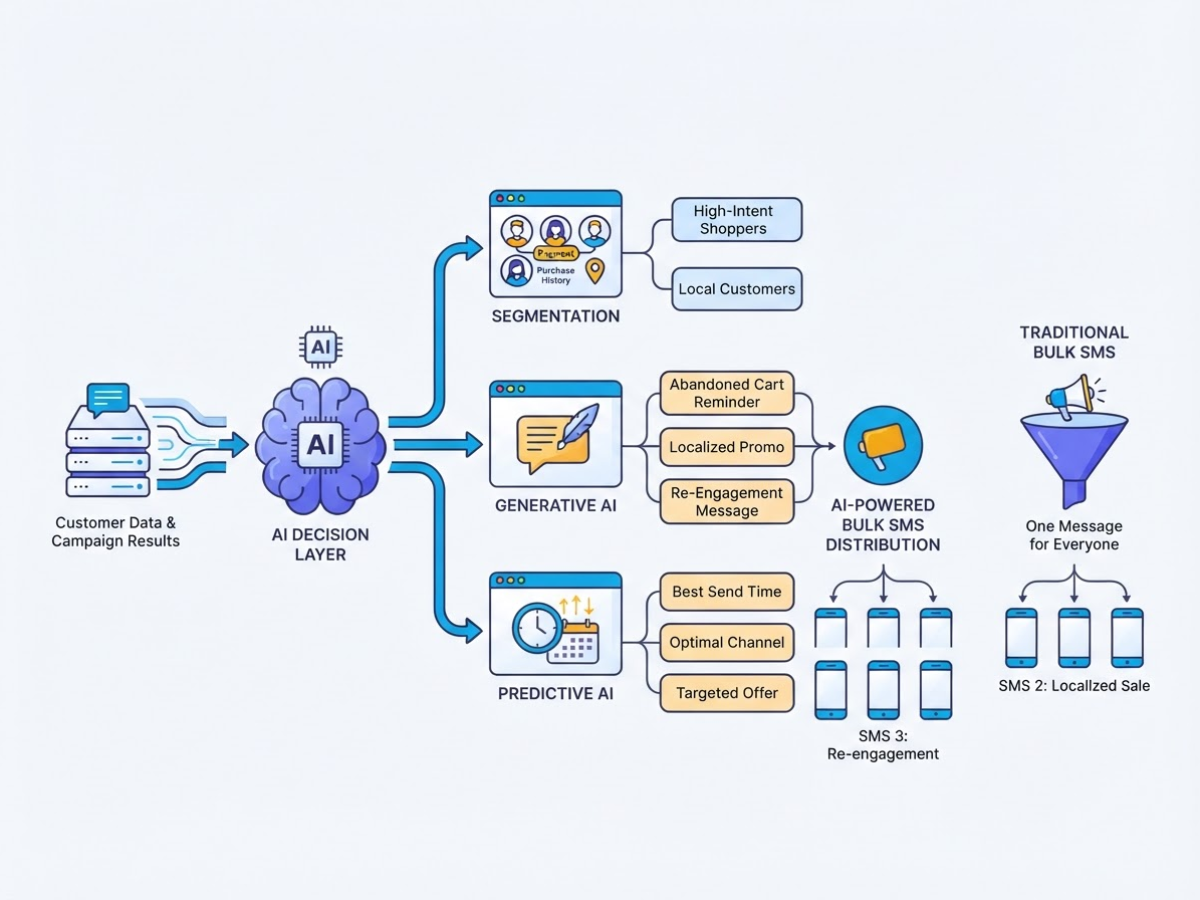
AI-powered bulk SMS is not simply a faster way to send the same message to more people. Traditional bulk SMS usually means uploading a contact list, writing one message, choosing a send time, and broadcasting it to everyone. AI adds a decision layer: it studies customer data and campaign results, then helps decide who should receive which message, through which channel, and when.
When I review campaign setups, the biggest mistake is treating AI as an automatic copy machine. It has several distinct jobs:
- Segmentation: Groups customers by purchases, location, activity, or likely intent.
- Generative AI: Drafts variants for an abandoned-cart reminder, localized promotion, or re-engagement message.
- Predictive AI: Estimates the best send time, audience, offer, or channel for each customer.
- Automation: Triggers appointment alerts, delivery updates, and follow-ups from customer actions.
- Analytics: Finds patterns in delivery, clicks, replies, conversions, unsubscribes, and failed campaigns.
| Traditional bulk SMS | AI-assisted bulk SMS |
|---|---|
| One message for a broad list | Different messages for defined customer groups |
| Fixed send time | Predicted timing based on past behavior |
| Manual follow-up | Automated reminders and response paths |
| Basic delivery reports | Analysis of conversions, churn signals, and channel results |
For example, a retailer might send an abandoned-cart reminder only to shoppers who left items within the last 24 hours. A clinic can automate appointment alerts, while a regional store can promote winter products to customers in colder locations. An inactive subscriber might receive a softer re-engagement offer instead of the same discount sent to recent buyers.
Generative AI writes or rewrites the copy. Predictive AI makes decisions about timing, audience selection, and whether SMS, email, WhatsApp, or another channel is more appropriate. Confusing these roles leads to poor campaigns, especially when generated text sounds polished but targets the wrong people.
Pro Tip: Start with one narrowly defined campaign objective before adding AI features; complexity without a clear objective makes results harder to interpret.
The technology is becoming mainstream: 97% of surveyed businesses planned to use AI in customer communications during 2025. Still, AI does not replace strategy, consent checks, suppression lists, or human review. It can select an unsuitable audience, invent a claim, or send a reminder at an awkward hour. Next, the focus shifts to the specific AI features that make these decisions possible.
How to Build an AI-Assisted Bulk SMS Campaign
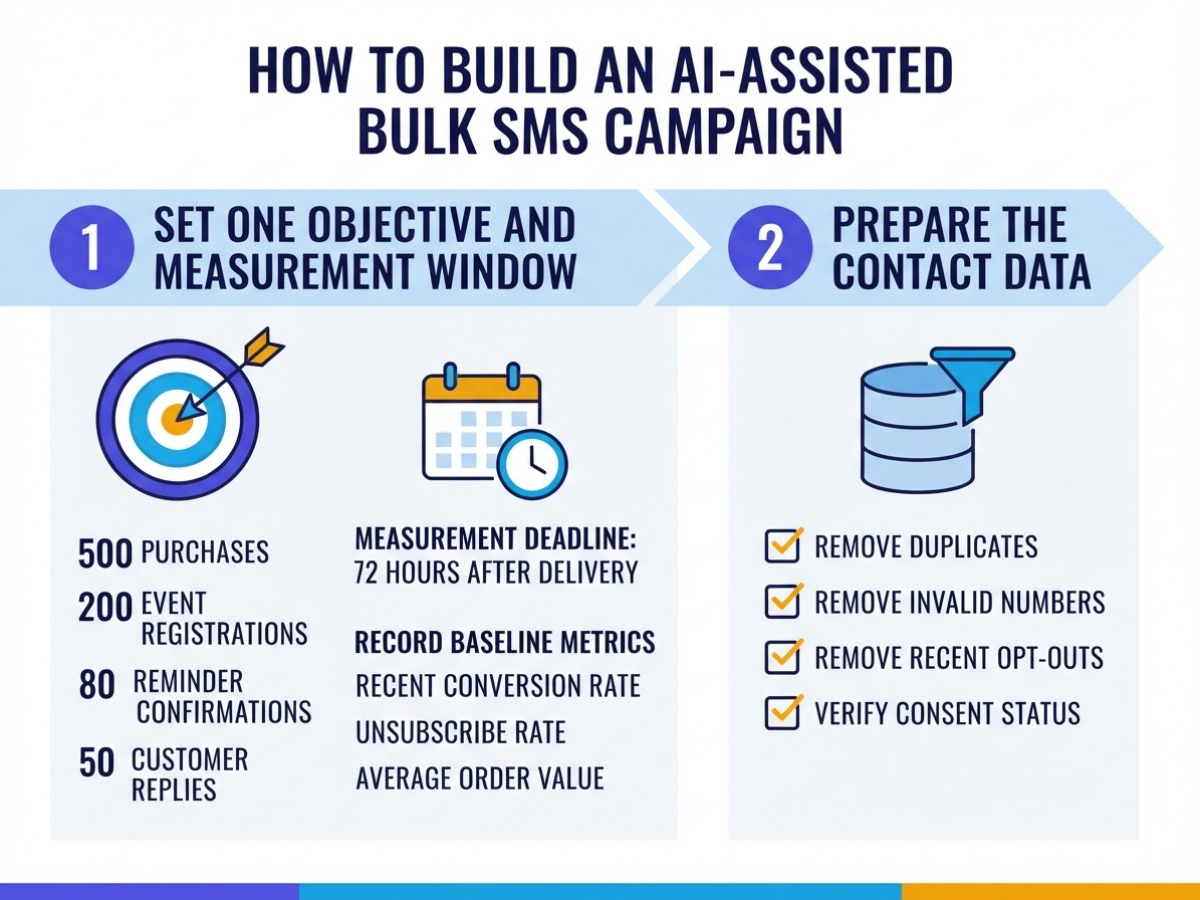
Start with the business result, not the AI feature. When I plan campaigns for clients, the cleanest briefs name one target action: 500 purchases, 200 event registrations, 80 reminder confirmations, or 50 customer replies. A message that tries to sell, educate, and collect feedback at once usually produces muddy reporting.
- Set one objective and measurement window. Choose the primary conversion, define the tracking link or reply keyword, and set a deadline such as 72 hours after delivery. Record the baseline too, including recent conversion rate, unsubscribe rate, and average order value, so a better click rate does not hide weaker revenue.
- Prepare the contact data. Remove duplicates, invalid numbers, recent opt-outs, and contacts without the required consent status. Classify the remaining records by location, lifecycle stage, past engagement, and customer value. A customer who bought last week should not receive the same offer as an inactive lead, and mixing those groups is one of the fastest ways to create complaints.
- Give the AI a locked brief. Include the audience, offer, tone, character limit, approved link, expiry date, sender name, and exact opt-out wording. Add a short “do not claim” list, such as guaranteed savings, medical outcomes, or stock availability unless those statements have been verified. Businesses cite privacy and security as a leading AI concern, so avoid pasting raw customer histories or unnecessary personal data into an unapproved tool.
- Generate several drafts, then edit like a human. Ask for three to five variants with different openings or calls to action, not five versions that merely swap adjectives. Before approval, check every personalization field, price, discount, URL, date, spelling, and opt-out instruction on an actual phone. AI will confidently invent a benefit or break a link, and a two-minute review is cheaper than explaining that mistake to 10,000 recipients.
A useful reference point is that 97% of surveyed businesses planned to use AI in customer communications in 2025. That adoption does not make unattended copy safe.
Pro Tip: Keep a fixed control group out of AI-driven optimization so you can compare incremental impact instead of only reporting improvement against the previous campaign.
- Let AI suggest segments and send times. Use engagement history, location, lifecycle stage, and customer value as inputs, then reject recommendations that conflict with consent or local quiet hours. Timing tools are useful, but they are not magic; a message sent at the predicted “best” hour can still annoy someone who received three campaigns yesterday. For practical setup checks, review this step-by-step bulk SMS setup guide.
- Run a small test before release. Send the approved variants to a limited, representative group, such as 1% of the eligible list. Confirm delivery, rendering, link tracking, personalization, replies, and opt-outs for at least 15 to 30 minutes before authorizing the full send. Fix failures first, even if that means missing an arbitrary launch time.
- Join the data after sending. Bring delivery, clicks, conversions, unsubscribes, complaints, revenue, and reply outcomes into one report. Compare each variant and segment against the control group, then document what to change next time. The next campaign should inherit tested facts, not an AI-generated guess.
AI Personalization vs Traditional SMS Blasts
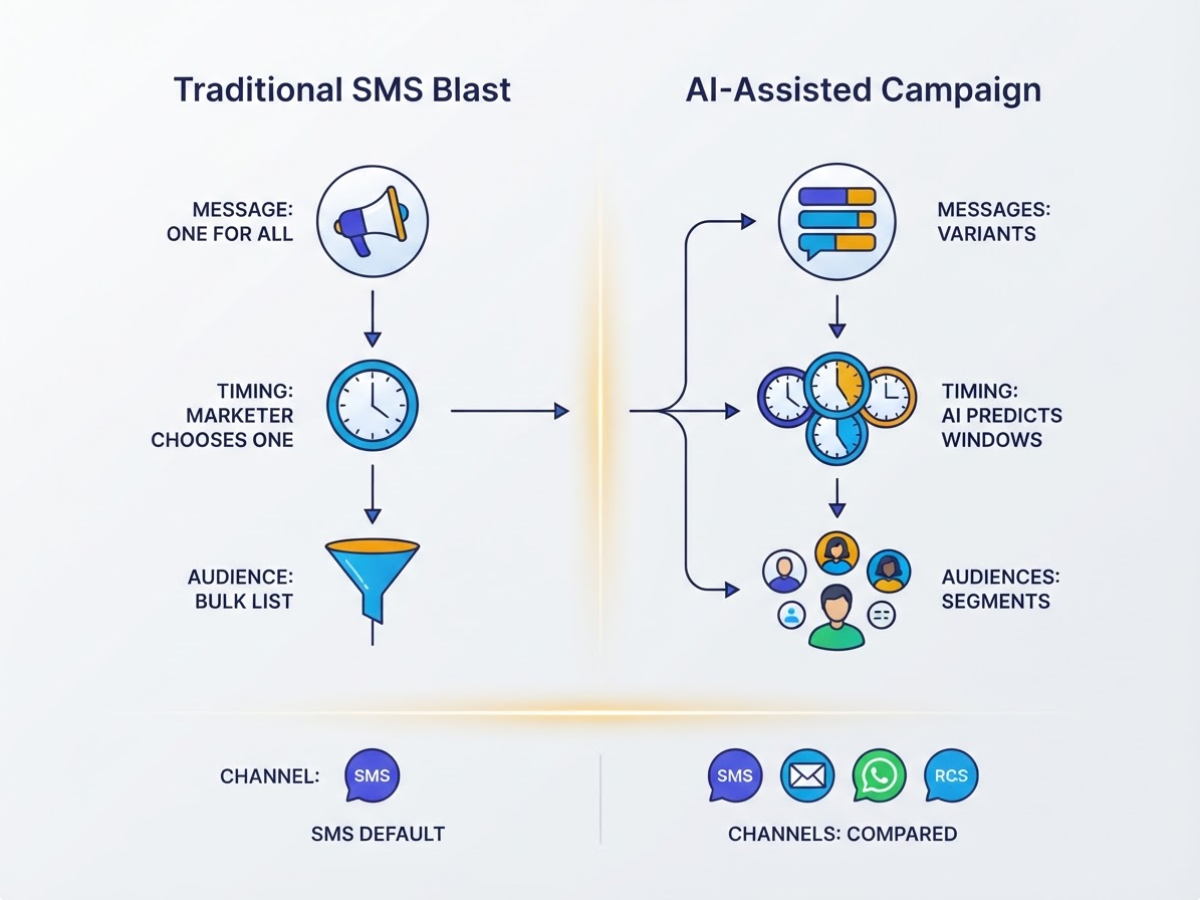
The old bulk SMS workflow starts with one approved message, one audience list, and one send time. I have seen that approach work perfectly for a power outage notice, then fail badly for a retail promotion sent to customers with very different buying habits.
| Campaign task | Traditional SMS blast | AI-assisted campaign |
|---|---|---|
| Message | One version for everyone | Variants based on behavior, location, purchase history, or lifecycle stage |
| Timing | A marketer chooses one schedule | The system predicts a useful send window for each segment or recipient |
| Reporting | Delivery, clicks, and replies for the whole campaign | Performance by segment, variant, channel, and attributed conversion |
| Channel | SMS is selected by default | SMS is compared with email, WhatsApp, or RCS |
A broadcast might send “Sale ends tonight” to every subscriber. An AI workflow could show a first-time buyer a welcome offer, a lapsed customer a win-back message, and a customer near a store a location-specific promotion. That relevance is useful only when your customer records are accurate. Duplicate profiles, stale locations, and missing consent create embarrassing personalization, not better marketing.
Scheduling shows a similar divide. Manual timing is quick and easy to audit, while predicted send windows can account for a customer’s past opening behavior, time zone, and recent activity. Still, rules must override the model: do not send at 2 a.m., during a restricted quiet period, or after a customer has opted out. A prediction is not permission.
For measurement, a basic blast tells you whether the campaign produced 4,000 clicks or 200 replies. AI-assisted reporting can show that one offer worked for recent purchasers in Pune but irritated inactive subscribers in Delhi, then connect those responses to purchases. That requires event tracking, CRM or commerce integration, data cleaning, approval workflows, and someone willing to review the results. Those costs are easy to underestimate.
Pro Tip: Do not personalize merely because a tool allows it; a useful benefit, relevant timing, and clear recipient expectation matter more than inserting a first name.
Use a simple broadcast for urgent service notices, delivery disruptions, or identical compliance-approved alerts. For campaigns that need channel judgment, AI models can help select between SMS, email, WhatsApp, and RCS for an individual customer, rather than treating SMS as the automatic choice. For everyday scheduling, a clear bulk SMS timing plan may be all you need.
The next decision is practical: identify which campaign inputs your team can trust before adding AI to the workflow.
What Results Can AI Improve?
AI does not guarantee more sales. It gives you better odds when your consent records, purchase history, offer rules, and event tracking are clean. I treat delivery rate as the floor, not the result: measure delivered messages and failed sends first, then engagement through clicks, replies, and response rate; conversion through signups and purchases; revenue through attributed sales and revenue per recipient; retention through repeat purchase and opt-out rate; and customer experience through complaints, negative replies, support tickets, and failed personalization.
Use this measurement timeline before calling a campaign successful:
- Before launch: Record a baseline for each metric from comparable sends, define the audience, and set an attribution window, such as 72 hours for a flash sale or 30 days for a welcome journey.
- During the test: Keep one control group or an identical non-AI version. Compare AI-assisted signup prompts, send timing, message variants, and journeys against that control.
- After the window closes: Check incremental purchases and revenue, then review opt-outs, complaints, invalid data, wrong names, irrelevant recommendations, and negative responses. Efficiency also matters: track hours saved, messages needed per conversion, and campaign cost per purchase.
That control is essential. A lift may come from a stronger discount, holiday demand, a different audience, email exposure, or a change in channel mix rather than AI. Run the test long enough to cover normal buying patterns, and avoid changing the offer halfway through.
Vendor-reported results show what is possible, not what you should promise. In a 60-day controlled test, Natural Life reported 31% more SMS signups, 39% more purchases, and 38% more revenue with Attentive’s AI Grow. In an 84-day 50/50 test, Levenger reported 33% more SMS signups, 38% more welcome purchases, and 39% more welcome-journey revenue. Good data and a defined baseline made those comparisons meaningful.
The next step is choosing the AI workflows that deserve testing first, rather than automating every message at once.
AI Bulk SMS Mistakes That Damage Trust
The fastest way to lose confidence in an AI-assisted SMS campaign is to let the model become the final editor. I have seen a correct offer turn into a broken landing-page link, an expired price, or “Hi {{first_name}}” sent to hundreds of people. Check every claim, date, price, URL, grammar choice, tone, and personalization token before scheduling the send.
The other failures usually look like this:
- Using data you cannot explain: Do not segment customers with health details, precise location, financial information, or other sensitive attributes unless you have a clear lawful basis and have explained the use. Collecting extra data “just in case” creates risk without making the message more useful.
- Chasing clicks at any cost: A model may recommend three messages in a week because that pattern produced short-term clicks. That does not make three interruptions acceptable. Set frequency caps and suppress customers who recently bought, complained, opted out, or received a service message.
- Treating compliance as a delivery setting: Preserve consent records, honor STOP requests immediately, respect quiet hours, identify the sender, and check local telecom rules before sending. A campaign that reaches the inbox but ignores those controls is still a failure.
- Trusting a prediction as a fact: A high purchase score is a guess, not permission or certainty. Test offers, timing, and copy across age groups, regions, languages, and customer-value bands instead of letting one model decide who matters.
- Letting poor data create bias: Missing language preferences, stale locations, duplicate profiles, and unequal purchase histories can exclude good customers or send absurd offers to the wrong people.
Consumer caution is already high: 94% of consumers reported significant security concerns about brand communications. That makes a human approval step worth the few extra minutes.
Before approval, check:
- Data: source, consent, lawful basis, retention, and sensitive fields
- Copy: facts, tone, grammar, links, prices, dates, tokens, sender identity, and accessibility
- Targeting: exclusions, language, bias checks, and a small test group
- Frequency: quiet hours, caps, recent contacts, and opt-outs
- Fallbacks: what happens when data is missing, the model fails, a link breaks, or delivery results look abnormal
Use the checklist every time, not only for large sends. Your next step is to measure campaign results without confusing a short-term click spike with lasting customer trust.
Where AI and Bulk SMS Are Heading Next
The next step is not replacing SMS with a fashionable channel. It is moving from a one-way blast to a customer journey: an AI-written reminder, a reply handled by automation, a payment link, and a follow-up sent only when the customer needs it. For some businesses, that journey may later include email, WhatsApp, voice, or Indian-language voice agents. Most small teams should not build all of this at once.
RCS is useful when the customer’s device, carrier, and market support it. It can add branded sender details, images, buttons, suggested replies, and richer product cards. The opportunity is real: Infobip reported a fivefold increase in global RCS traffic during 2024, after analysing more than 530 billion business-to-consumer interactions. Still, an RCS message that falls back badly, costs more than expected, or fails on a customer’s handset creates more support work than value.
SMS remains the dependable layer. Use it for one-time passwords, delivery alerts, appointment changes, urgent service notices, and short offers where reach matters more than visual design. AI can decide whether to send SMS first, wait for an email interaction, offer a WhatsApp conversation, or escalate to a voice call. Infobip says models can make that choice from a customer’s likely response across WhatsApp, RCS, email, and SMS. That decision only works when your consent records and customer data are accurate.
For an Indian business, I would take this route:
- Fix the base: clean phone numbers, record consent, honour opt-outs, and connect your SMS API to the order or CRM system. A practical guide to connecting a bulk SMS API can help expose integration gaps.
- Automate basics: start with OTPs, order updates, abandoned enquiry reminders, and support acknowledgements.
- Test carefully: compare two message versions, timing windows, and one personalisation variable at a time.
- Add channels selectively: evaluate RCS, email, WhatsApp, or voice only when SMS data, budget, and staff capacity justify the extra operations.
That phased approach protects reach and costs while giving AI useful choices instead of a larger, messier stack. The next decision is where AI still needs human checks before a message reaches a customer.
My honest take on AI in bulk SMS campaigns
I have seen businesses buy an AI add-on expecting it to rescue a weak SMS plan. It will not. AI cannot fix missing consent, vague offers, stale customer data, or messages sent at the wrong hour. Its strongest near-term value is disciplined execution: cleaner segments, faster message tests, better timing hypotheses, and reports that show what actually happened.
For a small business, I would start with one high-value workflow, such as appointment reminders or welcome messages. Buying every AI feature at once usually creates more settings to manage, not better campaigns. The setup can also expose an uncomfortable problem: generic AI-written copy often sounds polished while containing an inaccurate claim, an overpromotional phrase, or wording that ignores why a recipient joined your list.
I recommend running an AI-assisted campaign against a human-written control. Document which customer data informed the variation, then review opt-outs and complaints with the same seriousness as conversions. A higher click rate does not excuse a spike in blocked numbers or irritated replies.
My view is practical: AI should sit on top of dependable SMS infrastructure, not replace strategy or judgment. Used carefully, it removes repetitive work. It does not take responsibility for relevance, consent, or customer trust.
— AVM Cloud Content Strategy Team
Turn AI campaign ideas into reliable SMS workflows
When we help businesses plan AI-assisted SMS campaigns through AVM Cloud, we start with one focused use case, such as abandoned-cart reminders or appointment alerts. Build a consented contact list, choose a measurable target, and decide how you will review AI-written messages before they go out. AI can suggest segments and copy, but it will not fix poor data or unclear approvals.
DomainAdda presents AVM Cloud’s affordable messaging and marketing services, giving you the operational base for sending, integrations, and campaign management while your team controls prompts, approvals, segmentation rules, and reporting. Setup can be fiddly, especially when your API and consent records live in different tools. Before you begin, review the step-by-step bulk SMS setup guide or practical bulk SMS provider selection advice.
Frequently Asked Questions
Can AI write SMS marketing messages automatically?
Yes. AI can produce several message versions in seconds, but you still need to set rules for tone, offers, links, personalization fields, opt-outs, and the 160-character limit used by many SMS segments. I would have a person review every version because one incorrect price or broken merge field can turn a quick campaign into a support problem.
How does AI personalize bulk SMS campaigns?
AI can use approved details such as purchase history, location, lifecycle stage, and recent engagement to select groups or create relevant variations, such as sending a replenishment offer 30 days after a purchase. Use only the data you need, and do not let a model guess sensitive traits from incomplete customer records.
Is AI better than SMS automation for marketing?
Neither is automatically better: automation follows fixed rules, while AI can suggest timing, audiences, wording, or another channel when the pattern is less obvious. A practical setup combines both, with automation sending the campaign and a human approving AI recommendations before launch.
What data is needed to use AI for SMS marketing?
Start with essential fields such as consent status, customer segment, location, past engagement, purchase events, and campaign results, rather than uploading every record you have. A small dataset of 6 useful fields is often safer than a larger file containing unnecessary personal information, unclear sources, or outdated phone numbers.
Will AI replace SMS marketing platforms?
Probably not. AI may become a feature inside SMS and multichannel platforms, but businesses will still need consent records, delivery tracking, APIs, sender controls, reporting, and reliable message execution, especially when a campaign reaches 10,000 recipients. AI can suggest what to send, but it does not replace the infrastructure that proves who received it and why they were contacted.
Recommended reads
- Emerging Bulk Sms Marketing Trends In 2026
- How To Craft Sms Messages That Convert
- Avoiding Common Bulk Sms Marketing Mistakes
- Connecting Bulk Sms Api To Your Website Or App
Sources
- 97% of Businesses to Use AI in Customer Communications in 2025, But Are Consumers Ready for It?
- Key Findings on the State of Retail Communication – Sinch
- The Communications Blueprint | Twilio
- Infobip research reveals fivefold adoption of RCS in 2024Infobip’s Messaging Trends Report highlights the impact of Apple’s RCS support and the growing dominance of conversational messaging
- AI trends – Infobip
- How Natural Life Brings Its Personality Across AI-Powered SMS, Email, and RCS With Attentive
- How Levenger Co. Brought Email, SMS, and AI Together to Build More Intentional Customer Journeys with Attentive
- THE STATE OF CUSTOMER COMMUNICATIONS | CHAPTER 01 17
- The Communications Blueprint | Twilio
- BULK SMS