

Cheapest Website Hosting: A Smart Buying Guide
TL;DR: The cheapest website hosting is not always the plan with the lowest introductory price, so compare the full first-term cost with the renewal rate before you buy. Check GST, storage, the number of websites allowed, SSL, backups, support, and refund terms too, then choose between shared hosting, cloud hosting, or another option based on what your site actually needs.
A ₹69-per-month hosting offer looks hard to resist when you are launching a first website or trying to cut an existing bill. The catch appears at checkout, where the full term, taxes, add-ons, and renewal price can matter more than the headline rate. Hostinger lists its India Single shared-hosting plan at ₹69 per month for a 48-month term, renewing at ₹289 per month, so the cheapest-looking option may not stay cheap. This guide shows you how to calculate the real hosting cost, match features to a personal or business site, compare shared and cloud hosting, spot misleading bargains, and choose a plan without overspending.
| Point | Details |
|---|---|
| Compare Renewal Prices | A ₹69 introductory rate can renew at ₹289 per month, so calculate the first 24 months before buying. |
| Check Total Cost | Add GST, domain fees, backups, email, SSL, and paid add-ons instead of comparing monthly prices alone. |
| Match Hosting Needs | One small website may need only shared hosting, while multiple sites or traffic above 10,000 monthly visits may justify a larger plan. |
| Verify Essentials | Prioritize free SSL, reliable backups, adequate storage, support, and a clear 30-day refund policy over marketing extras. |
| Plan For Growth | Leave room for more traffic and websites, but do not pay for VPS or cloud resources you will not use within the next 12 months. |
What Does “Cheapest Website Hosting” Really Mean?
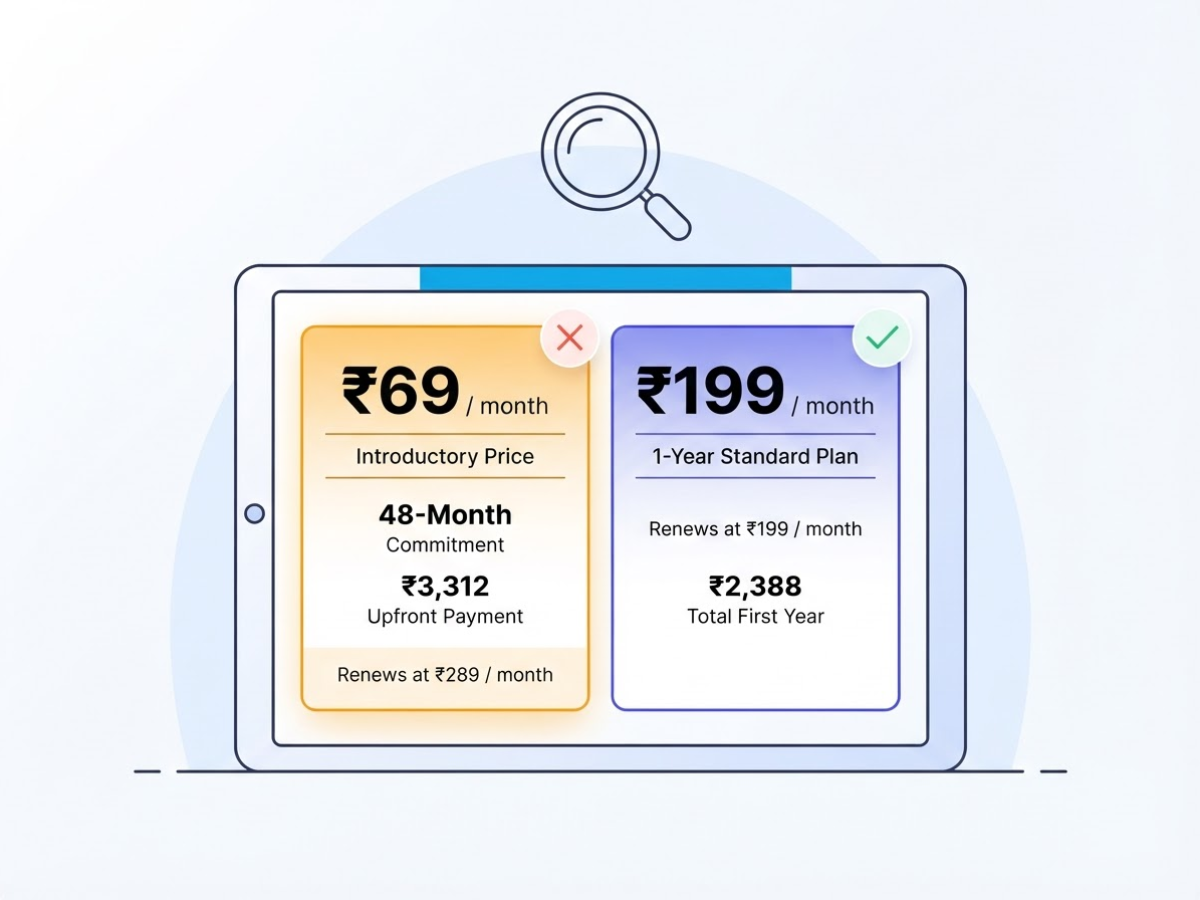
The cheapest website hosting is not always the plan with the smallest number beside “per month.” It is the option that keeps your total website cost reasonable for the period you actually expect to use it. That means checking the introductory price, renewal price, billing term, GST, and every paid extra before you compare providers.
A ₹69 monthly-equivalent price may require a 48-month payment upfront. Hostinger’s India Single shared-hosting plan, for example, lists ₹69 per month for 48 months, or ₹3,312 upfront, then renews at ₹289 per month after the first term. The plan details matter more than the headline rate. A one-month or one-year option may cost more per month but tie up less cash.
GST can also change the checkout total. Some providers display prices before India’s 18% GST, while others show tax-inclusive figures. A “free domain” may cover only the first year, and email, automated backups, premium SSL, migration, or extra storage can become separate charges. Most people notice these costs only after choosing a plan, which is a poor time to discover them.
Use this formula instead:
Monthly ownership cost = (plan total + GST + domain + email + backups + add-ons) ÷ number of months
| Cost item | What to check |
|---|---|
| Introductory price | Is it limited to the first term? |
| Renewal price | What will you pay next year or term? |
| Billing term | Is the displayed monthly amount based on 12, 36, or 48 months? |
| Extras | Are domain, email, backups, and GST included? |
Shared hosting is usually the sensible entry point for a blog, portfolio, brochure site, or small business website. Multiple websites share server resources, which keeps the price low, but busy sites can feel slower during traffic spikes. For a first site, that trade-off is usually acceptable. Paying for VPS hosting before you have consistent traffic is often wasted money. You can compare the practical differences in this shared versus VPS hosting guide.
Pro Tip: Divide the full checkout total by the commitment length; this exposes plans that look cheap only because the headline price hides a long billing term.
Before clicking Buy Now, check:
- The first-term total and renewal total
- Whether GST is included
- Domain and email limits
- Backup frequency and restoration fees
- Cancellation and refund conditions
Once you know the real monthly cost, you can compare what each cheap plan actually includes.
Which Hosting Type Is Cheapest for Your Website?
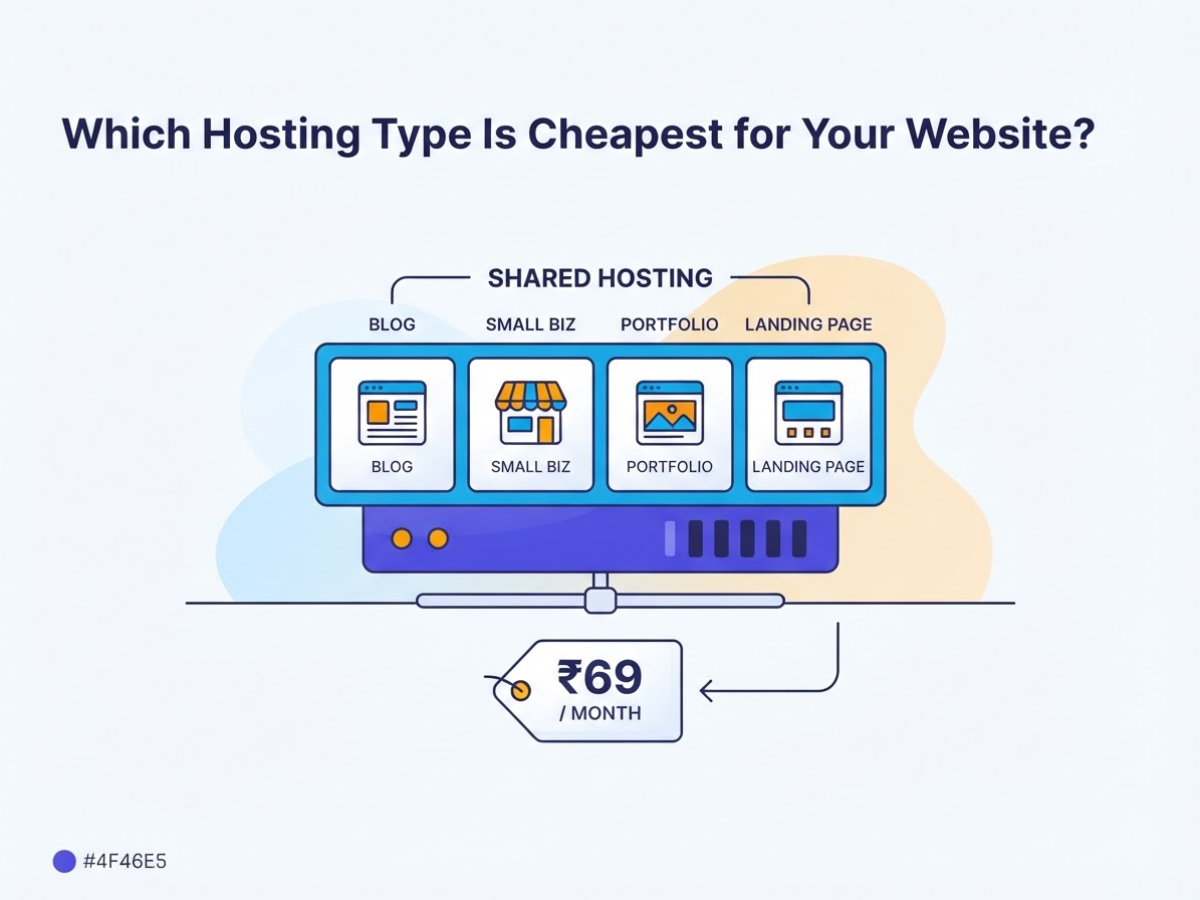
For most new websites, shared hosting is the cheapest sensible starting point. You share server resources with other customers, which keeps the monthly price low. Hostinger describes it as suitable for personal sites, blogs, and small businesses, and that matches what I see when helping people launch their first site.
Choose shared hosting for a personal website, blog, landing page, portfolio, or early-stage local business. A small WordPress site with modest traffic rarely needs an isolated server. The annoyance is that busy neighbours can sometimes affect speed, and promotional prices often jump sharply at renewal, so check the second-term cost before paying upfront.
Use this quick needs check:
| Your situation | Cheapest suitable choice |
|---|---|
| One website, under about 10,000 visits monthly, basic WordPress | Shared hosting |
| One to three sites, moderate traffic, ordinary business email | Shared hosting with extra storage and mailboxes |
| Several sites, traffic spikes, or higher availability expectations | Cloud hosting |
| Heavy plugins, online shops, custom applications, or sustained high traffic | VPS hosting |
| Little technical experience | Managed shared or managed cloud hosting |
| Comfortable managing servers, security, and updates | VPS can make sense later |
Cloud hosting becomes worth considering when traffic grows unpredictably, you run several websites, or a slow server could cost you enquiries. It usually costs more, and the pricing dashboards can be confusing, especially when backups, storage, or outgoing data are billed separately. For a closer look at the trade-offs, see this practical guide to the cheapest cloud hosting options.
VPS hosting is a later-stage purchase, not a badge of seriousness. You get more control and dedicated resources, but you also inherit jobs such as server updates, firewall rules, monitoring, and malware response. Paying for a VPS before you need it is one of the easiest ways to waste money.
Pro Tip: Start with the smallest plan that supports your first 12 months, but confirm that upgrading is possible without migrating to a different provider.
Ignore “unlimited” claims when your site is new and traffic is unknown. Hosts still enforce CPU, inode, database, or fair-use limits. Start with measured needs, then compare renewal prices before choosing the plan.
Cheapest Hosting Plans Compared: Price Versus Value
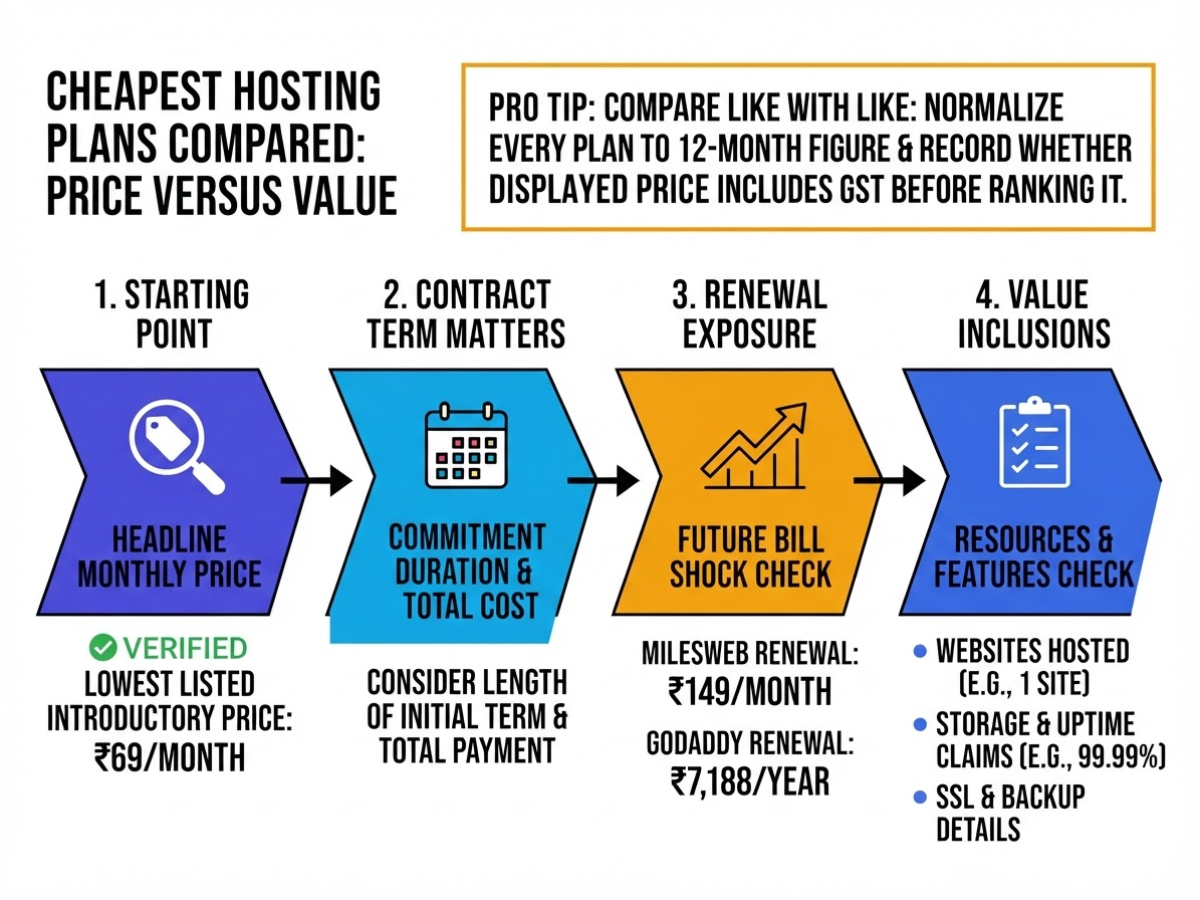
When I compare hosting quotes for clients, the monthly headline price is only the starting point. The contract term, renewal bill, and number of sites usually decide whether a “cheap” plan stays cheap. This practical guide to cheap website hosting in India is useful background, but you still need to check each provider’s live offer.
Pro Tip: Compare like with like: normalize every plan to a 12-month figure and record whether the displayed price includes GST before ranking it.
| Plan | First-term price and term | Websites and storage | Included extras | Renewal exposure |
|---|---|---|---|---|
| Hostinger Single | ₹69/month for 48 months, ₹3,312 total | 1 website; storage not specified in the supplied offer | Shared hosting; SSL and backup details should be checked at checkout | ₹289/month, or ₹3,468 per year |
| Hostinger Premium | ₹149/month for 48 months, ₹7,152 total | 3 websites; 20 GB SSD | Free weekly backups; check domain and SSL terms | ₹449/month, or ₹5,388 per year |
| MilesWeb Starter | ₹69/month for 36 months, before 18% GST | 1 website; 10 GB NVMe | Daily backups, free SSL, WordPress readiness | ₹149/month after the first term, plus 18% GST |
| MilesWeb Premium | ₹129/month for 36 months, before 18% GST | 5 websites; 25 GB NVMe | Free domain for 1 year, two mailboxes per website, daily backups, SSL for every website | Confirm the renewal quote before paying |
| GoDaddy Starter | ₹89/month for the first 3-year term | 1 website; 10 GB NVMe | cPanel and 30-day money-back guarantee; domain, backup, and SSL terms need checking | Standard price shown as ₹299/month |
The MilesWeb listing makes the tax issue easy to miss: its displayed prices exclude 18% GST. Its ₹69 Starter offer is therefore not directly comparable with a tax-inclusive price, and the 36-month term differs from Hostinger’s 48 months and GoDaddy’s 3 years. GoDaddy’s low first-term figure also needs caution because the standard price is ₹299 per month.
For one small site, the cheapest first term may be enough. For a designer, agency, or business owner running several sites, ₹129 for MilesWeb Premium can be better value than ₹69 for a single-site plan. You avoid buying a second account, and the included mailboxes, backups, domain, and per-site SSL reduce add-on costs. The annoyance is that the renewal price and GST can change the calculation, so save the checkout summary.
BigRock’s advertised 99.99% uptime and 30-day money-back guarantee are worth checking alongside price, but they do not prove overall superiority. The guarantee has conditions, including exclusions for some purchases and renewals. Next, compare the features that affect your site’s day-to-day running costs.
How to Buy the Cheapest Website Hosting Without Regret
Before you open a checkout page, write down what the site must do. This five-step process keeps a low price from turning into a costly migration later.
- Describe the website first. Note whether you need a blog, portfolio, shop, membership site, or business brochure site. Add the number of websites, expected monthly traffic, storage requirement, email accounts, and applications such as WordPress, WooCommerce, cPanel, or a specific PHP version. A one-page portfolio has very different needs from a store with product images and daily orders.
- Compare the full term, not the monthly teaser. Shortlist two or three plans, then record the first-term total, renewal total, GST, domain terms, and every paid add-on in a simple sheet. For example, ₹69 per month may look cheap until you notice a 48-month commitment and a much higher renewal rate. Hostinger’s India prices are displayed without GST, so add tax before comparing them with another provider’s final cart price. Check the India hosting comparison factors that affect the real cost.
- Verify the boring features before paying. Confirm that the plan includes SSL, backups, a usable control panel, WordPress support, migration help, support hours, published uptime information, and a refund policy. Do not treat “99.99% uptime” as a guarantee that your plugin or database will never fail. Hostinger includes free SSL and a 30-day money-back guarantee, but its displayed prices exclude GST.
- Inspect renewals and exclusions. Check whether the free domain lasts only for the first year. Confirm whether email, SSL, privacy protection, backups, or malware scanning renew separately. A cheap first invoice can become expensive when email and SSL appear as separate annual charges. Also read refund limits: BigRock’s money-back policy covers first-time accounts, not renewals or auto-renewals.
- Buy the shortest sensible commitment and set it up. Choose one year if you are testing an idea, or a longer term only when the renewal price still fits your budget. Connect the domain, enable SSL, create an off-site backup, install the application, and test contact forms, checkout, mobile layout, and email delivery.
Before payment:
- First-term and renewal totals checked
- GST and add-ons included
- Domain, email, SSL, backup, and refund terms clear
- Storage, site limit, applications, and support confirmed
After purchase:
- Domain resolves correctly
- HTTPS works on every main page
- Backup completes and can be downloaded
- Forms, login, links, images, and email tested
Once these checks pass, you can judge whether the cheapest website hosting plan is genuinely affordable for your site, not merely cheap at checkout.
Five Cheap Hosting Mistakes That Raise the Real Cost
A low monthly figure can hide a costly commitment. When I review hosting purchases, these five mistakes cause more trouble than choosing shared hosting itself:
- Mistake 1: Comparing monthly prices without checking the term. A blogger may see ₹69 per month and miss that the price requires 48 months and ₹3,312 upfront. Hostinger’s India Single plan renews at ₹289 per month, so the checkout total and the next invoice both matter. A one-month price is not a one-month commitment.
- Mistake 2: Ignoring the renewal bill and add-ons. Your first-year price may exclude GST, domain renewal, paid SSL, or separate email mailboxes. GoDaddy’s Economy offer shows ₹199 per month for one year, but the next year renews at ₹7,188, while SSL renews separately at ₹5,999. A local business that budgets only for the introductory rate can face a nasty bill just as its website starts generating leads. Check the renewal price, tax, domain, SSL, and email line by line. This practical guide to cheap website hosting in India covers the same cost checks before checkout.
- Mistake 3: Buying for one site when your plans already include two. A freelancer may launch a portfolio and add a client project six months later. A blogger may need a staging copy before redesigning a live site. Paying to upgrade is often more expensive and irritating than choosing a multi-site plan from the start. Count likely sites for the entire term, not just today’s site.
- Mistake 4: Treating “unlimited” as unlimited. Online store owners often focus on unmetered bandwidth, unlimited storage, or a 99.99% uptime figure, then skip fair-use rules and resource limits. Traffic spikes, large backups, or product images can still trigger restrictions. Read what the provider actually measures and what happens when you exceed it.
- Mistake 5: Skipping the boring safeguards. Cheap hosting is a poor bargain if you cannot restore a backup, move the site, access the control panel, or claim a refund. Confirm backup frequency, migration help, cPanel or equivalent access, and refund exclusions. A store owner can lose more in one failed restore than the hosting saved.
The next comparison should focus on the features that protect your budget after purchase, not just the advertised rate.
When the Cheapest Website Hosting Is Not the Best Choice
A shared plan has done its job when it gets your site online cheaply. It stops being a bargain when you repeatedly hit CPU or inode limits, pages slow during traffic spikes, or support keeps telling you to upgrade. Several active sites, ecommerce transactions, and business-critical uptime are also clear warning signs. I would not wait for a complete outage before moving.
Your alternatives involve different compromises:
| Option | Typical trade-off | Best fit |
|---|---|---|
| Higher-tier shared | Costs more, but keeps maintenance simple and adds storage, backups, or site limits | Several small sites or a growing blog |
| Cloud hosting | Usually costs more than basic shared hosting; handles changing demand better, but pricing can be less predictable | Campaign traffic, apps, and busy content sites |
| VPS hosting | Gives you more control and isolation, but you must handle server settings, security, and updates | Developers or businesses with technical help |
| Managed WordPress | Provider handles more WordPress maintenance; you pay extra and accept tighter software limits | Owners who want fewer plugin and server chores |
| Local hosting provider | Indian support or a nearby data centre may improve response times, but features and tooling vary | Local businesses serving a regional audience |
A higher-tier shared plan is often the sensible middle step. For example, Hostinger’s India Premium shared plan supports three websites and includes 20 GB SSD storage and weekly backups at ₹149 per month on a 48-month term. That costs more than entry-level hosting, but the extra storage and backup coverage can prevent a rushed migration six months later.
Cloud hosting suits traffic that rises and falls sharply, while VPS hosting makes sense when you need custom software or server-level access. I have seen small business owners choose a VPS too early, then lose hours to firewall rules and updates. Managed WordPress removes much of that work, although plugin restrictions and higher renewal prices can irritate experienced users. A local provider can offer useful phone support, but check backup restoration, uptime history, and migration help rather than trusting a city name.
Review your plan after 3, 6, and 12 months. Check monthly visitors, CPU and storage usage, downtime, slow periods, and unresolved support tickets. Upgrade when the same limit appears twice, not merely because a larger package sounds impressive.
Start lean for a simple site, choose broader shared hosting for multiple sites, then move to cloud, managed WordPress, or VPS hosting when your records show the need. The next step is to calculate what those limits cost you in practice.
My honest take on the cheapest website hosting
I assess “cheapest” hosting as the lowest dependable ownership cost, not the smallest number on a promotional banner. As an AVM Cloud content strategist, I have seen new site owners choose a ₹49 monthly offer, then discover that backups cost extra, support replies arrive slowly, or renewal jumps after the first term. That cheap plan was not cheap once a small problem consumed an afternoon.
For a new blog, portfolio, local-service website, or simple business site, I usually recommend basic shared hosting. You do not need an expensive server to publish pages, run a small WordPress site, or collect enquiries. But I would insist on included SSL, practical backups, usable support, and a clear upgrade path. Shared hosting has limits, and crowded accounts can feel sluggish during traffic spikes, but paying for unused capacity is a worse early mistake.
Here is the contrarian part: the longest billing term is not automatically the best deal. Paying several years upfront can be a poor decision when you have not tested support, verified uptime in practice, or confirmed what your site will need next year. I would rather see you pay for a shorter term, inspect the service, and retain the option to move.
Compare renewal pricing and GST before comparing feature counts. Those two figures often matter more than another email account or a larger headline storage number.
— AVM Cloud Content Strategy Team
Find affordable hosting without hidden trade-offs
If you are comparing the cheapest website hosting, do not stop at the first-year price. When I review plans with clients, the annoying surprises usually appear later: a low introductory rate, a costly renewal, missing essentials, or limits that become a problem when the site starts getting visitors. Check your storage, email, SSL, support needs, contract length, and likely growth before you choose.
DomainAdda is a practical next step if you need an affordable domain and cheap linux hosting setup in India, whether you run a small business, personal site, or early-stage project. You can also compare its lower-cost email marketing and SMS marketing services if customer outreach is part of the plan. Start with the DomainAdda website or read this guide to cheap website hosting in India before committing. The right plan is the one that stays suitable after renewal, not merely the one that looks cheapest today.
Frequently Asked Questions
How much should I pay for website hosting in India?
For a basic website, introductory shared hosting often costs about ₹69 to ₹199 per month, but that is rarely the final bill. Add 18% GST, the billing term, renewal rate, domain, email, and optional extras, then compare the complete first-year and renewal-year totals.
Is cheap web hosting safe for a small business?
It can be safe if your plan includes SSL, backups, account security, responsive support, and a clear refund policy. Check whether backups run at least once every 7 days and confirm how you restore them, because a low price becomes expensive when one accidental deletion leaves you without a working copy.
Can I host a website for free permanently?
Free hosting can work for a temporary project or a learning experiment, but it may restrict storage, speed, branding, support, or advertising. For a professional website, paid shared hosting is usually more practical because even a ₹100 monthly plan can support a custom domain and basic control-panel features.
What is the difference between monthly and yearly web hosting plans?
A monthly plan reduces your upfront commitment, while a yearly or multi-year plan often lowers the advertised monthly equivalent. Compare the full checkout total for 12 months and the renewal price, since a 70% introductory discount may apply only to the first term.
Does cheap hosting include a domain name?
Some hosting plans include a domain for the first year, while others charge separately or cover only certain extensions. Check the renewal fee and transfer rules carefully, because a domain advertised as free for 1 year can still cost ₹800 or more to renew.
Recommended reads
- Cheap Website Hosting India A Practical Guide
- Cheap Indian Hosting A Practical Buying Guide
- Shared Vs Vps Hosting Know Which Is The Best Option
- How To Host A Website Step By Step Guide
Sources
- Shared Hosting: Simple, Affordable & Fast | Hostinger
- Buy Web Hosting Services | Unlimited Bandwidth Hosting Plans
- India’s Best Web Hosting Company | 85% OFF Web Hosting Services
- Web Hosting | Lightning Fast Hosting & One Click Setup – GoDaddy
- Cheap Web Hosting | Fast, reliable & affordable – GoDaddy
- Buy Web Hosting – Fast, Secure & Reliable | BigRock
- BigRock – Money Back Policy