

Best Domain Registrar: How to Choose in India
TL;DR: The best domain registrar is the one with fair renewal pricing, clear transfer rules, free domain privacy, reliable DNS controls, responsive support, and the security features you actually need, not merely the cheapest first-year offer. If you run an Indian business, also compare .IN pricing, INR billing, payment options, and support for your preferred extension before registering.
Choosing a domain registrar by its $1 first-year offer is an easy mistake, especially when you are launching a site and every rupee matters. The frustration usually arrives later: a steep renewal bill, confusing DNS settings, or a domain that is harder to move than expected. I check legitimacy against ICANN’s public directory of accredited registrars, which is updated daily, rather than trusting a flashy checkout page. This guide compares upfront and renewal prices, privacy and DNS features, transfer and expiry rules, and practical choices for personal sites, startups, online stores, and Indian businesses, while keeping registrars separate from web hosts.
| Point | Details |
|---|---|
| Compare renewal pricing | Check the renewal price after the first 1-year registration term, because a cheap introductory offer can become expensive later. |
| Check transfer restrictions | ICANN allows a registrar to deny transfers requested within 60 days of initial registration or a previous registrar transfer. |
| Review privacy protection | Confirm which contact details remain visible in public registration records, because privacy and proxy services do not work the same way. |
| Secure DNS controls | Look for DNSSEC, 2-factor authentication, account locks, and straightforward DNS record management before you buy. |
| Plan for expiration | A deleted domain can remain in redemption for 30 days, then spend 5 days in Pending Delete before becoming available again. |
What Makes a Domain Registrar the Best Choice?
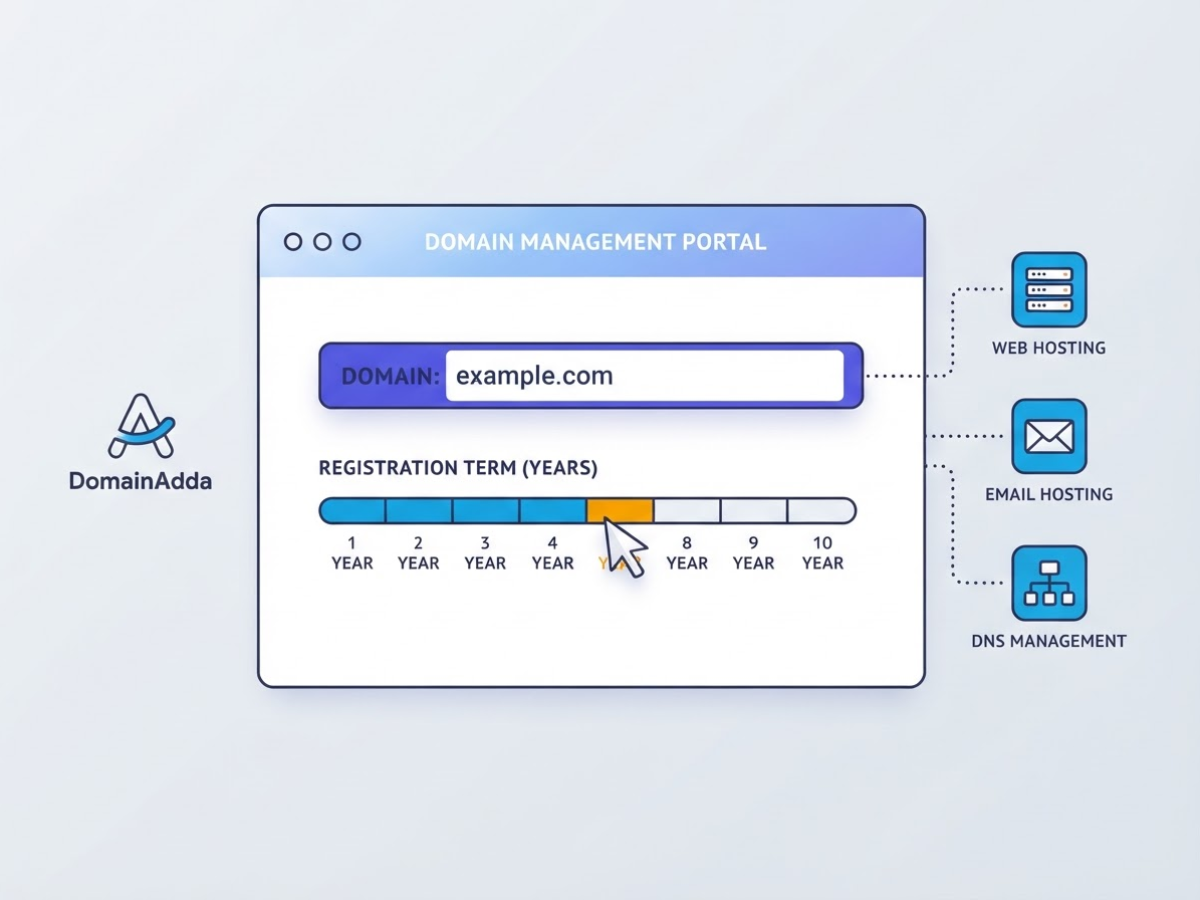
A domain registrar is the company you use to register a name such as example.com, renew it, change its contact details, and point it to online services. The registrar sends your request to the relevant domain registry, which maintains the authoritative database for that extension. You do not buy the domain forever. You reserve the right to use it for a fixed term, usually one to ten years.
That role is narrower than many checkout pages suggest. Your registrar may also sell web hosting, email hosting, DNS management, or a website builder, but each service does a different job. The domain is your address; hosting stores your website; email hosting handles mailboxes; DNS connects the address to those services. If that distinction is unclear, this guide to web hosting versus a domain name will save you a frustrating support conversation later.
When we assess a registrar for a customer, we use this scorecard rather than judging the first-year discount:
| Area | What to check |
|---|---|
| Price | Registration, renewal, taxes, and add-ons over three years |
| Extension fit | Availability and rules for .com, .org, .in, or newer options |
| Control | DNS records, nameservers, locks, and contact updates |
| Protection | Privacy, two-factor authentication, DNSSEC, and account recovery |
| Support | Response channels, hours, and practical transfer help |
| Exit terms | Transfer code access, lock periods, expiry, and redemption fees |
Renewal pricing deserves special attention. ICANN requires registrars to make renewal, post-expiration, and redemption fees reasonably available, but you still need to find and compare those figures. ICANN accreditation matters for many generic top-level domains because it identifies registrars operating under ICANN agreements, and its public directory lists current accredited registrars. For .IN, also review registry and registrar terms. The .IN registry publishes wholesale registration, transfer, and renewal prices in rupees per domain year, but your final bill and policies can differ.
Pro Tip: Judge a registrar by the account tools you will use during the next three years, not only by the checkout screen you see today.
The right choice depends on your extension, country, budget, technical comfort, and whether the domain supports a personal project or a revenue-producing business. Next, compare providers against this scorecard instead of treating the cheapest introductory price as the winner.
Best Domain Registrar Features: What Should You Compare?
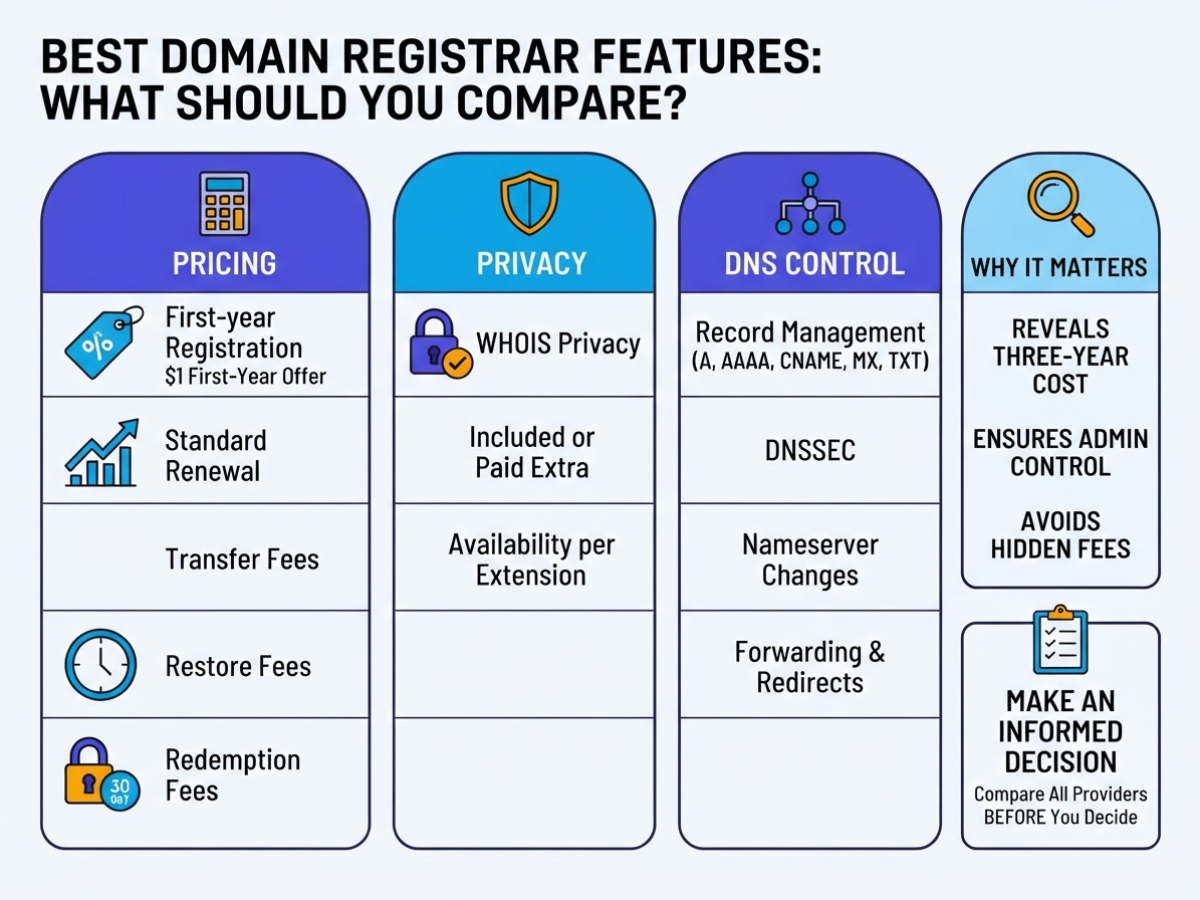
I compare registrars on the bill and the admin work they create after checkout. A $1 first-year offer means little if renewal costs jump, privacy costs extra, or restoring an expired domain requires a support ticket. Put each provider in the same sheet before you decide.
| Area | What to compare | Why it matters |
|---|---|---|
| Pricing | First-year registration, standard renewal, transfer, restore, and redemption fees | Reveals the three-year cost, not just the opening discount |
| Privacy | WHOIS privacy included, paid separately, or unavailable for the extension | Some country-code and restricted extensions have different rules |
| DNS | A and AAAA records, CNAME, MX, TXT, DNSSEC, nameserver changes, forwarding, redirects, and subdomains | You need control when adding email, verification records, or a new host |
| Security | Two-factor authentication, domain lock, login and renewal alerts, and role-based access | Reduces the chance that one stolen password changes your website’s routing |
| Service | Live chat, phone or email support, response expectations, payment methods, and bulk domain tools | Matters when you manage ten domains instead of one |
Do not accept vague pricing pages. ICANN requires registrars to make renewal, post-expiration, and redemption fees reasonably available, so check those figures before registering. A deleted domain can spend 30 days in redemption and another five days in Pending Delete, and a restore fee during that window can be painfully high. Cloudflare says its renewals use the registry’s list price rather than a registrar markup, which gives you a useful benchmark for judging renewal pricing.
Pro Tip: Create a three-year cost column in your comparison sheet; it exposes registrars whose first-year discount hides a high renewal price.
For DNS, I would not settle for a dashboard that only shows nameservers. You should be able to edit common records, activate DNSSEC, lock the domain, create subdomains, and redirect an old URL without hunting through help articles. DNSSEC is especially worth checking: Cloudflare provides free one-click DNSSEC activation, although changes can still take time to apply.
Bundled domain and hosting is convenient when you want one invoice, one login, and quick setup for a small site. Separating them is usually better for a business that may change hosts, use a specialist email provider, or give a developer limited access. A domain is not hosting, a distinction explained in this domain and hosting comparison.
Once you have scored these features, compare the registrars against your actual domain workload rather than a promotional price.
How to Choose the Best Domain Registrar Step by Step
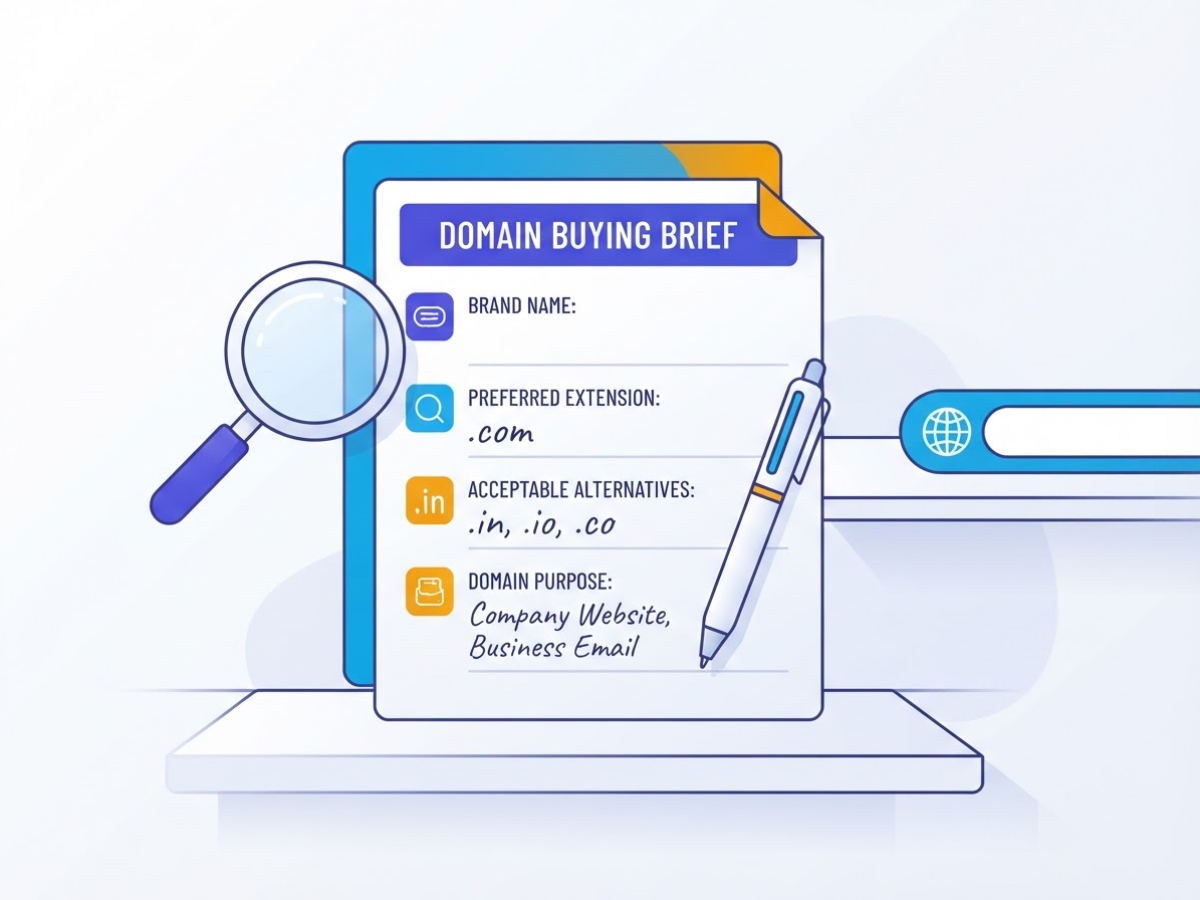
Before you open a registrar’s search box, make a one-page buying brief. Write the exact brand name, preferred extension, acceptable alternatives, and what the domain will do: company website, landing page, business email, or a parked name. This prevents a cheap first-year offer from steering you toward a poor-fit extension.
- Shortlist the name and extension. Search the registrar for your preferred name, then test sensible alternatives such as
.com, a country-code extension, or a relevant industry extension. If you plan to run email, treat the domain as a long-term business asset, not just a website address. A domain name and web hosting serve different jobs, so you do not need to buy both from the same company. - Check the real price. Visit the registrar’s standard registration and renewal pages directly. Do not rely only on a sponsored result advertising a ₹99 first year. Compare the first-year price, ordinary renewal price, taxes, add-ons, and the cost of each acceptable extension. Registrars must make renewal, post-expiration, and redemption fees reasonably available when you register, so look for those figures before entering payment details.
- Inspect ownership and controls. Confirm that the legal registrant will be the business owner or your own entity. Check whether domain privacy is included, whether you can edit DNS records and nameservers, and whether the account supports two-factor authentication, login alerts, and separate user access. A cheap domain becomes expensive when support has to recover it from an ex-employee’s inbox.
Pro Tip: Register the domain with the business owner’s legal details and a monitored email address, not a temporary freelancer or employee account.
- Read the exit rules. Before paying, find the transfer, change-of-registrant, cancellation, and expiry policies. ICANN rules can block a transfer within 60 days of initial registration or a previous registrar transfer, and a change of registrant can trigger another 60-day transfer lock unless you opt out in advance where offered. Check the authorization-code process too.
- Finish checkout carefully. Enter accurate contact information, reject unnecessary privacy or security add-ons if you do not need them, and enable two-factor authentication immediately. Save the invoice and verify that the registrant name, email address, term, and auto-renew setting are correct.
- Connect services only after checking requirements. Do not replace nameservers or add DNS records from memory. Ask your website host, email provider, or developer for the exact values first. Incorrect MX records can stop email, while an unnecessary nameserver change can take the website offline.
- Store the recovery details. Record renewal dates, invoices, authorization codes, registrar support details, and recovery contacts in a password manager or another secure location. Set calendar reminders 30 and 7 days before renewal.
This workflow leaves you with the domain, the ownership evidence, and the access needed to manage it when the next service connection comes up.
Which Registrar Is Right for Your Website or Business?
The right choice changes sharply once I know what the domain must do. A personal blog does not need the same control panel as a store handling payment verification or an agency managing 200 client names. I use the buyer’s likely headaches, not a generic star rating, to narrow the shortlist.
| Buyer profile | Priorities worth paying attention to |
|---|---|
| Personal blog | Simple search, clear renewal price, privacy, basic DNS |
| Startup or small business | Ownership control, email compatibility, security, support, predictable renewals |
| Online store | Reliable DNS, verification records, subdomains, redirects, fast support |
| Agency or domain investor | Bulk search, portfolios, permissions, transfers, expiry controls |
For a personal blog, avoid paying for tools you will never open. You need a clean search box, the real renewal price shown before checkout, privacy protection, and enough DNS control to connect hosting, analytics, or a newsletter. Privacy is not the same as proxy registration: ICANN explains that privacy services keep you as the registered name holder, while proxy services list the provider as the registrant. That distinction matters if ownership records ever become disputed.
A startup should retain direct ownership in the founder’s or company’s name, not an employee’s personal account. Check two-factor authentication, account recovery, support response times, and whether the registrar works cleanly with Google Workspace or another mail provider. If your team is unsure where DNS ends and hosting begins, this domain and web hosting difference guide prevents an irritating setup mistake. Renewal pricing deserves equal attention. A cheap first year can become an expensive annual habit.
Stores need fewer surprises. Test whether you can add TXT and CNAME verification records, create subdomains, set redirects, and recover access quickly when a checkout integration breaks. Slow ticket replies are not a minor inconvenience when a campaign or payment page is offline.
Agencies and investors should demand bulk search, portfolio views, user permissions, transfer tools, and clear expiry notices. For Indian buyers, add .IN availability, INR checkout, local payment methods, and support hours that overlap with your workday. The India domain buying guide is useful when price comparisons get confusing.
Bundles with hosting and email reduce setup work for a first site, but advanced users often prefer a standalone registrar and separate providers. That split costs more effort initially, yet it keeps a hosting outage from trapping your domain account. Next, compare the registrar features that affect your bill and daily admin work.
Registrar Mistakes That Can Cost You a Domain
The cheapest first year can become the most expensive choice later. I have seen clients select a registrar for a ₹99 promotion, then discover that renewal costs, privacy fees, support delays, and recovery charges matter far more than the opening invoice. Compare the second-year price and the rules before you register, not after the discount expires.
Common mistakes include:
- Registering a company domain with a personal email account that only one employee can access. Use a shared business mailbox, then protect it with multi-factor authentication. Your registrar account is part of your company’s identity, not a casual shopping login.
- Assuming the domain and hosting are the same product. Keep your registration records separate from your hosting plan, as explained in this domain name versus web hosting guide.
- Ignoring renewal notices, failed card payments, or a disabled auto-renew setting. Check the billing contact, payment method, and renewal term at least 30 days before expiry.
- Changing registrant details without checking the transfer consequences.
A transfer may be denied when requested within 60 days of the domain’s initial registration or within 60 days of its previous inter-registrar transfer, under ICANN’s transfer guidance. A separate 60-day lock can follow a change of registrant. The registrar must apply it unless you opted out in advance where that registrar offers an opt-out choice. That detail is easy to miss during an ownership update, and it can ruin a time-sensitive move to another provider.
Expiry has stages, not one instant deadline. During an auto-renew grace period, which can last 1 to 45 days, the registrar may still renew the name, sometimes for the normal renewal price. If it is deleted, the domain generally enters a 30-day redemption period, where recovery usually costs much more. After that comes Pending Delete for five days. You cannot normally restore it there, and someone else may register it when it is released. Check the business email setup guide if domain mail is tied to your renewal reminders.
Before moving providers, export or screenshot every DNS record, including A, CNAME, MX, TXT, and verification records. Recreating them from memory is how websites go offline and email stops arriving. Keep that file with your renewal and account-recovery details, then review the registrar’s expiry policy before choosing the best domain registrar for a business-critical name.
Can You Switch to a Different Domain Registrar Later?
I have moved domains after a registrar made a simple renewal feel like a yearly negotiation. A transfer is worth considering when renewal pricing jumps, support stops answering, DNS controls are too limited, privacy protection is missing, payment options do not suit you, or you want your domain and hosting managed under one account. It is also reasonable to keep the domain elsewhere if separating ownership from your web host makes support and security easier. Web hosting and a domain name do different jobs, so moving one does not require moving the other.
A transfer usually requires two actions at the current registrar: unlock the domain and request its authorization code, sometimes called an EPP code. You then submit that code to the destination registrar and approve confirmation emails. Do not assume the transfer will finish instantly. It can take several days, and a missed approval message can leave the request waiting.
ICANN policy allows a registrar to deny a transfer within 60 days of the domain’s initial registration or a previous registrar transfer. A 60-day transfer lock can also follow a change of registrant, although some registrars let you opt out before making that change.
Choose among these three options:
- Transfer the domain: Best when pricing, support, privacy, or DNS management is consistently frustrating.
- Keep the registrar, move hosting: Best when the registrar is acceptable and you only need a faster, cheaper, or better-supported server.
- Keep the registrar, move email: Often the least disruptive choice if your website works and only mail delivery needs attention.
Before starting, check the destination registrar’s transfer price, next renewal date, privacy terms, DNS record limits, DNSSEC support, and exact completion process. A cheap transfer means little if renewal costs double next year or the control panel hides basic records.
Use this short pre-transfer checklist:
- Export or record A, AAAA, CNAME, MX, TXT, and verification records.
- Confirm email providers, forwarding rules, and mailbox access will continue.
- Test access to both registrar accounts and update the account email if needed.
- Check outstanding invoices, auto-renewal settings, and payment details.
- Save every transfer approval and completion message.
If the current registrar is fine, moving only hosting or email avoids unnecessary downtime and lock periods. Once you know which service is actually causing trouble, you can compare registrar features without treating a full transfer as the automatic answer.
My honest take on choosing the best domain registrar
I have helped onboard businesses that treated a domain as a small purchase, then discovered that access, billing, and DNS control mattered far more six months later. My test for the best domain registrar is simple: ownership should become boring. I want transparent renewals, reliable account access, practical DNS controls, clear transfer rules, and support that answers before a missed deadline turns into a business problem.
Here is my contrarian view: the cheapest first-year offer should rarely decide the purchase. Saving ₹100 at registration can disappear through a higher renewal fee, paid privacy, weak account recovery, or an interface that makes a routine DNS change unnecessarily stressful. Renewal pricing and recovery options deserve more attention than a flashy introductory discount.
For most Indian businesses, I would shortlist registrars that support the required extensions and payment methods, then compare the full three-year cost. I also prefer keeping the domain separate from hosting when that gives the owner clearer control and an easier move later. A bundled DomainAdda setup can suit beginners, but I would still confirm who controls the domain account, DNS settings, and renewal billing. That check prevents a surprisingly common dispute when a freelancer or former employee holds the login.
— AVM Cloud Content Strategy Team
Choose a Domain Registrar With Straightforward Domain Management
If you want a practical starting point for a website in India, DomainAdda’s affordable domain registration and hosting options are worth comparing alongside other registrars. Keeping the domain and hosting with one provider can reduce setup friction, especially when you also need professional email or DNS changes. It can also make support simpler, although one company may not offer the lowest price or best controls for every service.
Before checkout, compare the available extension, registration price, renewal cost, privacy options, DNS controls, and support quality. Introductory pricing often looks attractive until the second year, and confusing DNS screens can waste an afternoon. Use this domain buying guide for India to check availability and review full pricing and renewal details, then register only after you know how the domain fits your hosting, email, or DNS plans.
Frequently Asked Questions
Is it better to buy a domain from a registrar or a hosting company?
A registrar handles domain ownership and DNS, while a hosting company provides server space for your website. Buying both from one provider can save setup time, but keeping them with 2 separate companies often makes switching hosts less painful later.
How much should I pay for a domain name each year?
A common domain extension may cost about $10 to $20 per year, but the final price depends on promotions, taxes, renewal rates, and the registrar’s policies. Check the second-year renewal price, plus privacy, transfer, and redemption fees, because a cheap first year can hide a much higher ongoing cost.
Can I own a domain without hosting?
Yes, you can register and hold a domain without buying hosting, even for 1 year or longer. You can later point it to web hosting, email, a landing page, or another service by changing its DNS records.
What happens if I forget to renew my domain?
Your domain may first enter an auto-renew grace period, then move toward deletion if you do not restore it. The redemption period lasts 30 days, followed by 5 days in Pending Delete before the domain may become available again, and recovery can cost much more than a normal renewal.
Can I change the owner of a domain name?
You can usually change the registrant information through your registrar, but the update may trigger a 60-day inter-registrar transfer lock. Some registrars offer an opt-out before you confirm the change, so check that setting and the applicable transfer policy first.
Recommended reads
- Buy Cheap Domain India Buying Guide
- Web Hosting Vs Domain Name The Difference
- Domain Mail Setup Guide For Business Email
- What To Look For In A Web Host Check These 7 Tips
Sources
- FAQs for Registrants: Transferring Your Domain Name
- Transfer Policy
- FAQs for Registrants: Domain Name Renewals and Expiration
- 5 Things every Domain Name Registrant should know about ICANN’s Expired Registration Recovery Policy (ERRP)
- Overview · Cloudflare Registrar docs
- Domain Name System Security Extensions (DNSSEC) · Cloudflare Registrar docs
- porkbun.com | Domain Name Pricing
- Registrar Data Escrow Program
- List of Accredited Registrars
- policies
- Information for Privacy and Proxy Service Providers, Customers and Third-Party Requesters