

Cheap Indian Hosting: A Practical Buying Guide
TL;DR: Cheap Indian hosting suits portfolios, blogs, landing pages, and small-business websites, but the lowest advertised price can hide renewal charges and add-ons. Before committing to a 12-month term, compare the renewal price, 18% GST, storage, backups, SSL, email, uptime, support, and contract conditions.
A hosting plan under ₹100 a month looks ideal for a student portfolio, blog, freelance site, or small business page. Then checkout reveals a long-term commitment, 18% GST, or a renewal price several times higher, and “cheap” starts to feel misleading. With 969.10 million internet subscribers in India as of March 31, 2025, choosing a dependable low-cost host matters, but a low price alone does not make a plan poor. You need to compare first-term and renewal costs, match resources to your site, check essential features, and complete setup without paying for extras you will not use.
| Point | Details |
|---|---|
| Check Renewal Pricing | A plan advertised at ₹69 per month can renew at ₹409 per month, so compare both prices before buying. |
| Add GST First | India’s GST rate for IT services is 18%, and some providers show prices before tax. |
| Match Your Resources | One brochure website may need 1 site and modest storage, while multiple sites require more domains, databases, and email accounts. |
| Prioritise Core Protections | Free SSL, daily backups, reliable support, and a stated uptime commitment matter more than unlimited marketing claims. |
| Follow Simple Setup | You can usually launch a first website by connecting a domain, opening the hosting control panel, activating SSL, and installing a CMS. |
What does cheap Indian hosting include?
Cheap Indian hosting usually means entry-level shared hosting sold from or for the Indian market. Your website runs on a server whose CPU, memory, storage, and network capacity are shared with other customers. That keeps the price low, but a busy neighbouring site can slow your pages or trigger resource limits. If you expect heavy traffic, compare shared and VPS hosting before committing.
The advertised monthly price is only one part of the bill. Check each item separately:
- Promotional price: The discounted rate for a first term, often 12, 24, or 36 months.
- Renewal price: The higher rate charged when that term ends.
- Billing term: A ₹69 monthly display can require upfront payment for three years.
- GST: Hosting prices can exclude India’s 18% GST, which the GST Council confirms for IT services.
- Domain fees and add-ons: A domain can be free for year one, then charge separately. Backups, malware scans, premium support, and site migration can also cost extra.
Pro Tip: Treat the advertised monthly figure as a calculation input, not the final price, until you multiply it by the full billing term and add GST.
Before paying, I check whether the plan includes these basics:
- NVMe or SSD storage, with a stated size such as 10 GB or 25 GB
- The number of websites allowed and any inode or CPU limits
- A clear bandwidth policy, not just “unlimited” in large print
- Free SSL, backups and their retention period, email accounts, and databases
- A control panel such as cPanel, plus support hours and contact methods
This setup suits a portfolio, blog, brochure site, landing page, or early-stage business website with modest traffic. It becomes frustrating when a host hides renewal rates, offers no usable backup policy, pushes paid extras at checkout, or describes resources vaguely. “Unlimited” storage does not help if the provider restricts files, processes, or visitors.
Use those inclusions and exclusions to compare the real cost of cheap Indian hosting plans.
Is cheap hosting right for your website?
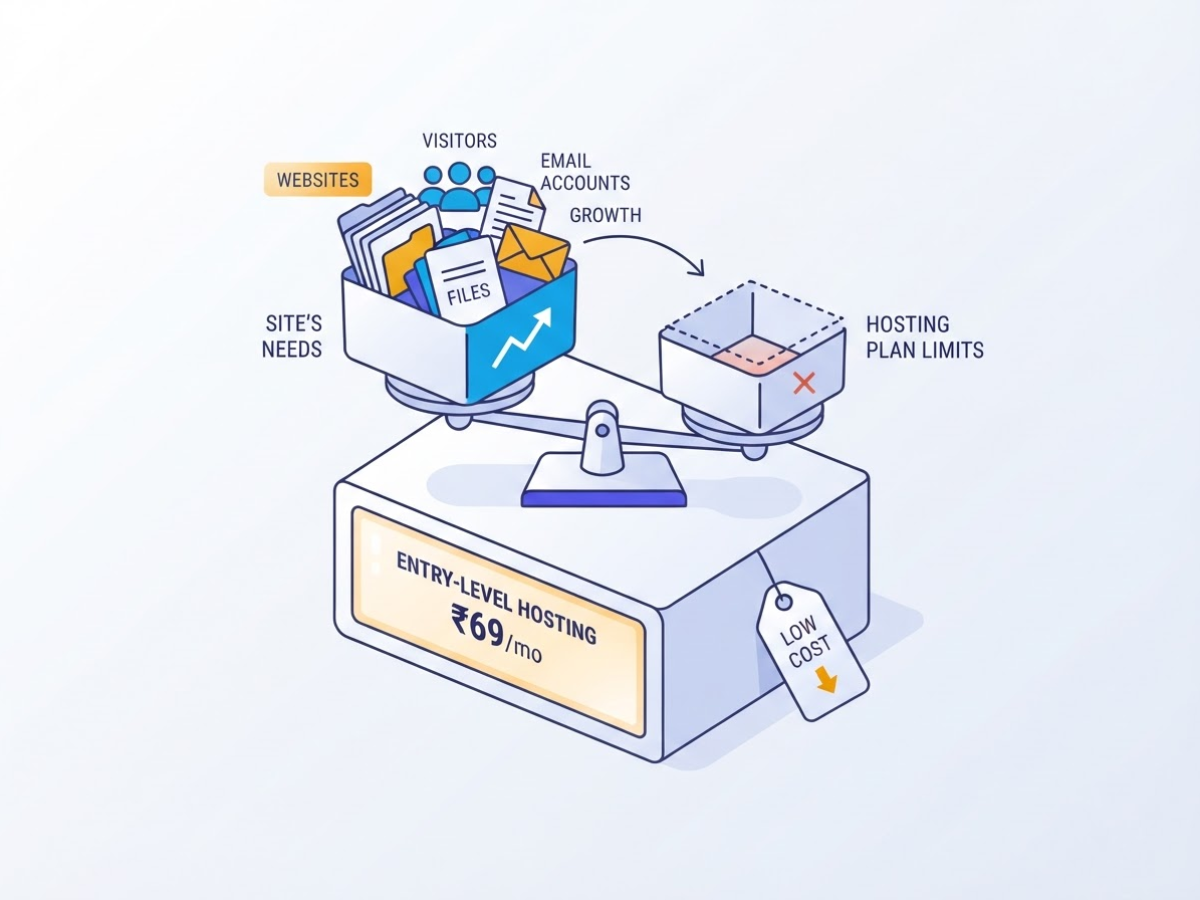
The useful test is not whether the monthly price looks low. It is whether the plan has enough room for your websites, visitors, files, email accounts, and the next 6 to 12 months of growth. When I review hosting choices with small businesses, the cheapest plan often works, but only when its limits match the site’s actual workload.
| Website type | Entry-level shared hosting fit | Watch out for |
|---|---|---|
| Personal blog or portfolio | Usually a good fit | Large image and video files |
| Local service business | Good for one brochure site and contact forms | Booking tools, heavy plugins, sudden campaigns |
| Small online store | Possible with a light catalogue | Many products, filters, payment plugins, busy sales days |
| WordPress site | Fine for one or two modest sites | Page builders, backups, security plugins, and bloated themes |
Shared hosting is normally enough for low-to-moderate traffic, a few lightweight applications, and 1 to 3 websites. Check the actual limits before paying: storage type and size, CPU or process limits, database limits, backups, and email accounts. A plan that says “unlimited” can still restrict how much server capacity your account uses.
Pro Tip: Estimate your busiest realistic month rather than your average month; a plan that barely fits today can become expensive when an upgrade is urgent.
Choose a higher shared tier or VPS if your site runs a resource-heavy application, receives sustained traffic spikes, streams media, handles a complex shop, or needs isolation from other customers. A VPS also makes more sense when you need custom server software, scheduled background jobs, or predictable resources. Shared and VPS hosting differ more than the price tag suggests, especially when you manage several demanding sites.
Indian rupee billing, local support hours, and familiar payment methods remove irritating friction. You avoid exchange-rate surprises and can get help from someone who understands local invoices and GST questions. An Indian data centre alone does not guarantee speed. Test the finished site against Google’s targets of LCP under 2.5 seconds, INP below 200 milliseconds, and CLS below 0.1, because themes, images, plugins, and network conditions matter too.
Before buying, answer five questions: how many websites will you host, how many visitors might arrive at the busiest time, how much storage will media require, how many mailboxes do you need, and when might you outgrow the plan? Those answers point to the right hosting tier and the costs to compare next.
How to compare cheap hosting prices in India
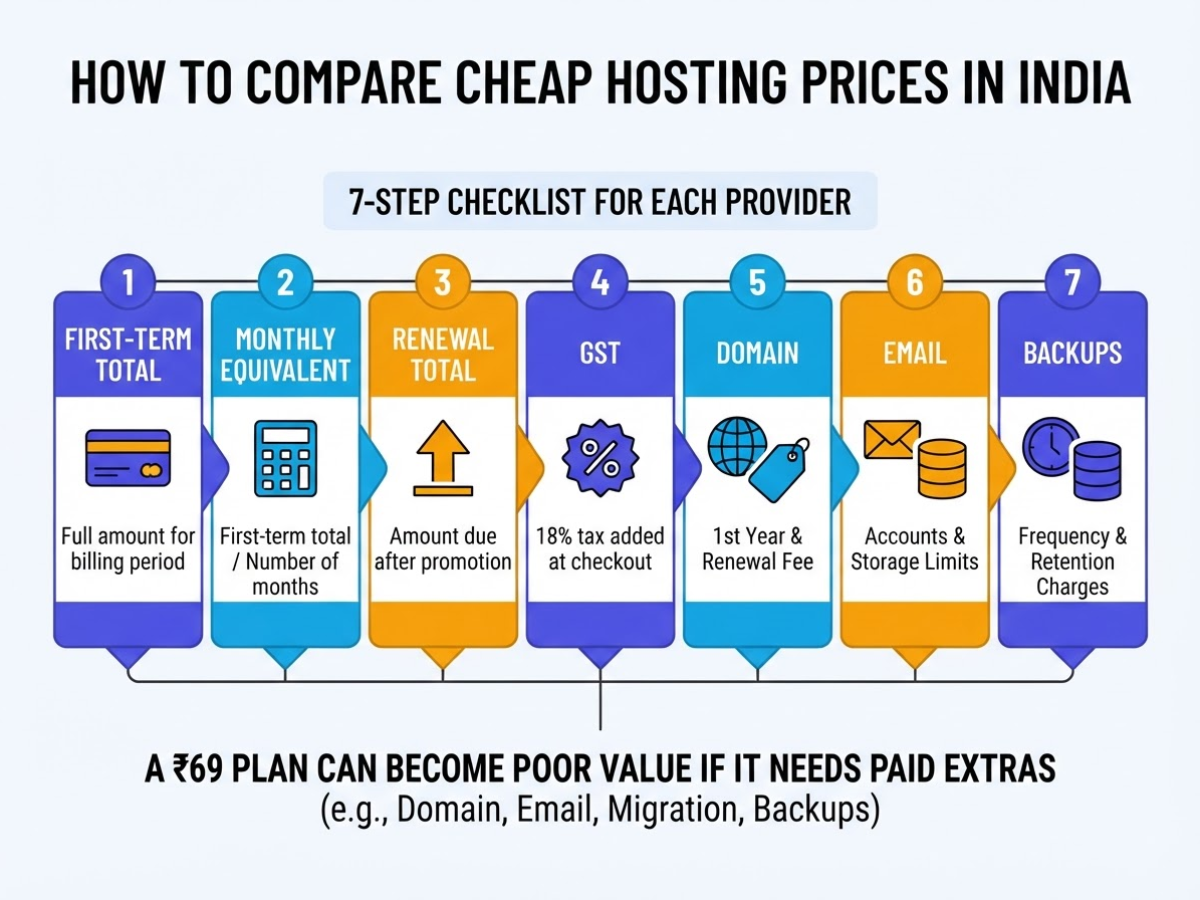
Price tags tell only the first part of the story. When I compare hosting for a small business site, I write down the amount charged today, the amount charged at renewal, and every missing extra before judging the offer. A ₹69 plan can become poor value if it needs a paid domain, email, migration, or backup service.
Use this checklist for each provider:
| Check | What to record |
|---|---|
| First-term total | Full amount for the selected billing period |
| Monthly equivalent | First-term total divided by the number of months |
| Renewal total | The amount due after the promotion ends |
| GST | Whether 18% tax is added at checkout |
| Domain | First-year inclusion and renewal fee |
| Number of accounts and storage limits | |
| Backups | Frequency, retention, and restore charges |
| SSL | Free certificate and renewal terms |
| Websites | Allowed sites, not just subdomains |
| Support | Channels, hours, and response expectations |
Current offers show why this matters. BigRock lists Standard at ₹69 per month, with renewal at ₹409 per month. Its stated package includes one website, 20 GB NVMe storage, 200 GB transfer, 10 email accounts, unlimited databases, daily backups, cPanel, and free Let’s Encrypt SSL. That is a more useful comparison than ₹69 alone.
MilesWeb lists Starter at ₹69 per month on a 36-month term, with 10 GB storage, one website, one email account, daily backups, free SSL, and a free domain for one year. Its page says displayed prices exclude 18% GST. GoDaddy lists Starter at ₹89 per month for the first three-year term, with one website, 10 GB NVMe storage, cPanel, and Node.js. These are not equivalent packages, even though their monthly figures sit close together.
Billing length creates much of the illusion. A 36-month purchase spreads a large upfront payment across 36 months, while a one-month price can reflect a different term or renewal rate. Check whether the displayed figure applies only to the first three-year term, and calculate the checkout total after GST rather than trusting the card on the pricing page.
Pro Tip: Calculate a three-year effective monthly cost that includes renewal exposure, GST, domain fees, and any paid backup or migration add-ons.
Storage and website counts often get the attention, but transfer limits, database access, control panel, backup frequency, and email caps cause more day-to-day irritation. If you run WordPress for one client, cheap Linux hosting can cover the basics; a growing shop can need more sites or mailboxes instead.
Save a screenshot of the offer and read the checkout terms before paying. Promotions, renewal prices, and included extras change, and a support agent can quote a different condition later. With the real cost recorded, you can judge whether the cheapest plan still fits your site’s workload.
How to set up cheap Indian hosting step by step
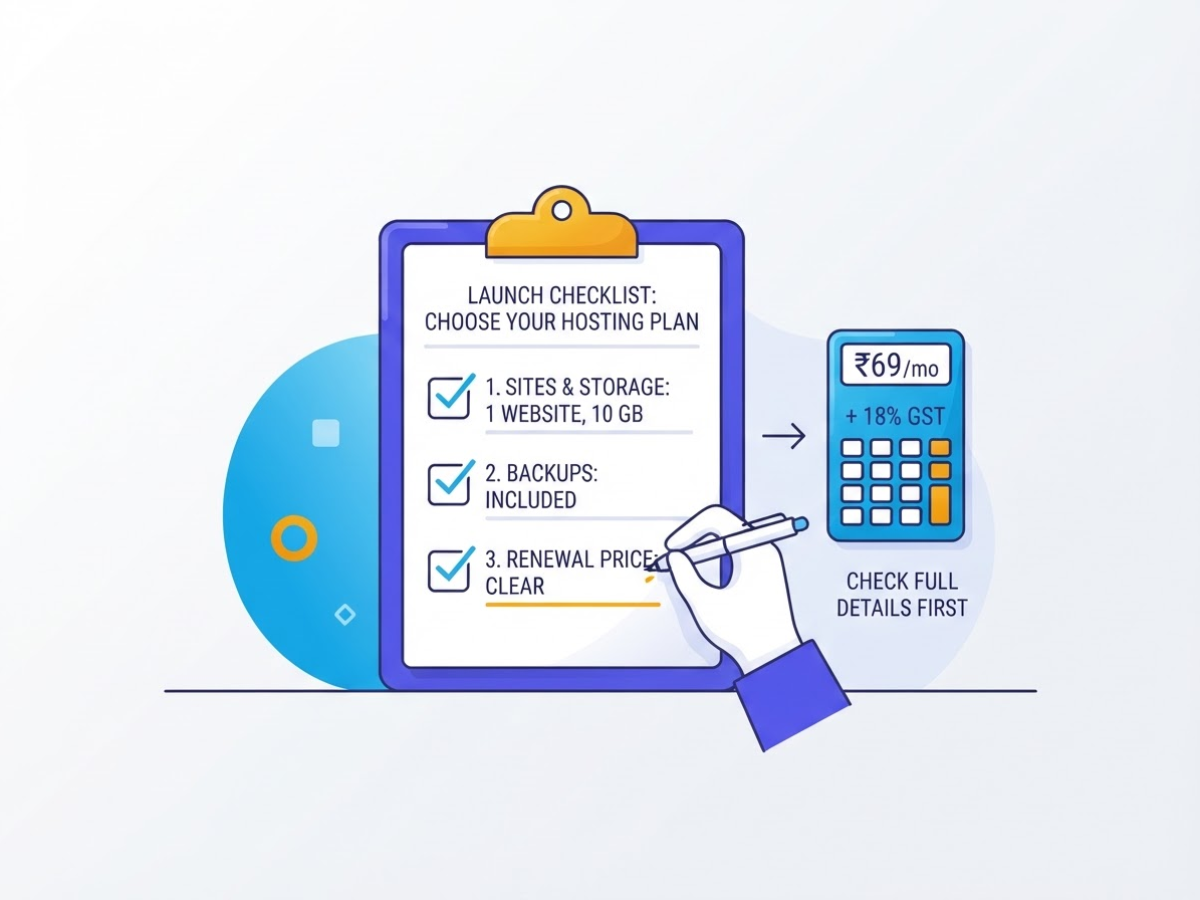
My usual launch checklist starts before you click Buy. A low introductory price can hide a costly renewal, missing backups, or a one-site limit, so check the full plan details first. If you are unsure about the server type, compare cheap Linux hosting with your site’s software requirements.
- Choose the plan around the site, not the discount. Count the websites you will host, then check storage, email accounts, database limits, backup frequency, and the renewal price. A simple portfolio can need one website and 10 GB, while a small shop can quickly need several databases and more storage. Confirm whether the advertised price excludes India’s 18% GST and whether backups are included or sold separately.
- Register or connect your domain. You can buy a new domain during checkout or keep one registered elsewhere. Changing nameservers hands DNS management to the hosting provider; updating individual DNS records keeps management with your registrar and lets you point only the website, email, or other services. I prefer nameservers for beginners, but changing them can interrupt existing email if you do not copy the required records first. This web hosting versus domain name guide explains the distinction clearly.
- Create the website space. Sign in to the control panel, add the domain, and note the document root, such as
public_html/example.com. Use the one-click WordPress installer for a CMS, or upload HTML, CSS, and image files through the file manager or FTP. The common beginner mistake is uploading files one folder too high, leaving visitors with a directory listing or blank page. - Secure and configure it. Activate the free SSL certificate, then open the site with
https://. Check that the non-secure address redirects to HTTPS and that images, menus, and forms do not still load over HTTP. Create one mailbox, such ashello@yourdomain.in, if the plan includes email, and send a test message both ways. - Test before announcing the site. Submit every contact form, click the main links, check the success message, and confirm that enquiries reach the right inbox. Set automatic backups, change the hosting and WordPress passwords, enable two-factor authentication where available, and test the site on a phone using mobile data.
If DNS still shows the old site, allow up to 24 to 48 hours for propagation and recheck the nameservers. If SSL stays pending, confirm the domain points to the new server and remove conflicting certificate settings. If the homepage is missing, move files into the panel’s exact document root and check that the opening file is named index.html or index.php.
After the launch checks pass, you can judge whether the setup is ready for real visitors and keep costs under control.
Mistakes that make budget hosting expensive
The cheapest checkout total can become the most expensive hosting decision after a few months. I have seen site owners compare only the first invoice, then discover a much higher renewal bill, missing backups, or a support queue that leaves a sales page offline.
Check these points before paying:
- Renewal price: Promotional rates often apply only to the first term. For example, BigRock lists Standard hosting at ₹69 per month initially, but ₹409 per month at renewal. Calculate the second-year cost, not just the welcome price.
- GST and contract length: A displayed price can exclude India’s 18% GST. Some offers also require 36 months upfront. MilesWeb, for instance, displays a ₹69 monthly rate on a 36-month term and states that GST is extra. Compare the final checkout amount with the actual commitment.
- Missing essentials: Confirm whether daily backups are included, how long they are retained, and whether you can restore them yourself. Check SSL renewal terms, email account and sending limits, inode counts, CPU or RAM restrictions, database limits, and migration help. A free SSL certificate is not much comfort if renewal requires a manual ticket.
- Wrong plan size: One-site hosting looks cheap until you add a second project and need to pay again. Conversely, a busy store, membership site, or application with background jobs can make shared hosting painfully slow. Use this shared versus VPS hosting comparison before forcing a resource-heavy project onto an entry-level plan.
- Weak launch support: Review uptime commitments and contact methods before your business site goes live. A provider advertising a 99.9% uptime guarantee can still have conditions, so read the service terms and test chat or ticket response times first.
Downtime, slow replies, and a failed migration can cost more than a year of hosting fees, especially when customers cannot place orders or contact you. Those risks make operating cost more useful than headline price.
What to choose as your website grows
I recommend an upgrade only after the hosting account shows a pattern, not because a sales banner says “unlimited.” Repeated CPU or memory warnings, a slow WordPress dashboard, failed cron jobs, database errors, or sluggish pages during traffic spikes are real signals. So are five client sites on one account, a much larger product database, or a business that now depends on the site for leads and orders.
Check your control panel’s resource graphs and error logs first. Note when the problem occurs, which site or plugin caused it, and how often visitors were online. A single bad plugin does not justify a VPS, and paying for 100 GB of storage will not fix a PHP worker limit.
| Next option | Choose it when | What you should gain |
|---|---|---|
| Multi-site shared hosting | You are adding a few small websites | More site slots, storage, email accounts, and fair resource limits |
| Reseller hosting | You host sites for clients or need separate accounts | Account isolation, individual logins, and billing control. See this reseller hosting guide before comparing plans. |
| Managed WordPress hosting | WordPress updates, caching, backups, or security consume your time | Provider-managed maintenance and WordPress-focused support |
| VPS | You need fixed resources, server-level settings, or stronger isolation | Dedicated CPU and memory allocations, root access, and more control |
The cheapest sensible move is often a multi-site shared plan. BigRock’s Business Linux plan is advertised at ₹159 per month, supports five websites, and renews at ₹649 per month. MilesWeb’s Premium plan advertises ₹129 per month on a 36-month term for 25 websites. Compare renewal prices, GST, backup limits, CPU rules, and the support queue before switching.
Do not buy an upgrade merely for a larger “unlimited” allowance. The extra price should buy measurable capacity, better account isolation, faster support, or management features you will use. If your logs show one plugin causing 503 errors, fixing that plugin is cheaper than moving the whole account.
Choose the smallest plan that removes a genuine limit. Then decide whether your present host is still worth keeping.
My honest take on cheap Indian hosting
I do not judge cheap Indian hosting by the smallest number beside “per month.” When I review plans for new sites, I ask a less flattering question: can a beginner launch without discovering a missing backup, weak support channel, or surprise renewal bill after the first payment? A low entry price means little if one avoidable problem forces a rushed migration six months later.
My contrarian view is that the cheapest plan can be the expensive choice. Paying a little more for daily backups, responsive support, and a renewal price shown before checkout often costs less than recovering a hacked site or rebuilding pages from scratch. I have also seen buyers pay for VPS hosting far too early. Most small business sites, portfolios, and first blogs should begin on a right-sized shared plan, then move up only when traffic, storage, or account limits show a real constraint.
I would keep the invoice honest. Separate hosting from the domain, business email, and optional marketing services so you know what each item costs. Free extras can help, but they often become confusing at renewal. For me, good value means predictable ownership, not a flashy introductory price.
— AVM Cloud Content Strategy Team
Find affordable hosting for your next website
If you have worked through the checklist, compare affordable hosting options for your Indian website rather than assume one plan fits everyone. At AVM Cloud, I would start by matching the plan to the number of websites you actually need. Paying for unused sites is a common mistake, while choosing too little space creates another headache later.
DomainAdda, our parent brand, lets you review low-cost Linux hosting plans and keep domain and hosting management in one place. Before ordering, check the billing term, renewal price, GST, backups, SSL, and support response. Introductory pricing can look attractive until renewal, and backup details are often vague. For more context, read this broader DomainAdda hosting review and compare the trade-offs for your site.
Frequently Asked Questions
How much does hosting cost in India per month?
Promotional shared hosting can start at about ₹69 to ₹89 per month, but the amount you actually pay depends on the billing term, renewal rate, GST, domain fees, and add-ons. I always check the full checkout total because a ₹69 monthly offer can require a 36-month commitment and renew at a much higher price.
Which hosting is best for a small business in India?
For a brochure site or local service business, entry-level shared hosting with SSL, backups, email, and responsive support is usually enough for the first 1 to 3 websites. Pick a plan with a clear upgrade path, since CPU limits, support quality, and outage response often matter more than storage.
Is cheap hosting safe for WordPress?
It can be safe if the provider includes SSL, routine backups, current server software, account isolation, and a way to restore your site. Before publishing, update WordPress and its plugins, use a unique password of at least 12 characters, and confirm how long backups remain available.
Does hosting price include GST in India?
Not always. Some providers show prices before GST, while India’s GST rate for IT services is 18%. Check the final amount at checkout and compare the tax-inclusive total for the complete billing term, not just the advertised monthly figure.
Can I host multiple websites on one cheap hosting plan?
Only when the plan explicitly supports multiple websites or domains and provides enough CPU, memory, storage, databases, and email accounts for them. A plan limited to 1 website does not become suitable for extra projects because it has unused disk space, and a second busy site can trigger resource limits.
Recommended reads
- Cheap Linux Hosting
- Domainadda Hosting Review Everything You Need To Know
- Shared Vs Vps Hosting Know Which Is The Best Option
- Web Hosting Vs Domain Name The Difference
Sources
- Buy Web Hosting – Fast, Secure & Reliable | BigRock
- Buy Web Hosting Services | Unlimited Bandwidth Hosting Plans
- Web Hosting | Lightning Fast Hosting & One Click Setup – GoDaddy
- Question 5: What is the rate of tax on IT services?
- Press Release Page | Press Information Bureau
- Understanding Core Web Vitals and Google search results | Google Search Central
- Web Hosting | Secure Web Hosting Services with 24/7 Support
Buy Cheap Domain : India Buying Guide
22/10/2026[…] Cheap Indian Hosting A Practical Buying Guide […]