

Avoiding Common Bulk SMS Marketing Mistakes
TL;DR: Avoid common bulk SMS marketing mistakes by collecting valid consent, completing India’s DLT sender and template registrations, keeping messages concise and relevant, and tracking opt-outs, delivery rates, and replies. Keep standard GSM messages within 160 characters, and use a pre-send check to confirm the recipient list, approved template, timing, links, and opt-out instructions before each campaign. A short checklist prevents wasted credits, avoidable complaints, and messages sent to the wrong audience.
You send a bulk SMS blast expecting quick sales, then discover the offer reached old customers, wrong locations, or people who never asked for it. Within hours, replies turn sour, your budget has paid for wasted segments, and complaints start landing. In India, TRAI lists six requirements for bulk communication, including Principal Entity registration, header assignment, content-template registration, and applicable consent-template registration and customer-consent acquisition. This guide shows Indian businesses using AVM Cloud and DomainAdda how to validate permission, prepare compliant sender details, segment recipients, write and test messages, schedule sends, handle links and character limits, and measure outcomes without mistaking delivery volume for success.
Table of Contents
- What Counts as a Bulk SMS Marketing Mistake?
- Is Your Business Ready to Send Commercial SMS?
- A Pre-Send Workflow That Prevents Most Errors
- The Mistakes That Damage Trust, Delivery, and Budget
- Bulk SMS Versus Other Channels: Where Mistakes Multiply
- How to Measure Whether You Fixed the Problem
- My honest take on avoiding bulk SMS mistakes
- Prevent bulk SMS mistakes with a better sending process
- Frequently Asked Questions
- Recommended reads
| Point | Details |
|---|---|
| Verify Permission First | Use documented, campaign-specific consent and keep an auditable record of each subscriber’s source before sending commercial SMS. |
| Complete TRAI Setup | Indian senders need 4 registrations or approvals: Principal Entity, header, content template, and applicable consent template. |
| Keep Messages Focused | A GSM-7 SMS holds 160 characters in one segment, while UCS-2 holds 70, so unnecessary symbols can trigger extra segments. |
| Respect Opt-Outs | Process unsubscribe replies promptly and aim to keep SMS opt-out rates below 1%. |
| Measure Business Outcomes | Track delivery, clicks, conversions, complaints, and opt-outs by campaign instead of judging results by send volume alone. |
What Counts as a Bulk SMS Marketing Mistake?
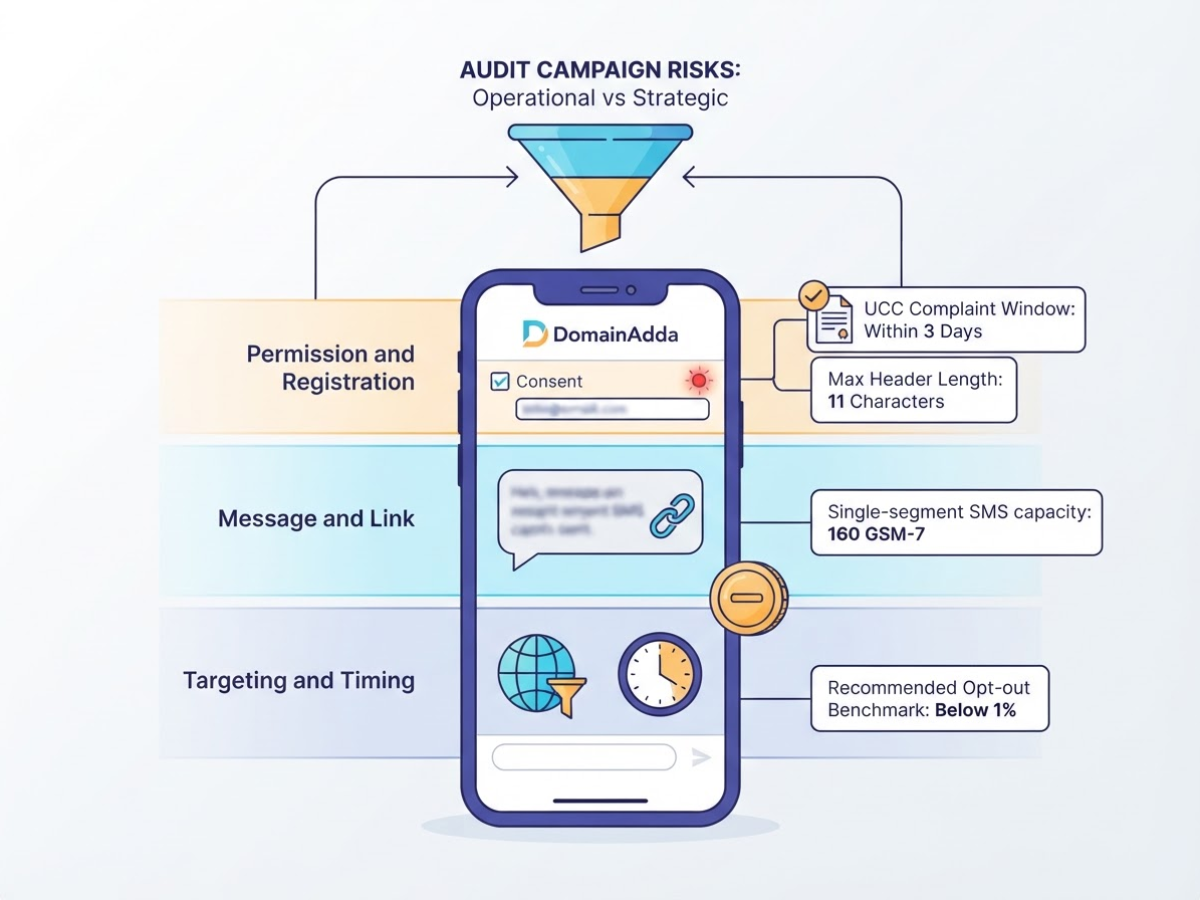
A bulk SMS marketing mistake is any sending, setup, or measurement error that damages legality, deliverability, cost, customer trust, or conversions. When I audit campaigns, I do not treat a failed send and a weak offer as the same problem. One is operational; the other is strategic, but both can waste money.
Start by sorting the risk before rewriting the message:
| Mistake category | What to check | Likely result |
|---|---|---|
| Permission and registration | Consent, sender identity, headers, templates, and opt-outs | Complaints, filtering, or regulatory trouble |
| Message and link | Clear copy, correct offer, working destination, and segment length | Confusion, extra SMS charges, or abandoned clicks |
| Targeting and timing | Audience fit, location, customer status, and send hour | Irritation and low response |
| Reporting | Delivery, clicks, replies, conversions, and unsubscribes | False confidence and repeated errors |
In India, uploading a contact list to a messaging platform is not enough for commercial communication. TRAI’s sender requirements include Principal Entity registration, header and content-template registration, identifier transmission, and applicable consent registration and customer consent. A campaign can therefore fail before the first message leaves your account. Buying or importing a list is especially risky because you may have no defensible record of permission.
Copy mistakes are easier to spot, but they still cause expensive friction. A recipient should know who sent the message, what the offer is, and what action to take. Check your bulk SMS timing as carefully as the wording, then test every link on a phone. A message sent at the wrong hour or to the wrong segment may deliver perfectly and still produce no sale.
Pro Tip: Treat every complaint or opt-out as campaign feedback and record the audience segment, message, timing, and source that produced it.
The practical test is simple: could the recipient identify the sender, understand the offer, and choose what to do next? The next section examines the permission and registration mistakes that create the greatest compliance risk.
Is Your Business Ready to Send Commercial SMS?
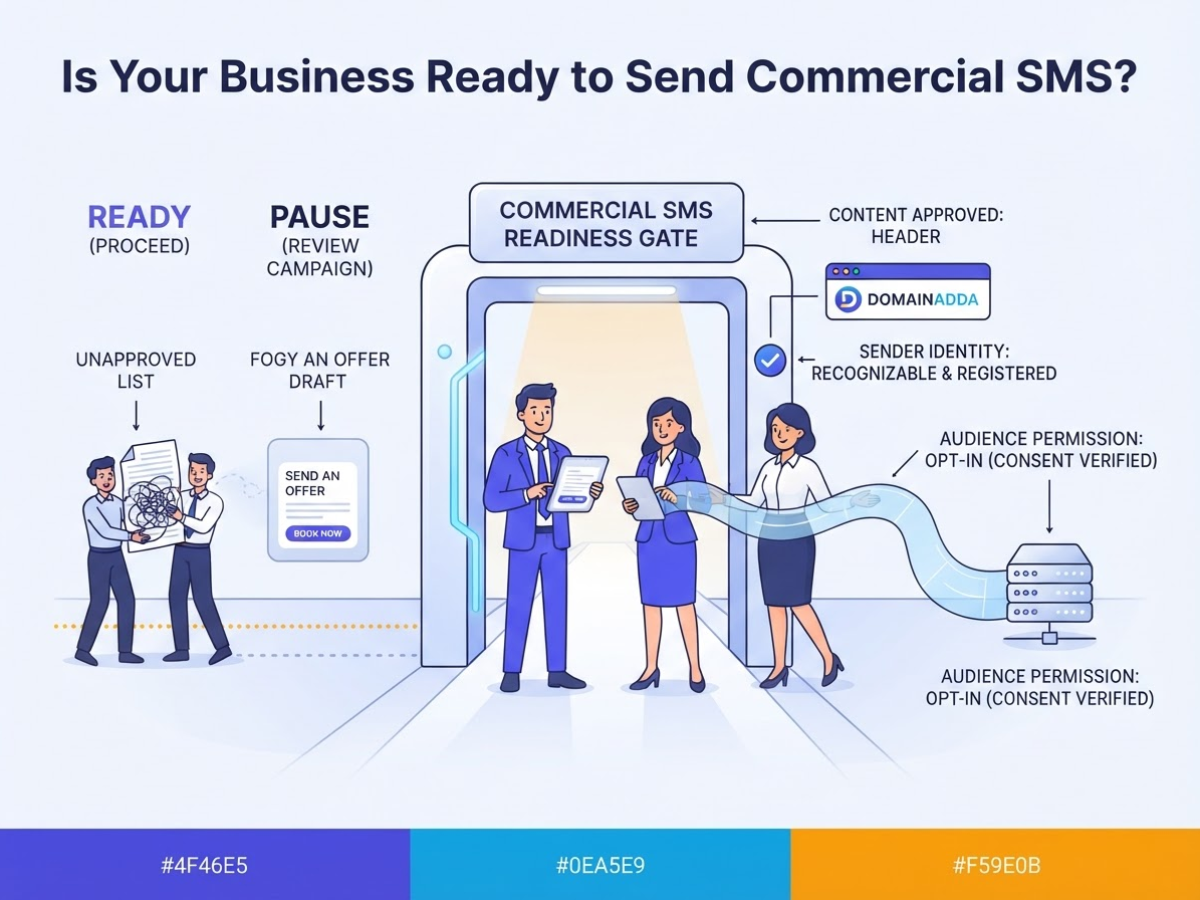
Before you buy credits or upload a contact file, run a simple readiness gate. In campaign reviews, the biggest warning sign is not a weak headline. It is a team that cannot explain why each recipient is getting the message or who will handle the reply.
| Check | Ready means | Pause if… |
|---|---|---|
| Objective | You can name one action, such as booking, renewing, or visiting a store. | The goal is simply “send an offer.” |
| Audience | You can show where each number came from and what permission covered. | The list was bought, shared, scraped, or copied from an old event. |
| Sender identity | The sender name or header is registered and recognisable. | Recipients may mistake the message for a stranger or another brand. |
| Content | Someone has approved the offer, link, timing, and opt-out wording. | Pricing, terms, or the destination page is still changing. |
| Support | A real person or inbox can answer replies and complaints. | Replies will disappear into an unmonitored number. |
Treat the message purpose carefully. Promotional SMS asks someone to buy, upgrade, book, or claim an offer. Transactional messages report an action the recipient has already taken, such as an order update or payment notice. Service-related texts support an ongoing relationship, such as an appointment change. These labels help you plan consent, content, and handling, but they do not automatically settle the rules that apply to your campaign.
For India, TRAI’s sender requirements include principal-entity registration, header and content-template registration, and consent steps where applicable. Commercial SMS must use a registered header, which can contain no more than 11 alphanumeric characters. If you cannot verify the consent wording, contact source, or sender identity, stop the send. A smaller list of customers who clearly know your business is safer than 50,000 unqualified numbers.
Pro Tip: Ask one colleague who was not involved in the campaign to explain what the recipient should do after reading the SMS; confusion usually exposes weak targeting or copy.
For international audiences, check each destination market separately. UK consumer marketing texts generally require specific consent, with a limited existing-customer exception, while CTIA guidance identifies opt-in consent and an opt-out route as foundational for US business messaging. Your bulk SMS planning process should record those differences before scheduling the send. Next, inspect the consent and list-building mistakes that create avoidable complaints.
A Pre-Send Workflow That Prevents Most Errors
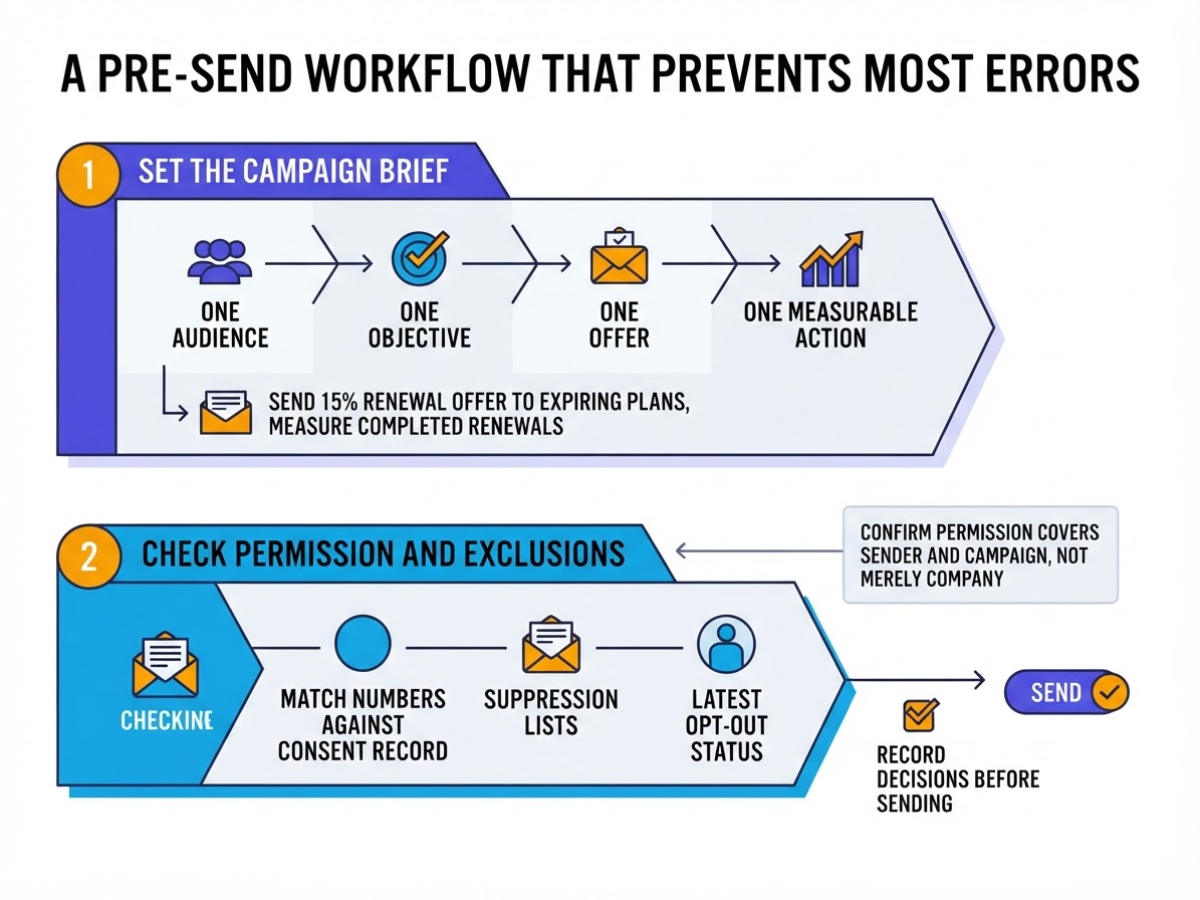
A reliable pre-send routine takes less time than repairing a campaign sent to the wrong list. Use the same checklist every time, even for a small promotion, and record each decision before anyone presses Send.
- Set the campaign brief. Choose one audience, one objective, one offer, and one measurable action. For example: send a 15% renewal offer to customers whose plans expire this month, then measure completed renewals. If a message tries to sell, educate, remind, and collect feedback at once, rewrite it.
- Check permission and exclusions. Match every number against its consent record, suppression list, and latest opt-out status. Confirm that the permission covers this sender and campaign, not merely your company in general. CTIA guidance says an opt-in should apply to the specific campaign or campaigns and Message Sender for which it was obtained. Do not use a purchased or shared list because it is convenient.
- Verify India’s registration chain. Before sending commercial SMS in India, confirm the Principal Entity, registered header, content template, and any applicable consent-template registration. Also check that the transmission includes the required PE ID, header, and content ID. TRAI’s sender requirements make this a pre-send control, not paperwork to finish afterward. Your commercial header must be registered and may contain no more than 11 alphanumeric characters.
- Write for the recipient, not the dashboard. Identify the sender, state the benefit, include the expiry date or timing, and give one clear action. Add a suitable reply or opt-out path. A message such as “AVM Cloud: Renew hosting at 15% off by 30 Nov. Pay at example.in/renew. Reply STOP to opt out” is easier to understand than vague promotional copy.
- Test the actual message. Send it to internal numbers on different phones and networks. Check rendering, links, personalization fields, punctuation, encoding, and segment count. GSM-7 allows 160 characters in one segment, while UCS-2 allows 70, so an emoji or smart quote can unexpectedly increase cost. Review the send schedule too, using your bulk SMS timing guidance as a practical reference.
Pro Tip: Use a campaign ID in your internal records and link every message version to its consent source, template approval, audience segment, and final results.
- Run a controlled release. Send a small test group first. Review delivery, rejection, opt-out, and error signals for 10 to 15 minutes, then release the approved audience only if the results match expectations. Stop the campaign when personalization or routing fails.
- Archive the evidence. Save the final copy, approval details, audience source, consent check, registration IDs, test results, and performance report. This archive turns a complaint or billing dispute into a traceable issue instead of a guessing exercise.
Once this workflow is routine, the next review should focus on the message and audience signals that reveal whether the campaign actually worked.
The Mistakes That Damage Trust, Delivery, and Budget
Trust usually disappears before the first campaign report arrives. In campaign reviews, the same failures keep appearing: a weak list, an unfamiliar sender, a rushed offer, or no one watching what happens after the send.
- Using a list you did not earn: Purchased, rented, shared, stale, and unverified numbers create complaints, dead sends, and accidental messages to people who never agreed to hear from you. Build a permissioned audience through checkout, a website form, or a keyword opt-in. CTIA advises senders to create and vet their own opt-in lists, rather than treating another company’s list as transferable permission.
- Hiding behind an unclear sender: An unregistered or inconsistent header makes a legitimate message look like spam. In India, commercial SMS requires a registered sender header, which can contain no more than 11 alphanumeric characters. Keep the same recognisable header across campaigns and complete the required sender, template, and consent registrations before sending.
- Cramming several offers into one text: “20% off, free shipping, new arrivals, and refer a friend” is not a campaign strategy. It is a crowded message. Choose one offer and one action, such as “Use SAVE20 by Friday: example.com/deal.” The recipient should understand the next step without rereading the SMS.
- Ignoring context: A 9 a.m. message in the customer’s local time may be fine, while the same send at 11 p.m. is intrusive. Segment by location, language preference, buying stage, and recent contact history. Set a frequency cap, and use a timing plan for bulk SMS sends instead of blasting every contact whenever the sales team remembers.
- Breaking personalization and links: A message that says “Hi {{first_name}}” or sends a customer to a page that does not show the promised discount feels careless. Test populated variables with real records, scan every link, and check the landing page on a phone before launch. Keep the link destination identical to the offer in the SMS.
- Treating opt-outs as optional: Include a clear reply keyword such as STOP, process it immediately, and suppress that number across every campaign. Continuing to message someone after an opt-out is one of the fastest ways to turn irritation into a complaint. Indian subscribers can report unsolicited commercial communication through 1909, and complaints made within three days are treated as valid complaints by TRAI.
- Going silent after launch: Delivery rate alone hides problems. Check delivery failures, replies, complaints, clicks, and opt-outs within the first few hours, then again after 24 hours. Pause a campaign when opt-outs spike instead of spending more credits on a damaged segment.
These checks expose the costly mistakes before they become a repeatable sending habit.
Bulk SMS Versus Other Channels: Where Mistakes Multiply
SMS earns its place when timing matters, not when you have a page of information to explain. In client campaigns, the biggest mistake was treating a text like a smaller email. Customers scan SMS quickly, expect a clear reason for the interruption, and often act from a phone with limited patience.
| Factor | SMS | |
|---|---|---|
| Immediacy | Usually noticed quickly, making it useful for time-sensitive prompts | Can sit unopened for hours or days |
| Message space | Tight; one GSM-7 segment holds 160 characters, while UCS-2 holds 70 | Room for detailed copy, images, menus, and legal information |
| Creative flexibility | Limited formatting and visual design | Supports layouts, images, buttons, and longer explanations |
| Inbox competition | Fewer competing messages, but the interruption feels more personal | More crowded, yet customers can read at their own pace |
| Customer expectation | Short, relevant, and actionable | Informative, browsable, and less immediate |
Use SMS for an urgent appointment reminder, a short offer, an authentication-related notice, or one next action such as “Confirm pickup by 6 p.m.” Do not force a product story, pricing explanation, and terms into one text. Send the context by email, use SMS for the timely prompt, and place the full details on a landing page. This guide to integrating bulk SMS with email marketing covers the basic pairing, but the handoff still needs testing on real devices.
Coordination creates its own traps. Repeating the same promotion in an email and three texts feels like pressure, not consistency. Use one offer name, the same landing-page price and expiry, and a recognisable sender identity across channels. Apply one suppression rule too, so a completed purchase or opt-out stops every related follow-up.
Email consent does not automatically authorise SMS. CTIA guidance says an opt-in should apply only to the specific campaign and message sender for which it was obtained, so keep channel consent records separate. Next, match each message to a sending time and frequency that customers can reasonably tolerate.
How to Measure Whether You Fixed the Problem
The report only matters if it connects message hygiene to money, leads, and customer damage. I review each send in this order, because a high delivery rate can hide a badly targeted offer.
- Within 24 hours, check delivery health. Record delivery rate, failed-delivery rate, click-through rate, conversion rate, revenue or leads, complaint rate, and opt-out rate. Separate temporary carrier failures from invalid numbers, then investigate any sudden rise in either group. A message that reaches 98% of recipients but produces almost no clicks may have a weak offer, a landing page that does not match the promise, or a call to action nobody understands.
- By 48 to 72 hours, review audience response. Treat below 1% as a monitoring target for opt-outs, consistent with Twilio’s SMS KPI guidance. Do not treat it as a universal pass mark, though. Industry, audience quality, sending frequency, and campaign type change what “normal” looks like. A service reminder and a flash sale should not share the same benchmark.
- Before calling the campaign successful, break down the averages. Compare results by consent source, audience segment, message length, send time, and offer. A long message may split into multiple billable segments because one SMS holds 160 GSM-7 characters or 70 UCS-2 characters, as Twilio documents. Overall averages often conceal the segment that caused the complaint spike or paid for weak clicks.
- Pause immediately when a stop condition appears. Rising complaints, unusual opt-outs, broken links, incorrect personalization, or unexpected message segmentation should halt the next batch. Do not send the remaining contacts just to complete the schedule. That is how a small template error becomes an expensive cleanup job.
- Within one week, hold a short post-campaign review. Save the baseline, identify the largest failure, and choose one controlled improvement for the next send, such as a different offer or send time. Change one major variable, keep the audience and tracking method stable, then compare the new results with the original.
That review gives you a defensible decision about whether to continue, revise, or stop the next campaign.
My honest take on avoiding bulk SMS mistakes
The biggest bulk SMS mistake I see is treating compliance as a technical checkbox at the end. Teams configure sender IDs, upload a contact file, and only then ask whether recipients gave clear permission. I prefer to design the campaign around permission, relevance, and recipient control from the first draft. That means documenting consent, explaining what subscribers will receive, and making opt-out handling a real operating process, not a line in a policy document.
Here’s the contrarian part: sending less often is not automatically safer. A timely delivery update or an expected appointment reminder can build trust, while one supposedly “safe” promotional message sent to the wrong audience can damage it. Frequency matters, but relevance matters more. I would rather send three useful messages to 2,000 documented subscribers than blast 50,000 contacts whose consent nobody can prove.
I also judge a campaign by complaints, opt-outs, and conversions, not delivery volume. A high delivery count can hide a poor customer experience. For Indian businesses, I would validate the TRAI-related sender, template, consent, and routing setup before launch, even when the paperwork feels tedious. That preparation causes friction upfront, but it prevents avoidable failures and gives you results worth trusting.
— AVM Cloud Content Strategist
Prevent bulk SMS mistakes with a better sending process
Before you launch, review the sender name, audience permissions, message template, test numbers, and reporting plan. I have seen teams spend more time fixing a mistyped link or an unapproved contact list than writing the campaign. A platform helps organise these checks, but it cannot create consent or make careless targeting responsible.
AVM Cloud and DomainAdda are practical options if you need affordable SMS marketing infrastructure alongside email, hosting, or campaign preparation support. You can compare lower-cost SMS and email marketing services or read guidance on choosing a bulk SMS provider in India before committing. The setup still takes a little patience, especially when sender details and reports need checking, but a clear workflow reduces avoidable mistakes. Review the available services or speak with the team when you are ready.
Frequently Asked Questions
How often should a business send bulk SMS marketing messages?
There is no universal number, but starting with 2 to 4 promotional messages per month gives you a reasonable control point for many businesses. Set the limit in writing, explain expectations during signup, and reduce the frequency if opt-outs or complaints increase.
Can I use a purchased phone number list for bulk SMS marketing?
A purchased list usually cannot prove that each recipient gave consent to your specific sender and campaign. Build your own permissioned audience and keep records showing when, where, and how consent was collected, ideally for every subscriber.
What should a promotional SMS include in India?
Identify the sender, state 1 clear purpose, use the required registered setup and approved template, and include an appropriate response or opt-out route where applicable. Keep the message short, because extra wording can push it into additional segments and make the campaign cost more than expected.
Why are my bulk SMS messages being split into multiple parts?
Encoding and length usually cause the problem: GSM-7 supports up to 160 characters in one segment, while UCS-2 supports up to 70. Emojis and some special characters can switch the message to UCS-2, splitting a message and potentially increasing your cost.
What should I do if someone complains about an unsolicited marketing SMS?
Stop sending messages to that recipient, record the complaint and suppression action, then check the consent source, sender identity, template, and audience segment. In India, subscribers can use 1909, and TRAI treats complaints made within 3 days as valid unsolicited commercial communication complaints.
Recommended reads
- How To Choose The Right Bulk Sms Provider In India
- Why Sms Marketing Is Still Popular In India Even With New Rules
- Integrating Bulk Sms With Email Marketing
- Timing Your Bulk Sms Sends For Maximum Engagement
Sources
- Advice to Senders | Telecom Regulatory Authority of India | Government of India
- Complain or report against UCC | Telecom Regulatory Authority of India | Government of India
- Unsolicited Commercial Communications(UCC) | Telecom Regulatory Authority of India | Government of India
- CTIA – Messaging
- Messaging Principles and Best Practices
- SMS marketing KPIs: How to measure your SMS marketing campaign’s success | Twilio
- Sending Shortened Links in Your Messages – Twilio Help Center
- How long can a message be? | Twilio
- Electronic mail marketing