
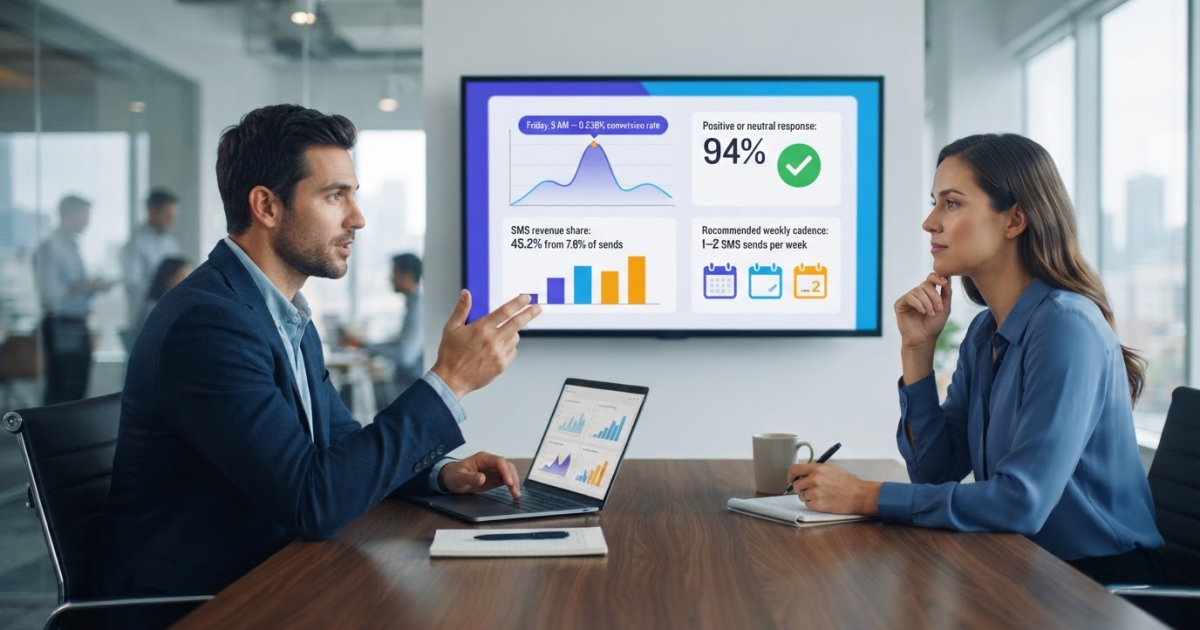
Timing Your Bulk SMS Sends for Maximum Engagement
TL;DR: Send bulk SMS on weekdays during local daytime hours, then test at least two slots, such as late morning and early afternoon, for each audience time zone. Use click, conversion, and unsubscribe rates to adjust the schedule. Urgency and industry often matter more than any universal “best time.”
A relevant SMS can still fall flat when it arrives while customers are asleep, commuting, working, or handling family routines. I have seen good offers ignored because the send time felt intrusive. Attentive found that messages sent between 1 p.m. and 5 p.m. Eastern Time were associated with stronger revenue and click-through performance. Use that benchmark as a starting point, then adapt it to local time zones, message urgency, customer behavior, Indian commercial-communication rules, and your platform’s reporting.
Table of Contents
- Why Send Time Changes Bulk SMS Engagement
- Build a Send-Time Baseline for Your Audience
- Match Timing to Message Urgency and Audience
- Weekday or Weekend? Compare Timing Hypotheses
- Timing Mistakes That Trigger SMS Opt-Outs
- Measure Results and Refine Your SMS Schedule
- My Honest Take on Bulk SMS Timing
- Turn Better Timing Into Better Bulk SMS Campaigns
- Frequently Asked Questions
- Recommended reads
| Point | Details |
|---|---|
| Start With Weekdays | Use weekday daytime windows as your control, then compare weekend sends after at least 2 campaigns. |
| Respect Local Time | Schedule each recipient for their own time zone so one campaign does not arrive at 6 a.m. or 11 p.m. locally. |
| Segment By Intent | Separate promotional, reminder, alert, and transactional messages because each has a different urgency. |
| Test One Variable | Compare at least 2 send windows while keeping the audience, offer, copy, and call to action unchanged. |
| Watch Unsubscribe Rate | Treat rising opt-outs as a timing or relevance warning, using 2% per campaign as a practical ceiling from Klaviyo guidance. |
Why Send Time Changes Bulk SMS Engagement
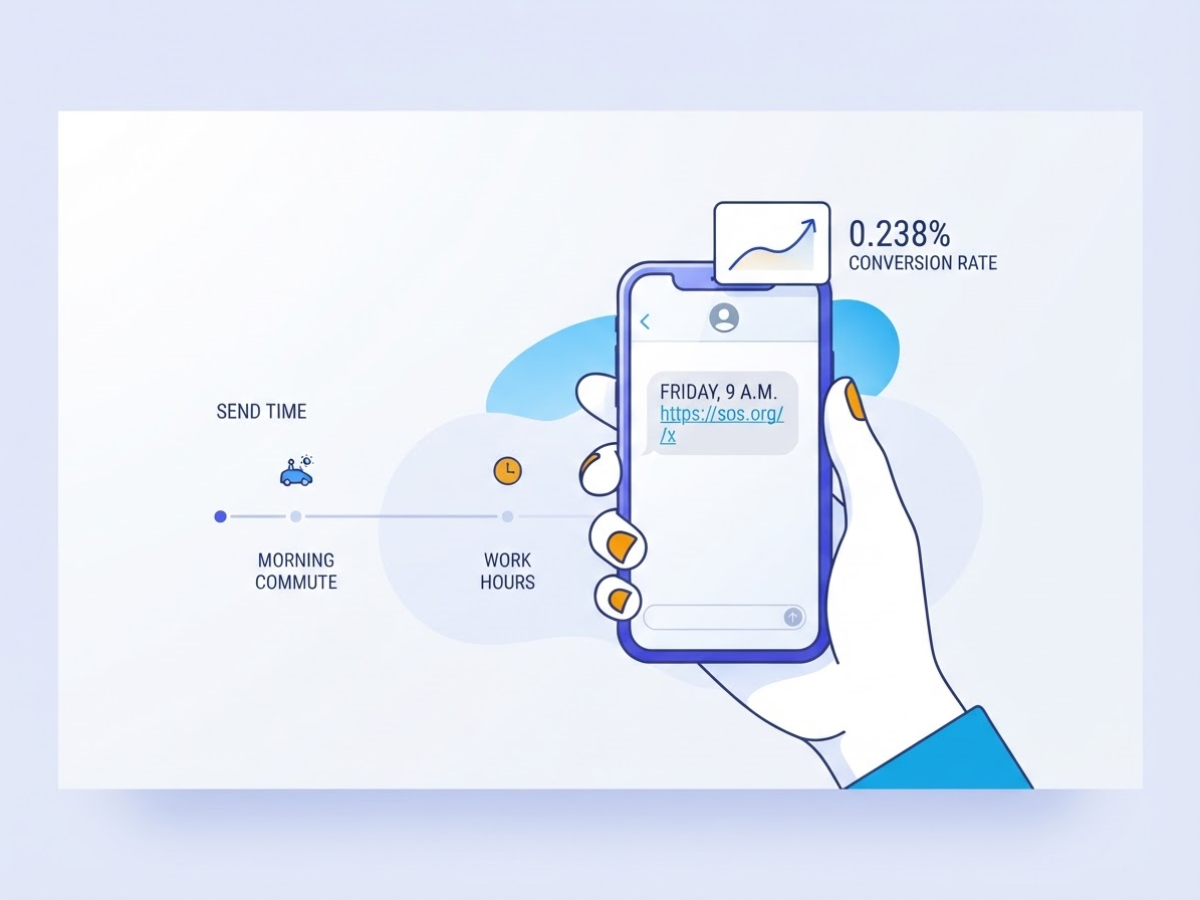
When I plan SMS campaigns for clients, send time is one of the easiest variables to change and one of the easiest to misread. Timing affects whether someone notices, considers, and acts on a message. A delivery report cannot tell you whether the timing worked.
Keep these outcomes separate:
| Metric | What it tells you |
|---|---|
| Delivery rate | Whether the carrier accepted the message for the recipient’s number |
| Read behavior | Whether recipients likely saw or opened it, where your platform can measure that |
| Click-through rate | Whether recipients tapped the link |
| Conversion rate | Whether they completed the target action, such as a purchase or booking |
| Unsubscribe rate | Whether the message caused people to leave your list |
A text delivered during sleep may sit unseen for hours. One sent during a work meeting may be dismissed. A message arriving during a commute, lunch break, evening shopping trip, or local payday routine faces a different response. The offer matters, but context decides whether the recipient has the attention and immediate need to use it.
A benchmark is only a hypothesis. Attentive’s SMS campaign data associated 1 p.m. to 5 p.m. Eastern Time with higher revenue and click-through rates, while weekdays generally produced more revenue per send and weekends sometimes produced higher click-through rates. That does not make 2 p.m. the proven best hour for your business. A restaurant, clinic, online retailer, and emergency service will see different patterns.
Your recipient’s local time matters more than the time zone attached to your marketing account. A 10 a.m. send in your dashboard could reach one customer at breakfast and another at 4 a.m. if you treat a national list as one region.
Pro Tip: Build the first test around the time zone where most recipients live, then split smaller regions instead of averaging them into one send time.
Use that initial hypothesis to design a test that compares timing without confusing it with audience or offer differences.
Build a Send-Time Baseline for Your Audience
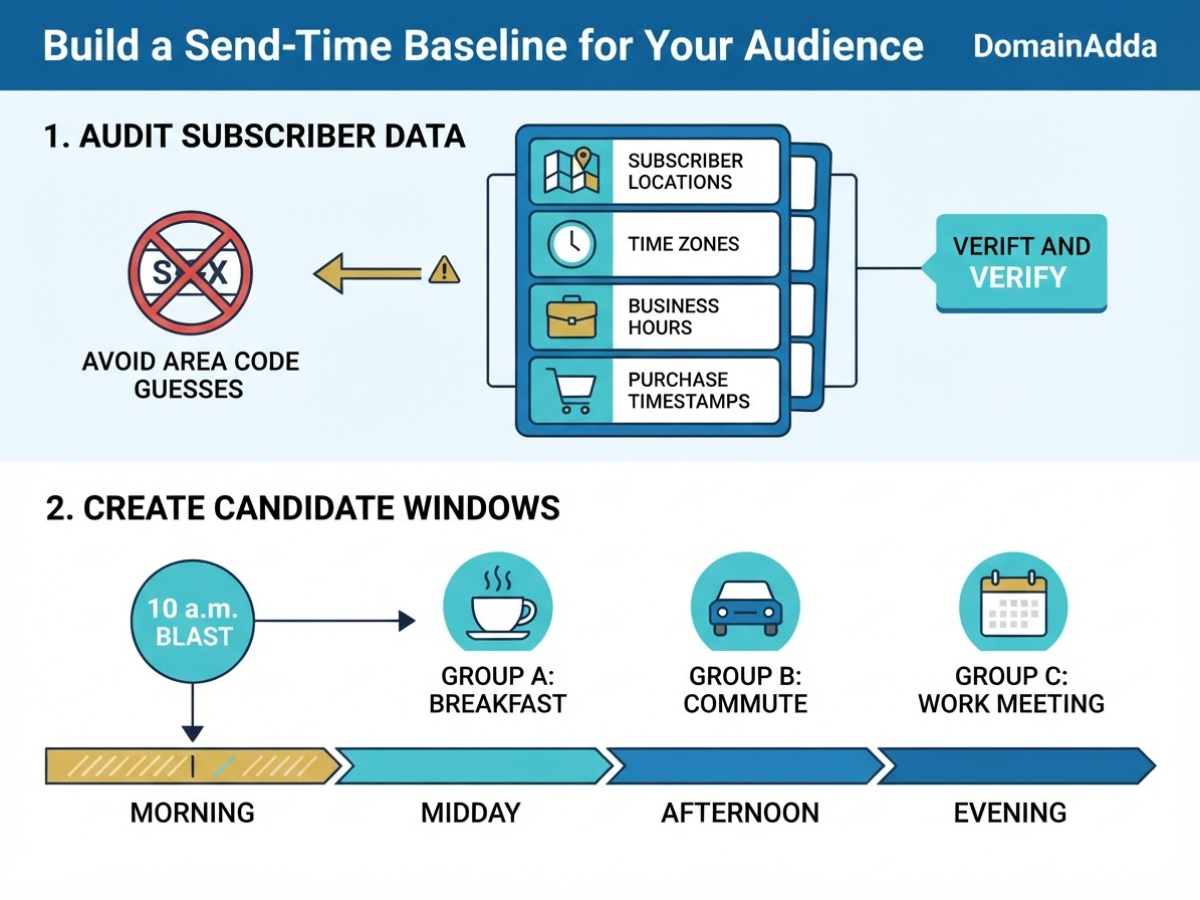
Before choosing a send time, I build a rough map of the audience. A national list often hides three different customer routines, and a single 10 a.m. blast can arrive during breakfast for one group and a meeting for another. Treat timing as an operating decision you can test, not a universal rule.
- Audit what you already know. Export subscriber locations, time zones, business hours, purchase timestamps, and consent records. Check whether consent covers promotional SMS, which weekdays or time bands subscribers accepted, and whether older records lack usable location data. Do not guess from the area code. People keep numbers when they move.
- Create three or four candidate windows. Start with morning, midday, afternoon, and early evening. Test 8:30 a.m., 12:30 p.m., 3:30 p.m., and 6 p.m. in each recipient’s local time. Attentive’s SMS campaign data associated 1 p.m. to 5 p.m. Eastern Time with stronger revenue and click-through rates, while Omnisend’s 2026 dataset identified Friday at 9 a.m. as its strongest conversion slot. These are starting points, not promises.
- Split the schedule by time zone. Deliver at the selected local time instead of launching one national send simultaneously. If your SMS platform cannot do this automatically, create separate segments for Eastern, Central, Mountain, and Pacific audiences. The manual setup is annoying, but waking someone at 6 a.m. costs more than a few minutes of administration.
- Choose one control window. Make one slot your comparison point, such as Tuesday at 10 a.m. Document the audience, offer, copy, send time, and objective. Keep those elements stable while testing timing, or you will mistake a better discount for a better hour.
- Set test rules before sending. Aim for at least 500 delivered messages per window when possible, and run each test for 2 to 4 comparable campaigns. Judge click-through, conversion, revenue per delivered message, and unsubscribes together. A high click rate is not a win if complaints rise.
Pro Tip: Keep a timing log with the campaign objective, audience segment, local send window, and result so future decisions rely on comparable tests rather than memory.
When you schedule through a bulk SMS service, confirm that its time-zone setting uses each contact’s stored location, not your account timezone. Then refine windows by audience behavior rather than hunches.
Match Timing to Message Urgency and Audience
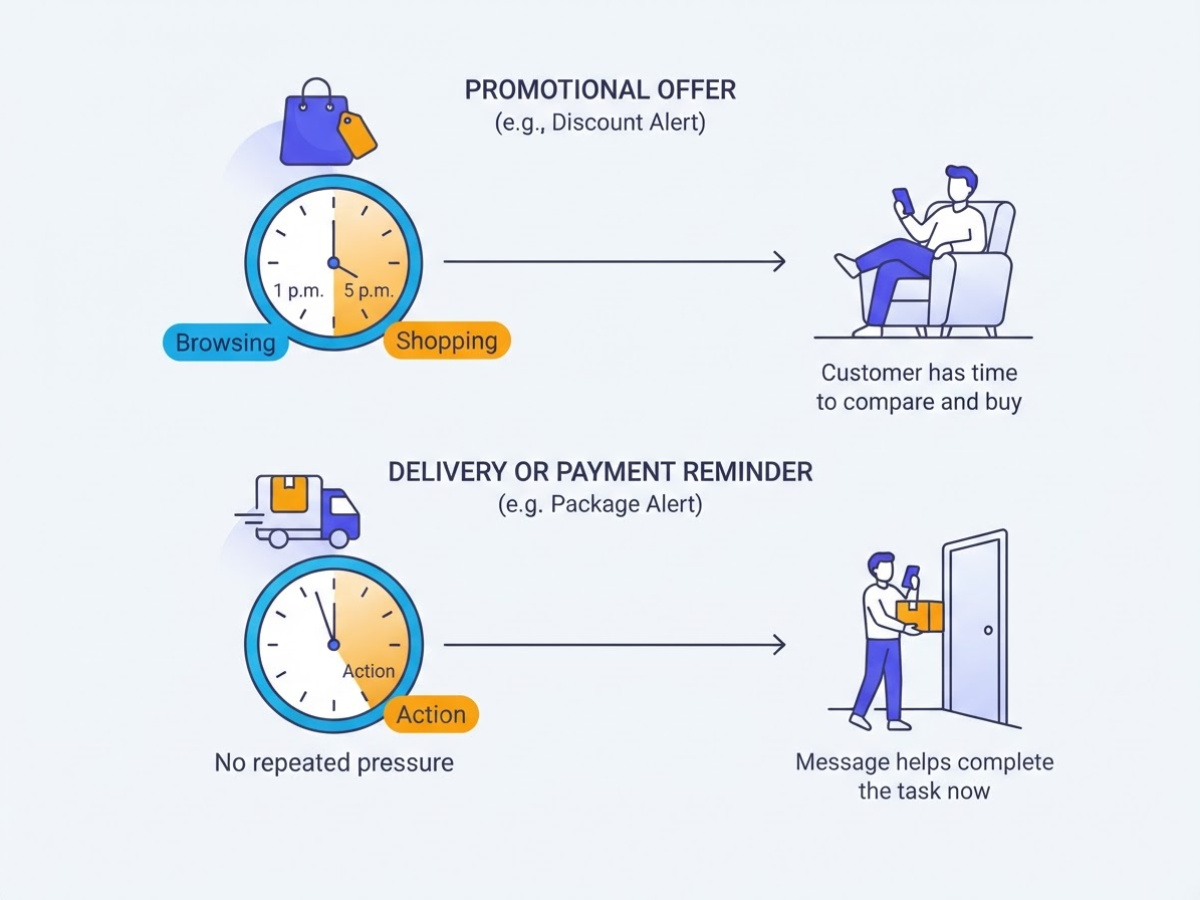
A discount message and a delivery alert should not compete for the same clock. I choose the action behind the SMS first, then check when that audience is available.
| Message type | Suitable starting window | Timing test |
|---|---|---|
| Promotional offer | 1 p.m. to 5 p.m. for browsing, or a known shopping period | Does the customer have time to compare and buy? |
| Appointment or event reminder | 24 hours before, plus a short final reminder when needed | Can the recipient prepare, reschedule, or travel? |
| Delivery or payment reminder | Close to the useful action, without repeated pressure | Will the message help them complete the task now? |
| Urgent alert | As soon as the risk or service issue is confirmed | Is delay more harmful than interruption? |
Do not chase the largest possible audience for every promotion. A lunch offer may work at 11:30 a.m., while an evening retail promotion may perform better after work. Attentive’s campaign data associates 1 p.m. to 5 p.m. Eastern Time with stronger revenue and click-through results, but local customer behavior matters more than a borrowed average. Friday mornings may suit a B2B software offer, while students may respond during a break or after classes.
Reminders need enough lead time to change behavior. Send a clinic reminder 24 hours ahead, an event reminder 1 to 3 days before, and a delivery update while the customer can still receive or redirect the parcel. Three reminders in one afternoon feels like nagging.
Pro Tip: For reminders, optimize for preparation time; the highest click rate is less valuable than arriving early enough to change behavior.
Urgent service alerts differ from marketing. A fraud warning, outage notice, or safety message may need immediate delivery, but urgency does not cancel consent, sender identification, or compliance duties. TRAI’s cited guidance says the 9 p.m. to 9 a.m. restriction did not apply to transactional messages under the regulation discussed, so classify the message correctly rather than labelling a promotion as transactional. TRAI’s current framework records preferences for commercial categories, time bands, and weekdays and supports OTP-verified consent through DLT’s Digital Consent Acquisition facility.
For Indian campaigns, store each recipient’s permitted time band, preferred weekdays, language, and consent status before scheduling. Account for regional holidays, too. One relevant message at the right moment beats five vaguely timed broadcasts. If customers move between SMS, WhatsApp, and chat, an omnichannel customer communication platform can help keep the schedule and conversation history together, though another tool also creates setup and reporting work.
Turn these audience and message rules into a measurable send-time baseline next.
Weekday or Weekend? Compare Timing Hypotheses
Your audience’s calendar changes what “convenient” means. On weekdays, office workers may read a text during a commute, lunch break, or gap between meetings. At weekends, people often browse more slowly, compare products, and act while shopping or making plans.
That difference creates a useful tension: weekday sends can produce more revenue per send, while weekend sends may earn more clicks. Attentive reports that pattern, so do not declare a winner from click-through rate alone. A weekend click from a casual browser is worth less than a weekday purchase from a ready buyer. This guide to SMS marketing strategy places that distinction in a broader campaign context.
| Timing hypothesis | Likely fit | What to watch |
|---|---|---|
| Morning, 7–9 a.m. | Coffee shops, commuters, breakfast delivery, appointment reminders | Fast clicks, but complaints if the message feels intrusive |
| Midday, 11 a.m.–1 p.m. | Retail, lunch offers, business services | Office schedules can suppress attention outside lunch |
| Afternoon, 1–5 p.m. | E-commerce, travel, subscriptions, B2B follow-ups | Attentive associates this window with stronger revenue and clicks |
| Early evening, 5–7 p.m. | Restaurants, entertainment, local retail | Strong leisure intent, but avoid dinner and family routines |
For a clean comparison, split a similar audience randomly, or use evenly matched segments if your platform cannot randomize. Send the same offer, copy, landing page, discount, and frequency to each cell. Test Tuesday versus Saturday while holding the send window constant. Then test morning versus afternoon instead of changing everything at once.
Judge the result against the campaign’s job. For a flash sale, use completed orders or revenue per delivered SMS. For content or product discovery, click-through rate may matter more. Klaviyo places good campaign click rates around 8.9%–14.5%, but a high click rate with weak checkout completion is not a victory.
Run the winning weekday or weekend pattern through a second test before making it your default. Then match that timing to the urgency of each message.
Timing Mistakes That Trigger SMS Opt-Outs
The fastest way to lose trust is to let the scheduling tool make the decision. I have seen campaigns set to an account’s time zone reach customers at 6 a.m. or close to midnight because the database stored phone numbers without reliable location data. Convert each recipient to local time, then apply a sensible delivery window.
Watch for these recurring mistakes:
- Using one clock for everyone: A 10 a.m. send in New York does not suit someone in California, London, or Mumbai. Validate incomplete time-zone fields instead of accepting the platform default.
- Treating subscribers as one audience: A recent buyer, inactive contact, and VIP customer should not receive identical timing or frequency. Segment by activity, purchase history, stated interests, and recent clicks.
- Sending promotions every day: Daily discounts train people to ignore you. Klaviyo recommends one or two SMS messages per week for most brands, with daily sends reserved for subscribers who explicitly opted in and receive clear value.
- Ignoring permission and quiet hours: Check consent status, opt-outs, preferences, regional rules, and local quiet hours on every send. In India, TRAI’s framework records preferences for categories, time bands, and weekdays, while verified consent is captured through its Digital Consent Acquisition process.
- Changing everything at once: If you alter time, offer, wording, and audience together, you will not know what caused the result. Change one major variable per test.
- Skipping the post-send review: Track failures, clicks, conversions, unsubscribes, and complaints by segment. Klaviyo advises keeping unsubscribe rates below 2% per campaign, a warning line rather than a target.
Teams also overvalue send volume and undervalue relevance. A carefully timed SMS campaign gives you cleaner evidence and fewer angry replies. Use those results in the next audience test.
Measure Results and Refine Your SMS Schedule
My reporting rule is simple: choose the action that matters before scheduling the test. Use clicks when the SMS drives traffic, conversions when it sells, and a completed action, such as appointment confirmation, for reminders. A high click-through rate means little if recipients abandon checkout.
Track each slot in the same report. Include delivery rate, click-through rate, conversion rate, revenue per recipient, unsubscribe rate, and complaint rate. Record audience size, offer, message length, landing page, and send date because a Friday discount to recent buyers is not comparable with a Tuesday reminder to cold leads.
Use this testing loop:
- Before sending: Define one primary KPI and one guardrail. Aim to increase revenue per recipient without pushing unsubscribes above 2%, a threshold Klaviyo recommends monitoring for SMS campaigns. Split recipients between two time slots while keeping copy, offer, and audience rules identical.
- Within 24 hours: Check delivery, clicks, complaints, and unsubscribes. Some customers click immediately but purchase later, especially when a message requires account login.
- After the conversion window: Wait 72 hours for a sale, or the full booking period for a reminder. Compare like-for-like campaigns across several sends rather than trusting one strong morning.
- After repeated tests: Keep a holdout group or recurring control window. If the new time beats control for 4 to 6 comparable sends, the improvement is more credible. If performance fades when novelty disappears, you found a temporary spike.
Break results down by geography and local time, device behavior, customer lifecycle, and message type. A lunchtime send may suit desktop-heavy business buyers but miss mobile-first shoppers. This slicing is tedious, but pooled averages hide the audience you need to fix.
Evaluate automated flows separately from broadcasts. A triggered cart reminder or welcome text arrives with personal context, so it can outperform a carefully timed blast; Klaviyo reports that SMS flows made up 7.6% of sends but generated 45.2% of SMS revenue, with average flow click rates near 10% (benchmark data). Treat flow timing, frequency, and trigger quality as their own test system.
Apply the schedule carefully to the next campaign rather than rewriting every send at once.
My Honest Take on Bulk SMS Timing
I have never found a universally perfect hour for bulk SMS. The campaigns that performed reliably started with relevance, clear consent, and local time, then matched the send to the message’s intent. A lunch offer, appointment reminder, and payment alert should not share one rule because an industry report names 10 a.m. as a strong average.
Here is the contrarian point: chasing the highest click-time slot can reduce profit. I have seen teams celebrate a busy click window that produced few purchases, more support questions, and a rise in opt-outs. A cheaper send that reaches fewer people but brings qualified orders is better.
I recommend testing two or three controlled windows, such as 9 a.m., 1 p.m., and 6 p.m., while keeping a stable control group. Do not change the offer, audience, and timing at once. Review purchases, replies, revenue, and opt-outs by segment because one blended average can hide that evening works for consumers while business contacts respond during work hours.
That approach guides how I think about DomainAdda’s affordable SMS marketing tools. Businesses need dependable execution without another complicated analytics project. Start small, keep the variables understandable, and accept that a slightly messy test can produce a more useful decision.
— AVM Cloud Content Strategy Team
Turn Better Timing Into Better Bulk SMS Campaigns
If SMS results look inconsistent, review audience data, remove old contacts, confirm consent, and choose one test window instead of sending to everyone. The frustrating part is rarely writing the message. It is discovering later that the send time, segment, or delivery data was never recorded.
AVM Cloud is a practical next step if you want an affordable setup for scheduling campaigns, managing audiences, checking delivery reports, and handling consent responsibly. The reporting will not fix a weak offer, and the first setup may take sorting, but it gives you evidence for choosing a better send time. You can review AVM Cloud’s affordable SMS marketing and hosting options or compare features when choosing a bulk SMS provider in India. Learn more about its domain, hosting, email marketing, and SMS marketing services when ready.
Frequently Asked Questions
How far in advance should a bulk SMS campaign be scheduled?
Schedule a planned promotional campaign at least 24 hours ahead so you can check audience segments, consent records, links, message credits, and time-zone settings. Send immediately only when the communication is genuinely urgent; rushing often leaves broken links or the wrong recipient group.
What is a good SMS marketing frequency for small businesses?
Start with 1 to 2 promotional SMS messages per week, but only if subscribers agreed to receive messages at that pace. Review conversions, complaints, and unsubscribe rates each month instead of assuming more sends produce more sales.
Should I send the same SMS to every customer?
Usually, no. Divide recipients by location, purchase history, lifecycle, message intent, or recent activity. Even 2 groups, such as active customers and inactive subscribers, can help you change the offer and timing instead of irritating everyone.
How do I calculate the best time to send SMS messages?
Test the same campaign type across at least 2 or 3 time windows, and compare results per delivered recipient rather than total clicks. Use the metric tied to your goal, such as conversion rate for sales or completed appointments for reminders, while tracking unsubscribes.
Can promotional SMS messages be sent after 9 p.m. in India?
Do not assume a promotional SMS is allowed after 9 p.m. because your platform can schedule it. Check the current TRAI framework, consent records, sender category, customer preferences, and message type. Transactional communications can receive different treatment from commercial messages, so verify the rule for your campaign.
Recommended reads
- Importance Of Bulk Sms Guide Your Marketing Strategies In 2022
- How To Choose The Right Bulk Sms Provider In India
- Integrating Bulk Sms With Email Marketing
- Sms Vs Email Which Is Better For Your Business In 2026
Sources
- Top 13 SMS Marketing Questions Answered — Blog | Attentive
- Best Time to Send SMS Marketing Messages (2026 Research)
- We Sent 1 Billion Text Messages: Here’s What Surprised Us
- 2026 SMS Marketing Benchmarks & Stats by Industry – Klaviyo
- How to create a sending schedule based on SMS engagement
- Campaign SMS and MMS benchmarks | Klaviyo Help Center
- Information note to the Press (Press Release No. 49 /2011)
- Microsoft Word – Final English TCCCPR Regulation_12.02.2025_2.00 pm