

Essential SMS Marketing Terms Every Business Should Know
TL;DR: Essential SMS marketing terms cover campaign types, consent, sender registration, message segments, delivery, CTR, conversion rate, and opt-outs. A standard SMS holds up to 160 GSM-7 characters, while Unicode messages usually hold 70 characters, so message length can affect both delivery and cost.
SMS marketing gets confusing fast: one unfamiliar acronym can change how you build a campaign, price a message, or handle consent. When I help Indian businesses set up email and SMS services, I see teams worry about compliance while still trying to decide what a “good” result looks like. For context, Klaviyo classifies US SMS click rates of 14.6% or higher as “Great”, but treat that benchmark as directional, not a promise for every audience or market. The practical terms below cover message infrastructure, subscriber consent, campaign types, message construction, performance measurement, and common mistakes.
| Point | Details |
|---|---|
| Core Infrastructure | Learn A2P messaging, sender IDs, headers, gateways, and delivery statuses before launching your first campaign. |
| Consent Comes First | In India, commercial senders must register the sender, header, content templates, and customer consent before sending messages. |
| Message Length Limits | One SMS segment supports up to 160 GSM-7 characters or 70 UCS-2 characters, after which additional segments may apply. |
| Measure Real Outcomes | Calculate CTR as clicks divided by delivered messages, then track conversion rate and unsubscribes alongside it. |
| Separate Send Types | Use one-time campaigns for planned broadcasts and automated flows for behavior- or profile-triggered messages. |
The SMS Marketing Vocabulary Map: From A2P to Delivery
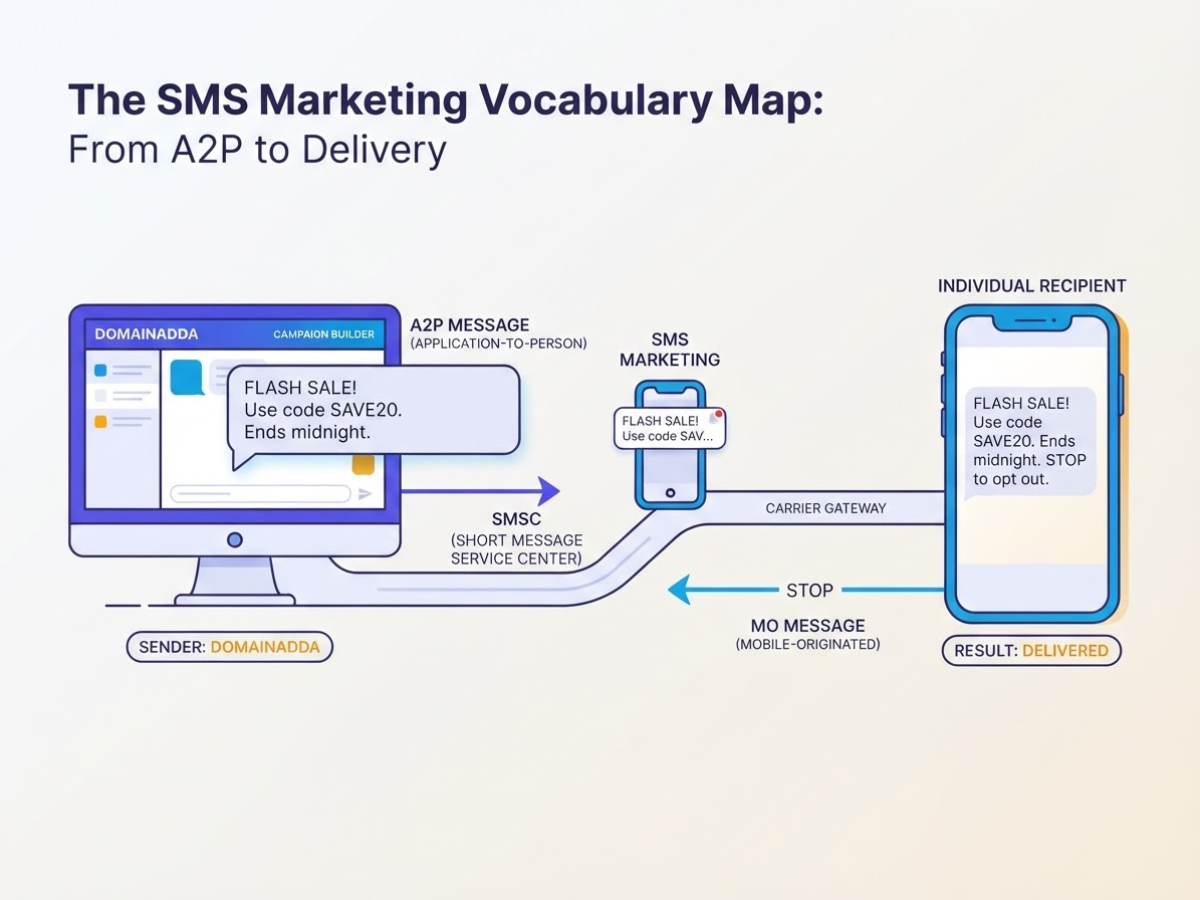
When I explain SMS campaigns to new business owners, the confusing part is rarely writing the message. It is understanding what happens after they click Send. A text moves through several systems, and each system uses its own label for the sender, route, and result.
SMS marketing means using text messages to promote an offer, confirm an action, share an update, or bring a customer back. A2P messaging, or application-to-person messaging, is any message sent by software to an individual. That includes marketing messages, reminders, chatbots, notifications, and one-time passwords.
The opposite is MO, or mobile-originated messaging. An MO message starts on a person’s phone, such as when a customer texts “STOP” to a business number. A2P starts in your business platform, such as an SMS API, booking system, or CRM, and travels to the customer.
Here are the terms you will see most often:
| Term | Plain-English meaning |
|---|---|
| SMS gateway | The service that accepts your message from a platform and passes it to telecom networks. |
| Sender ID | The name or number displayed as the sender on the recipient’s phone. |
| Registered header | India’s approved alphanumeric sender identity for commercial messages. It can contain no more than 11 characters or numbers. |
| Delivery status | The network’s reported outcome after it tries to route the message. |
Indian businesses face extra setup because commercial SMS requires sender registration, a registered header, approved content templates, and recorded customer consent. TRAI lists these registration requirements, so you cannot simply choose a brand name and start sending. The paperwork is irritating, but skipping it can stop messages before they reach the network.
Pro Tip: Treat the sender header as part of brand recognition and compliance, not merely a technical field.
Think of one order update as a four-part journey:
- Business platform: You create the message and submit the recipient number.
- Telecom network: The gateway routes it through an operator and checks permitted traffic.
- Recipient device: The customer’s phone receives the text if the number, network, and handset are available.
- Tracked outcome: Your platform records what happened.
Do not treat sent, delivered, failed, and undelivered as synonyms. Sent means your platform accepted or handed off the request. Delivered means the network confirmed arrival at the phone. Failed usually means the send attempt could not proceed, while undelivered means the attempt occurred but the message did not reach the device, often because of an invalid number, blocked route, or unavailable handset.
Those labels let you read campaign reports without mistaking a handoff for a customer receiving the message. Compliance terms determine which messages businesses may send.
Campaign, Flow, Broadcast, or Transactional: Which Send Is Which?
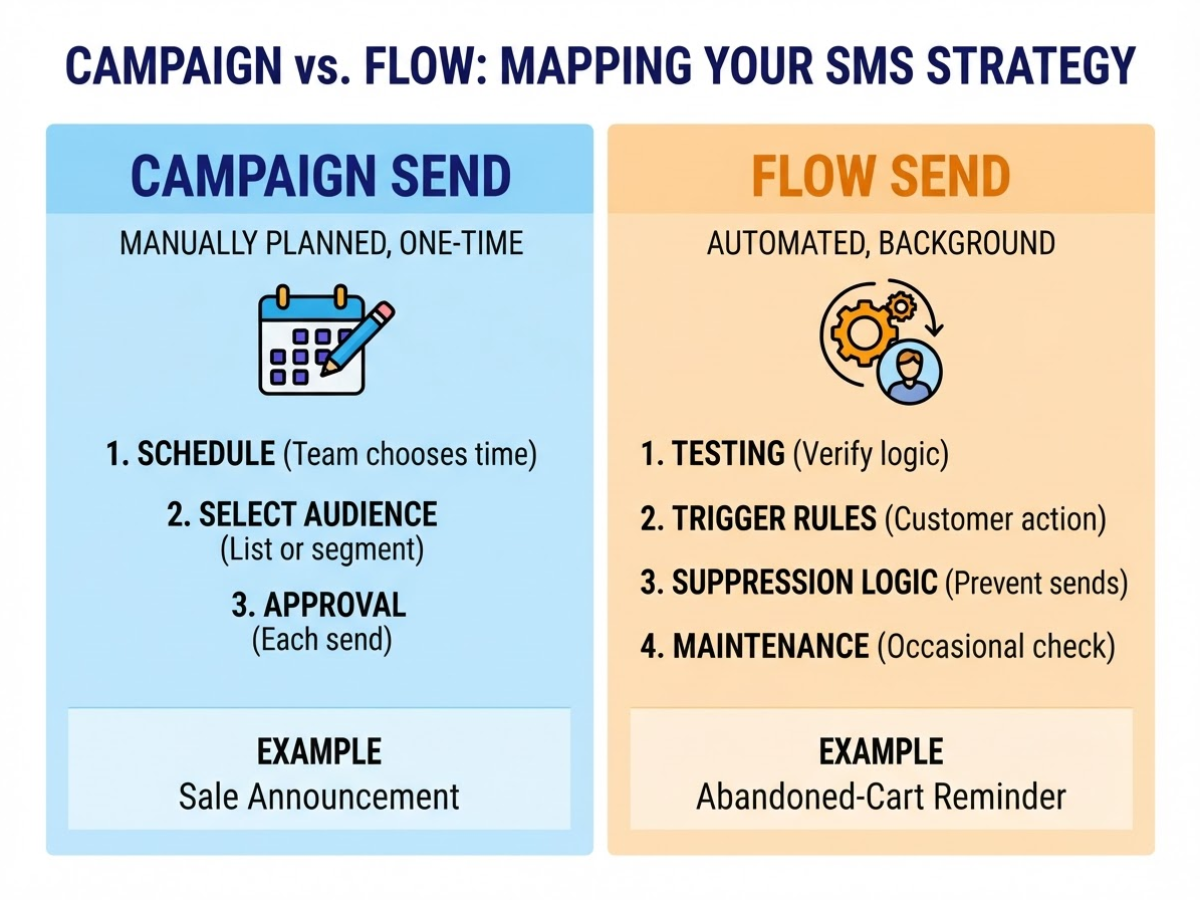
When I map an SMS plan for a client, I start with the event behind the message, not the button in the software. A sale announcement, abandoned-cart reminder, appointment confirmation, OTP, delivery update, and account alert may all use SMS, but they do not belong in the same send category.
A bulk sms campaign is a manually planned, one-time message sent to a list or segment. A flow runs in the background and sends messages after a customer action or profile change. The campaign needs a schedule, audience, and approval each time; the flow needs testing, trigger rules, suppression logic, and maintenance.
| Send type | Trigger and timing | Typical audience | Example | Main upkeep |
|---|---|---|---|---|
| Campaign | Your team chooses the send time | A selected segment or list | Sale announcement | Build, schedule, and review each send |
| Automated flow | Customer action or profile property | People who meet the trigger | Abandoned-cart reminder | Test conditions and stop rules |
| Broadcast or bulk SMS | One planned send to many recipients | A broad, selected list | Storewide weekend offer | Segment carefully and manage consent |
| Transactional or service message | A customer event or necessary account update | The affected customer | OTP or delivery update | Keep event data accurate |
Broadcast and bulk SMS describe reach, not permission. Sending one message to 10,000 opted-in customers is still a campaign or broadcast, and that scale does not remove consent requirements. Check location, purchase history, and opt-out status before pressing send. A bulk SMS service can handle volume, but it cannot fix a poor audience definition.
Pro Tip: Name the customer action that triggers a message before choosing the platform feature; this prevents an automated flow from becoming an unplanned broadcast.
In India, TRAI distinguishes promotional communication from service messages. Promotional SMS advertises an offer and requires the relevant consent and registered sender setup. Service messages facilitate, complete, or confirm a consented transaction, or provide related product, warranty, safety, or security information. An appointment confirmation, OTP, delivery update, and account alert usually fit the service purpose; a discount added to any of them can turn the message promotional.
Use this test: choose a campaign for a planned announcement, a flow for a repeatable customer action, a broadcast for a broad but controlled list, and a transactional send when the customer’s account or order changed. Message construction is the next source of costly surprises.
A Practical Glossary for Building Your First SMS
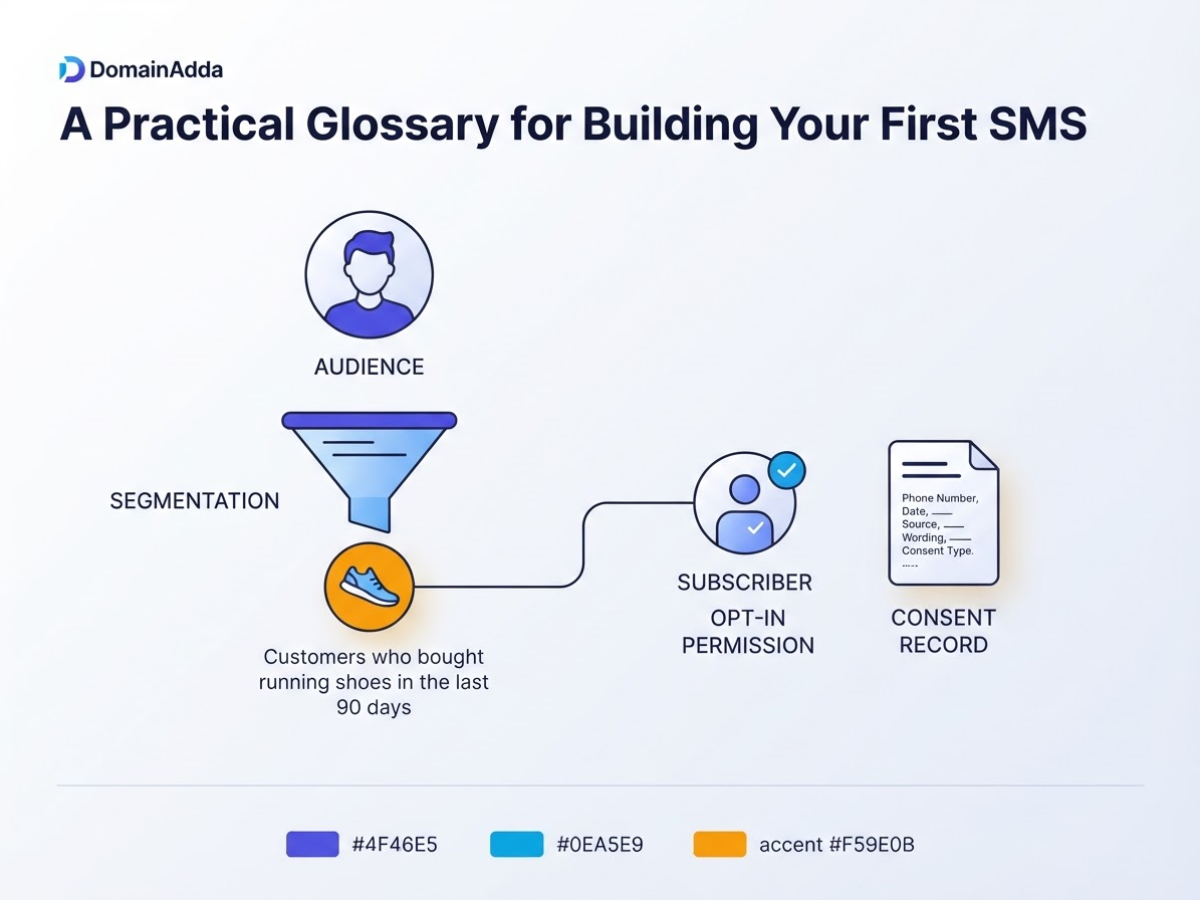
A first SMS becomes easier to build when you treat it as a short campaign brief, not a box for pasted promotional copy. I use this sequence when setting up client sends because it catches expensive mistakes before a message reaches a phone.
- Start with the audience and permission. An audience is the full group you could contact. A subscriber has joined your SMS list, while opt-in is the action showing they asked to receive messages. Keep a consent record with the phone number, date, source, wording shown, and consent type. Then use segmentation to narrow the send, such as “customers who bought running shoes in the last 90 days.” Sending one offer to everyone is lazy targeting.
- Write around one action. Personalization adds relevant details, such as a customer’s first name or pickup location. Merge fields insert those details, so test missing names before sending. Your CTA, or call to action, tells the reader what to do: “Book today” or “Use code JUNE20.” Put a branded short link behind that CTA, send visitors to a focused landing page, and add UTM tracking so analytics identifies the SMS source, campaign, and medium. A clear SMS marketing plan beats five unrelated links.
- Check the character rules. One SMS segment holds up to 160 GSM-7 characters or 70 UCS-2 characters. GSM-7 covers common Latin letters and symbols. UCS-2 carries Unicode text, including many non-Latin characters and emojis. When encoding changes, capacity drops; concatenation joins multiple segments so a longer message appears as one thread, but carriers can charge each segment separately. Twilio documents the 160-character GSM-7 and 70-character UCS-2 limits.
Pro Tip: Check character encoding after adding emojis, smart punctuation, or non-Latin text because the message may switch from GSM-7 to UCS-2.
- Run the pre-send checklist. Confirm the audience, consent record, sender header, approved template, character count, destination link, landing page, send time, and opt-out path. In India, TRAI requires sender, header, content-template, and customer-consent registration for commercial communication, so verify each item before scheduling.
- Keep the first send short. Aim for 320 characters or fewer, even if your platform accepts longer messages. Twilio recommends that limit for user experience and deliverability. Preview the message on a real phone, click the link, and confirm that “Reply STOP to opt out” works.
The send is assembled. The next decision is how to classify and measure its result.
Which SMS Metrics Matter After You Press Send?
The first mistake I see in SMS reports is treating “sent” as “seen.” A campaign can send 10,000 messages but deliver only 9,600, so action metrics should use the delivered number where the definition calls for it. That distinction matters more than a polished dashboard.
Use this reporting sequence after each send:
- Delivery rate: delivered messages ÷ total messages sent × 100. It shows how many messages reached a recipient’s handset or network. Failure rate: failed messages ÷ total messages sent × 100. Failures can point to invalid numbers, carrier filtering, blocked recipients, or account and routing problems.
- Click-through rate (CTR): clicks ÷ delivered messages × 100. For example, 192 clicks from 9,600 delivered messages produces a 2% CTR. Sinch uses this delivered-message formula, not total messages sent.
- Conversion rate: conversions ÷ delivered messages × 100, unless your analytics platform clearly documents another denominator. Define a conversion before sending, such as a purchase, registration, booking, payment, demo request, or completed form.
- Response rate: replies or other qualifying responses ÷ delivered messages × 100. A reply to “YES” may count for an appointment confirmation, while an unprompted “stop” is not campaign success.
- Unsubscribe rate: opt-outs ÷ delivered messages × 100. A rising rate usually means the offer, frequency, audience, or timing is wrong. It is a warning signal, not just a list-cleaning number.
- ROI: (revenue attributed to the campaign − campaign cost) ÷ campaign cost × 100. Include message fees, discounts, creative work, and platform costs. Otherwise, a sale can look profitable when it was not.
Klaviyo’s US SMS and MMS benchmark labels click rates of 14.6% or higher as “Great” and 8.9% to 14.5% as “Good.” Its US conversion benchmark calls 2.1% or higher “Great” and 1.0% to 2.0% “Good.” Treat those figures as directional context, not a universal target for Indian businesses or every industry. A payment reminder and a flash-sale message should not share the same expectation.
I review results by segment, message type, offer, send time, and landing page. That review often exposes the real problem: returning customers click, new subscribers ignore the offer, or a good SMS loses sales on a slow checkout page. Your next campaign needs that diagnosis more than another average benchmark.
Permission, Opt-Out, and Compliance Terms to Get Right
The compliance mistake I see most often is treating one checkbox as lifelong permission to text someone about anything. An SMS program needs a precise record of who agreed, which sender they agreed to hear from, and what purpose that permission covered. This matters in India, where commercial SMS rules have changed how businesses register and send messages.
| Term | What it means in practice |
|---|---|
| Opt-in | The subscriber takes an action to request messages, such as ticking a box or texting a keyword. |
| Explicit consent | Clear permission for a named sender and stated purpose, not a preselected or vague agreement. |
| Consent records | Evidence showing the phone number, time, source, wording shown, sender, and purpose accepted. |
| Opt-out | The subscriber asks you to stop a message category or all messages. |
| Suppression list | A protected list of numbers your sending system must exclude after opt-out or another blocking event. |
| Quiet-hour or preference controls | Settings for delivery times, message categories, frequency, language, or channel choices. |
Keep consent tied to the recipient, your business identity, and the message purpose. Someone who agrees to order updates has not automatically agreed to weekly offers from a different brand. Store the original consent text and timestamp. A screenshot without the source or wording rarely helps when a complaint reaches your support team.
For commercial communication in India, TRAI requires senders to complete sender registration, header registration, content-template registration, and customer-consent registration before sending. A registered header identifies the sender, while an approved content template controls the message wording. TRAI’s sender guidance is the right place to check the current process, since provider dashboards can hide requirements behind setup screens.
TRAI distinguishes promotional messages from service messages. Promotional messages advertise or encourage a purchase, while service messages support a consented transaction or provide related product, warranty, safety, or security information. Calling a sales message a “service alert” does not make it one, and service status does not erase consent, registration, timing, or opt-out obligations.
Put “Reply STOP to opt out” or an equivalent instruction where the subscriber can see it. Reply-based opt-out is not decorative copy. Your system should suppress the number promptly and make the status visible to every sending tool. A delay of two days because one vendor exports suppression data manually is a preventable customer-service problem.
Before increasing volume, verify the current TRAI rules, telecom-provider requirements, and other laws that apply to your audience and industry. Correct classification comes before performance measurement.
Common SMS Marketing Terminology Mistakes
Small reporting shortcuts can quietly wreck an SMS program. I have seen teams celebrate a high sent rate, then wonder why sales lagged because undelivered numbers were still in the report. Keep these mistakes visible when planning and reviewing campaigns:
- Treating sent rate as delivery rate: “Sent” means the provider accepted the request. It does not prove carrier delivery, and delivery does not prove a customer read it, clicked, or bought. Track each stage separately.
- Using the wrong CTR denominator: If your formula is clicks ÷ delivered messages × 100, do not divide clicks by total sends. Sending 10,000 messages, delivering 9,600, and getting 480 clicks produces a 5% CTR on delivered messages, not 4.8%.
- Calling every automated message a campaign: A campaign is a scheduled, one-time send, while a flow is an automated series triggered by customer behavior or profile data. Mixing the labels makes a failed trigger harder to find.
- Blurring service and promotional content: An appointment reminder or order update supports an existing transaction. A discount blast sells something. Service consent does not automatically cover unrelated promotions.
- Counting one long text as one SMS: A message over 160 GSM-7 characters or 70 UCS-2 characters is split into segments, and each segment is charged separately. Emojis and some accented characters can switch a message to UCS-2, shrinking the limit and raising the bill.
- Collecting numbers without usable permission: Record who opted in, when, where, and what they agreed to receive. Keep an opt-out route, such as replying STOP, and remove that number from promotional sends promptly.
- Copying a benchmark without checking its definition: A US benchmark does not automatically fit a local shop, a different offer, or a different industry. Compare audience, timing, conversion window, and CTR denominator.
These distinctions make your next report more trustworthy and give you a sound basis for choosing the next SMS test.
My honest take on SMS marketing terminology
I have watched businesses spend more time debating click-rate benchmarks than defining what a click means. That is backwards. Before chasing a 15% click rate or sending 100,000 messages, agree on what counts as delivered, clicked, converted, and unsubscribed. Otherwise, a precise-looking report can hide broken tracking or missing consent records.
The terms I put first are consent, segment, CTA, delivery, conversion, and opt-out. They sound less technical than API callbacks or throughput, but they prevent expensive mistakes. A large bulk send feels productive until you discover that old contacts never agreed to receive messages, your Indian sender details were not registered correctly, or your template needs approval. Suppression handling is another unglamorous task: when someone opts out, your system must stop sending to that number, including through future campaigns.
When I help businesses evaluate DomainAdda SMS tools, I do not expect beginners to master every API term on day one. I do expect the owner, marketer, and developer to use the same vocabulary. That shared language makes automation and reporting less frustrating, even though setup can involve tedious record checks and template cleanup. Start with definitions and operational discipline, not send volume. The technical pieces become easier once everyone agrees on what the numbers represent.
— AVM Cloud Content Strategy Team
Put the right SMS marketing terms into practice with DomainAdda
Once you understand sender registration, templates, delivery reports, audience management, message segments, and opt-outs, provider conversations become less vague. You can ask what each setting does, where compliance checks happen, and who handles mistakes when a campaign targets the wrong list. Software does not remove your responsibility to use consented data and follow local rules.
For an affordable option in India, review DomainAdda’s SMS marketing service guidance and its advice on choosing a bulk SMS provider. The setup can still involve template approvals, confusing delivery statuses, and testing before your workflow feels comfortable. If you need a second opinion, contact AVM Cloud or DomainAdda with your monthly send volume, audience process, and current tools. They can help you compare a practical setup without pretending one provider fits every business.
Frequently Asked Questions
What is the difference between SMS marketing and bulk SMS?
SMS marketing is the broader practice of using text messages to communicate with customers, while bulk SMS usually means sending 1 message to many recipients at once. A bulk send still needs consent, sensible segmentation, clear content, and tracking, because blasting the same offer to everyone usually creates more complaints than sales.
What does A2P mean in SMS?
A2P means application-to-person messaging: 1 person receives a message sent by software rather than another individual. Marketing campaigns, delivery alerts, appointment reminders, chatbots, and one-time passwords all fall under A2P messaging, which can make sender registration and filtering complicated.
How many characters can an SMS contain?
A standard SMS segment holds up to 160 GSM-7 characters or 70 UCS-2 characters. Longer messages, accented characters, and emoji can split a text into 2 or more segments, increasing costs and sometimes making the message look awkward on the recipient’s phone.
What is a good SMS click-through rate?
There is no universal good rate because audience, industry, offer, and measurement method change the result. As a directional US benchmark, Klaviyo classifies SMS and MMS click rates of 14.6% or higher as Great, but calculate CTR from delivered messages and compare it with your own past campaigns.
How do customers unsubscribe from marketing text messages?
Businesses should provide a clear opt-out method, most commonly a reply such as STOP, and suppress that recipient promptly after the request. Treat 1 unsubscribe message as enough to stop marketing texts, while checking the rules that apply to your sender, message type, and market.
Recommended reads
- Why Sms Marketing Is Still Popular In India Even With New Rules
- How To Choose The Right Bulk Sms Provider In India
- Integrating Bulk Sms With Email Marketing
- Sms Vs Email Which Is Better For Your Business In 2026
Sources
- Campaign SMS and MMS benchmarks
- How to create and send an SMS campaign
- What is P2P and A2P messaging?
- Messages resource
- Maximum Message Length with Twilio Programmable Messaging
- SMS marketing analytics: Measuring & optimizing text campaigns
- Advice to Senders
- Federal Communications Commission FCC 24-24