
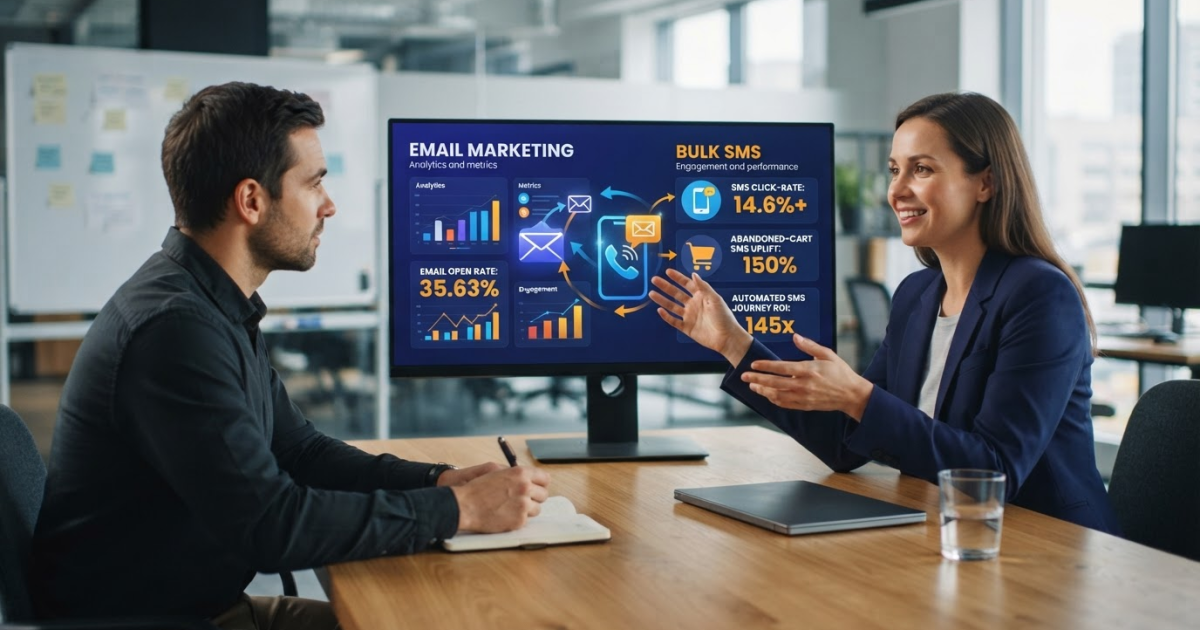
Integrating Bulk SMS with Email Marketing
TL;DR: Integrating bulk SMS with email marketing means coordinating 2 channels through one customer record instead of sending disconnected campaigns that repeat themselves. Use email for detail and SMS for timely reminders, then track delivery, clicks, conversions, consent, and message frequency so Indian subscribers do not feel spammed.
A time-sensitive offer can disappear in a crowded inbox while an SMS gets attention but leaves little room for product details, terms, or reassurance. When I help businesses set up affordable email Marketing and Bulk SMS services under AVM Cloud, this mismatch causes more frustration than the software. Mailchimp’s 2024 benchmark reports a 35.63% industry-average email open rate, but your own testing matters more. The focus here is consent, audience data, channel choice, a three-stage workflow, attribution, and Indian bulk-communication compliance.
| Point | Details |
|---|---|
| Assign Clear Roles | Use email for detailed education, while SMS handles urgent updates, reminders, and short calls to action across 2 channels. |
| Unify Subscriber Data | Keep 1 profile per contact with email consent, SMS consent, source, segment, and engagement status. |
| Sequence Messages Carefully | Use a 3-stage journey: context, eligible follow-up, and suppression after conversion. |
| Measure Incrementally | Track at least 6 signals, including deliverability, clicks, conversions, revenue, opt-outs, and channel-assisted conversions. |
| Protect Compliance | In India, complete Principal Entity registration and prepare headers, templates, IDs, and consent records before sending commercial traffic. Headers can contain no more than 11 characters. |
What Integrating Bulk SMS with Email Marketing Actually Means
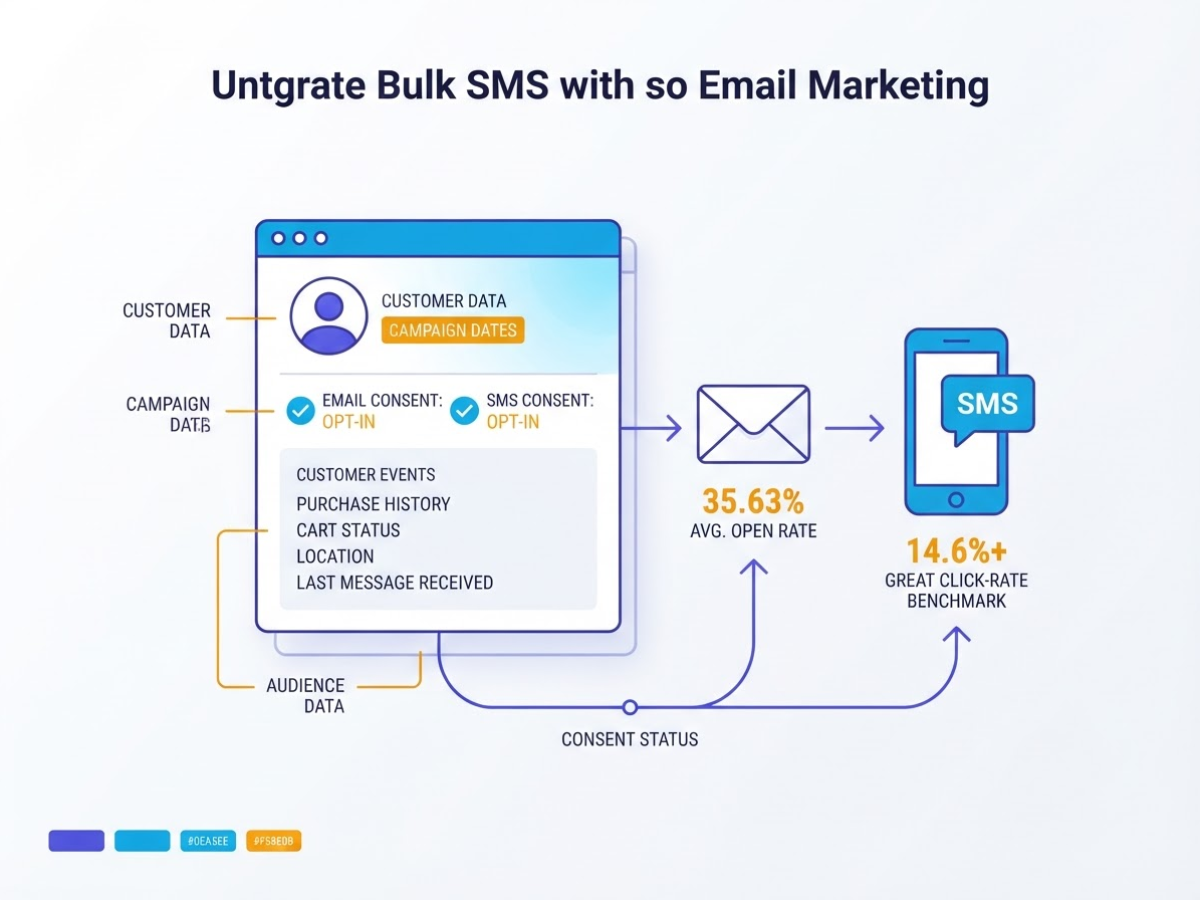
Integration means building one customer journey across email and SMS, not copying a promotion into two dashboards. When I map campaigns for a business, I check four shared pieces first: audience data, consent status, campaign dates, and customer events. Without them, the channels contradict each other.
Your tools should recognise the same customer record. It might show email and SMS opt-ins, purchase history, cart status, location, and the last message received. Consent remains channel-specific. Someone who agrees to promotional email has not automatically agreed to promotional SMS, and Indian senders must also account for registered headers and consent requirements under TRAI rules.
The channels have different jobs:
| Channel | Best use | Typical message |
|---|---|---|
| Context, visuals, education, longer offers | Product guide, comparison, launch details | |
| SMS | Urgency, reminders, concise calls to action | “Sale ends at midnight. Shop now: link” |
That division matters. Mailchimp’s 2024 benchmark reports a 35.63% industry-average email open rate, but an email still needs space to explain an offer. SMS gets attention quickly, yet its limited space makes it a poor place for a five-part product explanation. That is why SMS marketing remains relevant for direct customer communication, even when email carries the fuller story.
I usually describe integration in three levels:
- Calendar coordination: Email announces a sale on Monday, while SMS reminds opted-in shoppers on Friday.
- Audience synchronization: A customer who purchases exits both campaigns instead of receiving an awkward “still interested?” message.
- Event-based orchestration: A signup starts an email welcome series, an abandoned cart triggers a timed SMS, and a purchase sends confirmation or follow-up content.
Integration does not require identical copy or simultaneous delivery. Sending both messages at 10 a.m. is often lazy planning. The better outcome is one journey, with each channel doing the job it handles best.
Pro Tip: Treat the customer event, such as signup, cart abandonment, booking, or purchase, as the integration point rather than the marketing channel.
The next decision is where each campaign moment belongs: email, SMS, or both.
Build the Integration: A Practical Five-Step Workflow
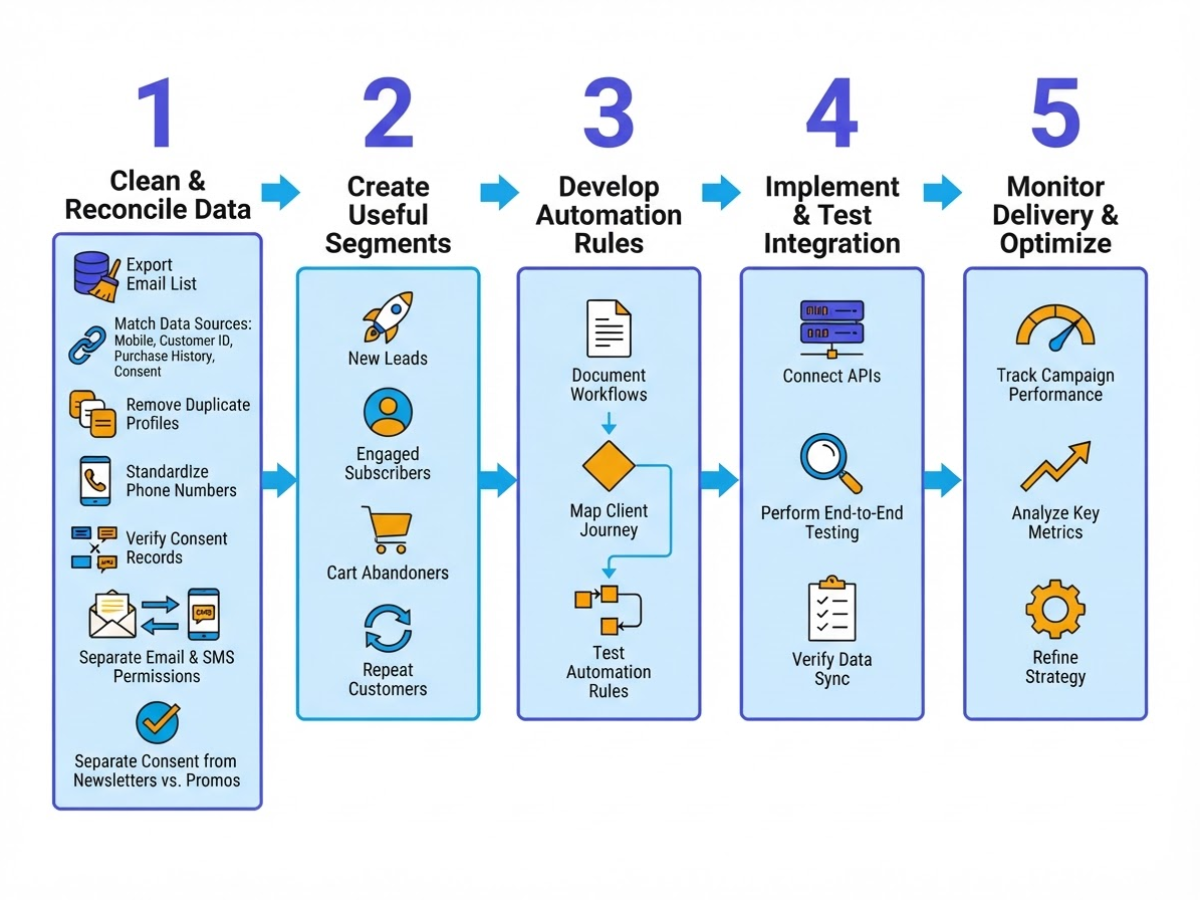
When I set up a campaign for a client, the integration usually breaks before the first message goes out. The cause is rarely the API. It is usually a stale phone number, missing consent, or an automation rule nobody documented. Use this five-step workflow:
- Clean and reconcile your data. Match email addresses with mobile numbers, customer IDs, purchase history, and consent records. Remove duplicates, standardize phone numbers with country codes, and separate valid consent from vague entries such as “imported from CRM.” Keep email and SMS permissions in separate fields.
- Create useful segments. Start with new leads, engaged subscribers, cart abandoners, repeat buyers, and inactive contacts. Define each segment with a rule, such as “opened an email or clicked within 90 days” or “added an item to cart but did not purchase within 24 hours.” Avoid creating 20 tiny segments on day one. Maintaining them will teach you less than a clean pilot.
- Give each channel one job. Let email introduce the offer, explain details, and provide education. Let SMS add urgency with a short deadline or reminder. Use email for follow-up, product guidance, or reassurance. These SMS-versus-email trade-offs matter because repeating the same copy in both channels feels careless. As a baseline, Mailchimp’s 2024 benchmark reports a 2.62% industry-average email click rate, so judge email on clicks and sales, not opens alone.
- Write automation rules before building them. Set the trigger, wait time, frequency cap, and exit condition. For example, send the email immediately, wait six hours, then send one SMS only if the recipient has not purchased or clicked. Suppress follow-ups after conversion, cap promotional SMS at two per week, and define fallbacks: email-only without mobile consent, SMS-only without a usable email, and no send when both are missing.
Pro Tip: Use a conversion event to stop follow-up messages automatically; otherwise a successful buyer may receive an unnecessary reminder.
- Test, pilot, and review. Check links, merge fields, sender identity, unsubscribe keywords, landing pages, timing, and channel reporting with internal test records. Launch one segment against one objective, such as abandoned-cart recovery, before automating several journeys. Review delivery, clicks, conversions, unsubscribes, and revenue after 48 to 72 hours. If complaints rise or tracking disagrees, pause the campaign rather than widening the audience.
A clean pilot gives you the evidence needed to map the full customer journey and add triggers carefully.
Email First, SMS First, or Both? Choose by Campaign Scenario
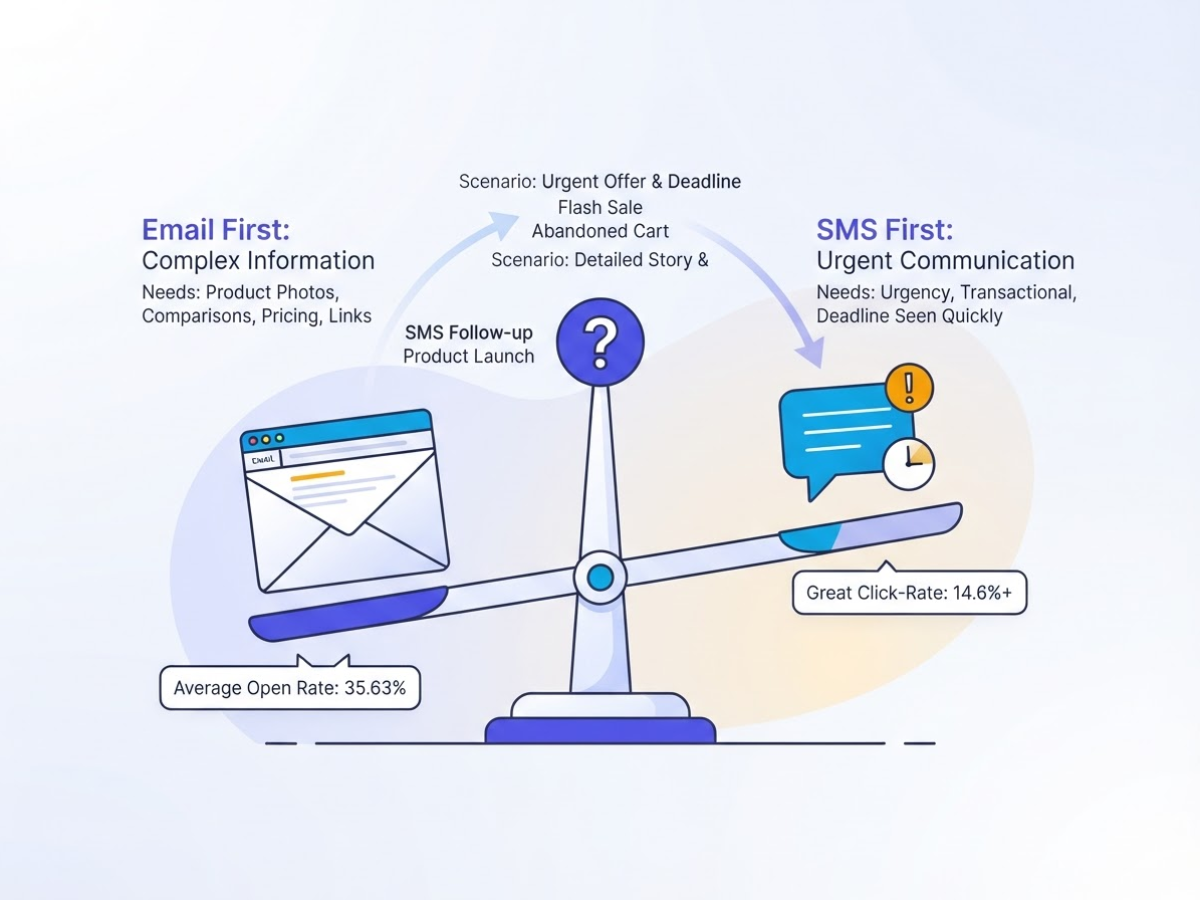
I choose the lead channel by asking one blunt question: how quickly must the customer understand and act? Email usually leads when the offer needs photos, comparisons, pricing detail, or several links. SMS leads when the message is urgent, location-specific, transactional, or expires soon, provided the recipient has valid consent.
| Campaign objective | Recommended lead | Follow-up or standalone plan | Why |
|---|---|---|---|
| Product launch | Email first | SMS 4–24 hours later to non-buyers | Email carries the story, images, and comparison points. |
| Flash sale | SMS first | Email before or after with terms and product detail | SMS gets the deadline seen quickly. |
| Abandoned cart | SMS first | Email with product images, FAQs, and recovery link | The reminder is urgent, but email can remove hesitation. |
| Appointment reminder | SMS alone | Email confirmation when details are lengthy | Customers need the time, place, and reply option immediately. |
| Education sequence | Email first | SMS only for a missed lesson or deadline | A text message is a poor substitute for explanations. |
| Order update | SMS alone or SMS first | Email for receipts, tracking history, or policy details | Short status messages work well on a phone. |
| Re-engagement | Email first | SMS only for opted-in, high-value customers | A text can feel intrusive when the customer has gone quiet. |
I use both channels when the customer needs context plus a timely prompt. Send an email explaining a new service, then a different SMS the next morning with one clear action. Do not paste the email subject and body into a text. That shortcut creates duplicate messages, awkward links, and unsubscribes. Klaviyo classifies an SMS click rate of 14.6% or higher as “Great”, but a click is not profit when discounts and SMS costs reduce the margin.
My decision matrix is simple: high urgency favors SMS; long message length favors email; limited permission rules SMS out; high customer value can justify both; and a response window under 24 hours usually needs SMS in the mix. Email still matters because Mailchimp’s 2024 benchmark reports a 35.63% average open rate, while SMS cannot replace a detailed inbox message.
Pro Tip: For a limited-time offer, test email-led and SMS-led journeys separately; the best sequence depends on urgency, audience behaviour, and margin.
Use these scenarios to set the data fields and triggers that control delivery timing.
India Compliance and Deliverability Checks Before You Automate
Compliance is not a checkbox added after connecting your email platform. When I review Indian SMS setups, the common failure is a campaign that works technically but gets blocked because the sender skipped a registration or passed the wrong identifier.
For commercial bulk communication, complete the relevant TRAI registration and transmission requirements before scheduling sends. That can include Principal Entity registration, header assignment, content-template registration, and transmission of the PE ID, header, and Content ID. Where applicable, you also need consent-template registration and consumer consent acquisition. A registered commercial SMS header in India must contain no more than 11 characters, so make that decision before launch week.
Email and SMS permissions are separate. Store the channel, consent wording, timestamp, source, and withdrawal status independently. This feels fussy until a customer challenges a message and your team cannot prove what they agreed to.
Common mistakes include:
- Treating an email unsubscribe as an SMS opt-out, or the reverse.
- Sending to invalid numbers because the CRM record still looks active.
- Ignoring STOP replies, complaints, and carrier delivery failures.
- Using unapproved message variations after registering one template.
- Reusing shortened links without checking the destination, domain, or redirect chain.
- Sending both channels at full frequency instead of applying a shared contact cap.
Build suppression into the integration, not a spreadsheet. A text opt-out should immediately suppress SMS, while an email unsubscribe should suppress email. Keep complaint flags, invalid numbers, hard bounces, and failed deliveries available to both systems so the next campaign does not revive a blocked contact.
Deliverability also depends on behaviour. Set a frequency cap, avoid late-night messages in the recipient’s local time, and stagger email and SMS instead of firing them within the same minute. Keep the sender identity, offer, link, and core wording consistent enough for recognition. Watch unsubscribe rates too: Klaviyo classifies 2.0% or higher as critical for SMS, a useful warning even though its benchmark is not India-specific.
Before launch, confirm current TRAI requirements and ask your provider to show its registration, template, consent, suppression, and delivery-failure process. A successful API call is not proof that a message is deliverable.
Measure the Combined Journey, Not Just the Last Click
The first reporting mistake I see is treating an email open or SMS click as the result. Those numbers describe activity, not business impact. Set one campaign objective and one primary conversion before sending: a completed order, booking, lead, or renewal.
Build the measurement plan around these milestones:
- Before launch: Assign a unique campaign ID and event ID to every recipient. Use separate UTM parameters, coupon codes, landing pages, and sequence labels for email and SMS.
WELCOME_EMAIL_01tells you more thanWELCOMEwhen both messages promote the same offer. - During delivery: Record email delivery, opens, clicks, SMS delivery, SMS clicks, bounces, unsubscribes, and complaints. Capture channel eligibility too. Someone without SMS consent should not appear in the SMS denominator.
- After conversion: Report completed conversions, revenue, average order value, and assisted conversions within a fixed window, such as seven days. Do not let a last-click dashboard erase the email that introduced the offer or the SMS that brought the customer back. Thank Tommi’s abandoned-cart SMS workflow increased completed orders by 150% compared with email, but that comparison only matters when the audience, offer, and attribution window match.
- At review: When the audience is large enough, compare email-only, SMS-only, and coordinated cohorts. A holdout group that receives neither channel gives the cleanest estimate of incremental lift. Without one, you may celebrate conversions that would have happened anyway.
Calculate cost per conversion, revenue per recipient, return on spend, and opt-out cost. The last figure matters because a cheap conversion can become expensive if it removes a valuable subscriber. Engagement helps diagnose problems, but it is not the finish line. For context, the cost comparison between bulk SMS and other channels can help set realistic channel assumptions.
Turn the findings into specific changes: move SMS earlier or later, tighten eligibility, rewrite the copy, strengthen the offer, or reverse the channel order. The next test should change one variable, not send the same campaign to a larger list.
My honest take on integrating bulk SMS with email marketing
I have seen teams treat SMS as the “stronger” channel because texts get opened quickly. I disagree. A poorly timed appointment reminder or irrelevant promotional text can damage trust faster than an ignored email, and a high click rate does not prove that the campaign made money.
At AVM Cloud, I recommend starting with one high-intent journey, not a sprawling omnichannel build. Choose abandoned-cart recovery, an appointment reminder, or a lead follow-up. Give each channel a clear job: email carries context and options, while SMS handles a time-sensitive prompt. If both repeat the same message, you have added noise, not coordination.
Affordable sending infrastructure makes testing accessible, but message volume is rarely the real constraint. Consent records, suppression rules, frequency limits, and a proper holdout group matter more than the number of texts you can send. The irritating work is where campaigns fail: excluding converted customers, stopping reminders after an appointment is booked, and keeping email and SMS status data aligned.
I would run a small pilot with one conversion event, defined channel roles, and a control group. Review it after enough recipients have completed or exited the journey, then compare profit and complaints, not clicks alone.
— AVM Cloud Content Strategy Team
Launch coordinated email and SMS campaigns with AVM Cloud
When I help teams connect email and bulk SMS, the biggest headache is rarely sending messages. It is keeping audience lists, consent records, timing, and reports from living in separate places. AVM Cloud, powered through the DomainAdda marketing ecosystem, gives you a practical place to coordinate that workflow, while you still review SMS content and compliance before sending.
Start with one audience segment and one use case, such as a promotion, appointment reminder, or follow-up. Prepare both versions, schedule them together, then review the results instead of guessing from scattered dashboards. Setup takes housekeeping when lists are messy, but avoiding disconnected vendors removes a common source of mistakes. Explore guidance for choosing a suitable bulk SMS provider or contact the AVM Cloud team for implementation help.
Frequently Asked Questions
Can I send the same campaign through email and SMS?
You can coordinate both channels, but identical copy wastes the strengths of each format. Use email for the full offer and supporting details, then use SMS for a short reminder or urgent action, with separate consent and opt-out records.
How long should I wait between an email and a bulk SMS?
There is no fixed delay, but waiting 4 to 24 hours gives recipients time to read the email before seeing the reminder. Compare purchases, clicks, and unsubscribes because sending both messages within minutes can feel intrusive.
Do email subscribers automatically consent to SMS marketing in India?
- Email consent does not automatically grant permission for SMS marketing, so record SMS consent separately, including its source, timestamp, and current status, before sending commercial messages in India. Removing one email address does not necessarily remove the matching phone number.
What is the best SMS length when it supports an email campaign?
Aim for 160 characters or fewer when the message can remain clear in one standard SMS, although special characters or Unicode text may reduce that limit. Include one benefit, one action, and a tested link, then check the sender name and opt-out wording before sending widely.
How do I know whether email or SMS caused the conversion?
Use separate tracking links, coupon codes, or event IDs for each channel, and compare email-only, SMS-only, and combined groups over a window such as 7 days. A holdout group that receives neither message usually estimates incremental sales more reliably than last-click attribution.
Recommended reads
- Sms Vs Email Which Is Better For Your Business In 2026
- 6 Email Marketing Tips To Hit Your Goals In 2026
- How To Choose The Right Bulk Sms Provider In India
- Why Sms Marketing Is Still Popular In India Even With New Rules